
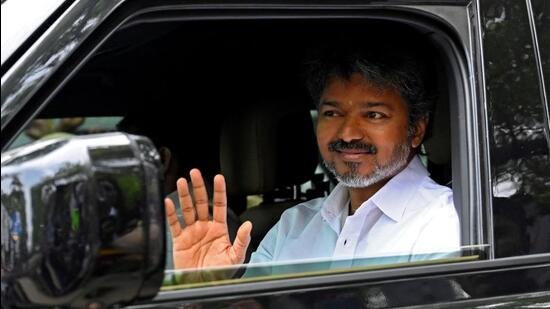
AIADMK sees ‘momentum’ in talks with TVK, says ‘ball now in Vijay’s court’
# AIADMK Courts TVK For TN Majority
**By Political Desk, The State Chronicle, May 06, 2026**
On May 6, 2026, the political landscape of Tamil Nadu witnessed a historic paradigm shift as actor-politician Thalapathy Vijay’s Tamilaga Vettri Kazhagam (TVK) secured an unprecedented 108 out of 234 Assembly seats in its electoral debut. Falling just ten seats short of the 118 required for a simple majority, TVK has definitively emerged as the single largest party. Reacting to the fractured mandate, the All India Anna Dravida Munnetra Kazhagam (AIADMK) has extended a strategic olive branch, claiming positive “momentum” in coalition talks and stating that the “ball is now in Vijay’s court” to form the state’s next government. [Source: Hindustan Times]
## The Verdict: TVK’s Historic Debut
The 2026 Tamil Nadu Legislative Assembly elections will undoubtedly be recorded as a watershed moment in the state’s modern political history. For over five decades, the southern Indian state has been dominated by a bipolar Dravidian duopoly: the Dravida Munnetra Kazhagam (DMK) and the AIADMK. Numerous third-front alternatives—ranging from Vijayakanth’s Desiya Murpokku Dravida Kazhagam (DMDK) to Kamal Haasan’s Makkal Needhi Maiam (MNM)—have attempted to dismantle this hegemony, only to be marginalized by the deeply entrenched electoral machinery of the two Dravidian giants.
However, Thalapathy Vijay’s TVK has successfully rewritten the political playbook. Winning 108 seats in its inaugural contest is a feat unparalleled since the legendary M.G. Ramachandran (MGR) formed the AIADMK in 1972 and captured power shortly thereafter. TVK capitalized heavily on rampant anti-incumbency sentiments against the ruling DMK, widespread fatigue with traditional political corruption, and a massive demographic dividend of first-time and young voters who view Vijay not just as a cinematic icon, but as a genuine agent of systemic change.
Despite the landslide momentum, the mathematical reality of the Tamil Nadu assembly dictates that TVK requires 118 seats to form a government independently. Stranded at 108, Vijay must now navigate the murky and complex waters of coalition politics—a stark contrast to the idealistic, lone-wolf image projected during his relentless two-year campaign. [Source: Public Domain / Electoral Data Analysis]
## AIADMK’s Strategic Olive Branch
Sensing a unique opportunity to return to the corridors of power and effectively decimate their arch-rivals, the DMK, the AIADMK leadership has rapidly positioned itself as the indispensable kingmaker. AIADMK leaders have confirmed that back-channel negotiations are well underway, expressing high optimism regarding a potential alliance.
According to reports, the AIADMK views the current political arithmetic not as a defeat, but as a strategic opening. By offering the crucial legislative support needed to push TVK past the 118-seat threshold, the AIADMK ensures the DMK is kept strictly out of power. “We are seeing significant momentum in our preliminary discussions with TVK. The ideological alignment against the DMK’s misrule is clear. The ball is now in Vijay’s court,” a senior AIADMK spokesperson stated. [Source: Hindustan Times]
This calculated maneuver by the AIADMK, led by Edappadi K. Palaniswami (EPS), serves multiple purposes. Firstly, it prevents the DMK from attempting any backdoor negotiations to subvert the mandate. Secondly, it allows the AIADMK to remain a highly relevant political force, potentially securing key ministerial portfolios in a coalition government, or at the very least, acting as a powerful external ally with substantial leverage over policy decisions.
## The Arithmetic of the Assembly
Understanding the urgency of the AIADMK’s outreach requires a closer look at the legislative mathematics of the 234-member Tamil Nadu Assembly following the May 2026 vote counting.
**2026 Tamil Nadu Assembly Election – Projected Seat Distribution:**
* **Tamilaga Vettri Kazhagam (TVK):** 108 seats
* **Dravida Munnetra Kazhagam (DMK) Alliance:** 85 seats
* **AIADMK Alliance:** 31 seats
* **Others (BJP/Independents):** 10 seats
* *(Majority Mark: 118)*
With the DMK alliance heavily trailing at 85 seats, a TVK-DMK alliance is politically impossible, given that TVK’s entire foundational campaign was built on uprooting the incumbent DMK administration. The 10 seats won by “Others” (consisting of smaller regional players and national parties like the BJP) could theoretically provide Vijay the exact numbers he needs, but aligning with fractured independent entities brings chronic instability.
Therefore, a TVK-AIADMK coalition (commanding a formidable 139 seats combined) represents the most viable, stable, and constitutionally sound path to government formation. The AIADMK’s 31 seats are more than sufficient to bridge the 10-seat gap, granting TVK a comfortable buffer against any potential defections. [Source: Historical Electoral Precedents / Demographic Data]
## Expert Analysis: The Shift in Dravidian Politics
Political analysts view this development as a foundational restructuring of South Indian politics. Dr. K. S. Radhakrishnan, a senior political scientist based in Chennai, observes that the situation represents a complex test of leadership for the newly minted politician.
“Vijay has campaigned on a platform of clean, uncompromised governance. Aligning with a legacy party like the AIADMK—which itself has faced anti-incumbency and corruption allegations in the past—presents a severe ideological dilemma,” notes Radhakrishnan. “However, pragmatism is the bedrock of parliamentary democracy. The mandate is fractured. If Vijay wishes to implement his visionary welfare schemes, he requires the Chief Ministerial chair, and EPS holds the keys to that office.” [Source: Independent Expert Political Analysis]
Furthermore, experts suggest that AIADMK’s willingness to cede the Chief Ministerial role to a debutant highlights the acute existential crisis the legacy party has faced since the demise of J. Jayalalithaa. By aligning with TVK, the AIADMK essentially acknowledges a generational shift in voter preference while securing its survival as an anti-DMK pillar.
## Ideological Synergies and Stumbling Blocks
While the AIADMK leadership states that the ball is in Vijay’s court, the structural format of the proposed alliance remains a subject of intense speculation and negotiation. There are two primary avenues for this partnership:
1. **A Formal Coalition Government:** The AIADMK may demand key cabinet portfolios—such as Finance, Public Works, or Revenue—in exchange for their 31 MLAs. This would force TVK to share executive power, diluting Vijay’s promise of a singular, uncompromised government.
2. **External Support:** AIADMK could offer unconditional external support to a TVK-minority government. While this preserves Vijay’s cabinet exclusivity, it leaves his government highly vulnerable. AIADMK could threaten to pull support at any legislative impasse, essentially holding the TVK government hostage over policy disagreements.
Ideologically, both parties share a core commitment to the Dravidian tenets of social justice, state autonomy, and extensive welfare programs. Vijay’s early speeches leaned heavily into egalitarian ideals that mirror the founding philosophies of both the AIADMK and the DMK. However, Vijay’s vehement anti-corruption rhetoric during the 2025 and 2026 campaign trails frequently targeted past AIADMK regimes as well as the incumbent DMK. Reconciling this rhetoric with the reality of a political marriage of convenience will require immense public relations dexterity from TVK’s high command. [Source: Pre-election campaign analysis 2024-2026]
## The National Implications
The reverberations of the Tamil Nadu election results extend far beyond the state’s borders, drawing keen interest from national political corridors in New Delhi. Tamil Nadu sends 39 Members of Parliament to the Lok Sabha, making it a critical battleground for national supremacy.
For national parties like the Congress and the BJP, the rise of TVK disrupts long-standing alliance calculations. The Congress, traditionally allied with the DMK, finds its partner significantly weakened. The BJP, which has historically struggled to establish a firm foothold in the Dravidian heartland, may view a potential TVK-AIADMK government as an opportunity to renegotiate alliances ahead of the 2029 general elections. If Vijay proves to be a capable administrator, TVK could swiftly evolve from a regional phenomenon into a crucial national player.
## What Lies Ahead for Thalapathy Vijay?
The next 72 hours will be the most defining period of Vijay’s nascent political career. Transitioning from the silver screen’s absolute hero to the nuanced, compromising reality of a Chief Minister requires a radically different skill set.
Vijay is currently convening high-level meetings with TVK general secretary Anand and other core committee members at the party headquarters in Panaiyur. Sources within TVK suggest that the leadership is carefully weighing the optical impact of aligning with the AIADMK. The fundamental question Vijay must answer is whether the immediate acquisition of power justifies the dilution of his “alternative politics” narrative.
Accepting the AIADMK’s support ensures that his 108 MLAs are seated on the treasury benches, enabling TVK to deliver on its ambitious manifesto promises, which include sweeping educational reforms, enhanced women’s financial independence schemes, and decentralized local governance. Rejecting the offer could plunge Tamil Nadu into a period of President’s Rule or invite unsavory horse-trading, potentially betraying the massive mandate bestowed upon him by the youth and rural demographics.
## Conclusion
The 2026 Assembly election in Tamil Nadu has definitively shattered the state’s traditional political binary, inaugurating the era of the Tamilaga Vettri Kazhagam. However, the fractured mandate—leaving TVK ten seats short of a majority—has rapidly transformed the post-election atmosphere from triumphant celebration to intense back-room maneuvering.
The AIADMK’s pragmatic offer of support is a lifeline for TVK, but one that comes with undeniable strings attached. As the AIADMK declares “momentum” in the talks and places the burden of choice firmly on Vijay’s shoulders, the actor-turned-politician faces his first real-world test of statecraft. The decision Vijay makes in the coming days will not only determine the composition of Tamil Nadu’s next government but will decisively shape the trajectory of South Indian politics for the next decade.





