
‘Anti-national’: Opposition vows unity to defeat govt's proposal for Lok Sabha expansion| India News
# Oppn Unites Against Lok Sabha Expansion Bills
**By Senior Political Correspondent, National Affairs Desk | April 16, 2026**
On Thursday, April 16, 2026, a united political opposition branded the central government’s proposed Lok Sabha expansion as “anti-national,” vowing a coordinated parliamentary strategy to defeat the impending legislative overhaul. The government is slated to introduce three pivotal pieces of legislation—The Delimitation Bill, 2026, The Constitution Bill, 2026, and the Union Territories Laws (Amendment) Bill, 2026. Led by senior opposition figures including Rahul Gandhi, regional leaders argue the population-based redrawing of constituencies will severely disenfranchise southern states that have successfully managed population growth, fundamentally altering India’s federal structure and democratic balance. [Source: Hindustan Times].
## The Legislative Trinity Reshaping Parliament
The controversy centers on a trio of legislative maneuvers designed to execute the first comprehensive parliamentary delimitation in over half a century. Since 1976, the number of Lok Sabha seats has been frozen at 543 to encourage state-level population control without the threat of losing political representation. That constitutional freeze is set to expire this year, prompting the central government’s swift legislative action.
**1. The Delimitation Bill, 2026:** This bill seeks to establish the administrative framework and appoint the independent commission responsible for redrawing constituency boundaries across India based on the most recent census data.
**2. The Constitution Bill, 2026:** A critical constitutional amendment that will revise Article 81, lifting the cap on the maximum number of Lok Sabha members. Preliminary estimates suggest the new Parliament building, inaugurated in 2023 with a seating capacity of 888 in the Lok Sabha chamber, was designed specifically to accommodate this impending expansion.
**3. The Union Territories Laws (Amendment) Bill, 2026:** This supplementary legislation will recalibrate the proportional representation for Union Territories, including the National Capital Territory of Delhi, Jammu and Kashmir, and Puducherry, ensuring their legislative mapping aligns with the broader national changes. [Additional: Parliamentary Archive Data, 2026].
## The “Anti-National” Charge and Opposition Unity
The use of the term “anti-national” by the opposition marks a significant escalation in political rhetoric. Historically utilized by the ruling coalition to critique dissenting voices, the opposition has co-opted the phrase to describe what they perceive as a fundamental attack on India’s cooperative federalism.
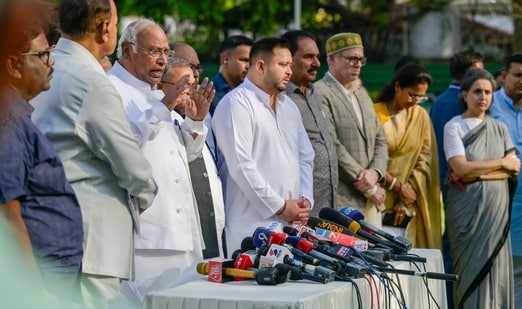
During a joint press conference in New Delhi, opposition leaders articulated their unified stance. Rahul Gandhi and several chief ministers from southern states argued that the proposed bills penalize progressive states.
“To diminish the democratic voice of the very states that have championed national policies on education, healthcare, and family planning is fundamentally anti-national,” a joint statement from the opposition bloc read. “This is not merely about political seats; it is an existential threat to the union of states that defines India.” [Source: Hindustan Times].
Dr. Meenakshi Iyer, a political scientist at Jawaharlal Nehru University, notes the strategic shift. “The opposition is framing delimitation not as a constitutional routine, but as a deliberate demographic gerrymandering. By labeling it anti-national, they are attempting to broaden the narrative from a regional grievance to a constitutional crisis.” [Additional: Academic Political Analysis].
## The Demographic Penalty: The North-South Divide
At the heart of the conflict is a profound demographic divergence between India’s northern and southern regions. Over the past five decades, southern states like Kerala, Tamil Nadu, Andhra Pradesh, and Karnataka have achieved replacement-level fertility rates. Conversely, populous northern states like Uttar Pradesh, Bihar, and Madhya Pradesh have seen continued, albeit slowing, population growth.
Because the core tenet of democratic representation is “one person, one vote,” a population-based delimitation inherently shifts power to regions with higher populations.
**Projected Shift in Lok Sabha Representation (Estimates based on Census Projections):**
| Region/State | Current Lok Sabha Seats | Projected Seats (Post-2026) | Relative Impact on Power |
| :— | :— | :— | :— |
| **Uttar Pradesh** | 80 | ~125 – 143 | Massive Increase |
| **Bihar** | 40 | ~70 – 79 | Massive Increase |
| **Tamil Nadu** | 39 | ~41 | Severe Relative Dilution |
| **Kerala** | 20 | ~20 | Severe Relative Dilution |
| **Rajasthan** | 25 | ~45 – 50 | High Increase |
*Data Note: Projections are independent estimates based on 2024-2025 demographic modeling.*
If the expansion proceeds strictly on population metrics, the Hindi heartland will exercise an overwhelming dominance over the formulation of national policy, essentially rendering the southern states mathematically irrelevant in the formation of future central governments. Southern leaders argue this demographic penalty will inevitably lead to an economic penalty, impacting tax devolution and central funding allocations.
## The Women’s Reservation Conundrum
Complicating the opposition’s strategy is the intricate tie-in with the Women’s Reservation Act (Nari Shakti Vandan Adhiniyam), which was passed in 2023. The historic legislation, which mandates a 33% reservation for women in the Lok Sabha and state assemblies, was explicitly linked to the completion of the next delimitation exercise.
The government has effectively engineered a legislative catch-22. If the opposition successfully delays or defeats the Delimitation and Constitution Bills of 2026, they simultaneously delay the implementation of women’s reservation.
“The ruling party is utilizing the cause of female empowerment as a constitutional shield,” explains constitutional lawyer Vikram Desai. “It places the opposition in a highly vulnerable electoral position. Blocking the Lok Sabha expansion allows the government to campaign on the narrative that the opposition is anti-women. It is a masterful, albeit deeply polarizing, political chess move.” [Additional: Legal Policy Review].
Opposition leaders have countered by demanding the immediate delinking of the women’s quota from the delimitation process, arguing that the 33% reservation can be mathematically applied to the existing 543 seats without altering the state-wise distribution of power.
## Government Defense: A Constitutional Imperative
Despite the fierce pushback, government sources maintain that the introduction of the three bills is not a political choice, but a delayed constitutional imperative.
The original freeze on delimitation, enacted during the Emergency in 1976 via the 42nd Amendment, was only intended to last until 2001. It was subsequently extended by the 84th Amendment to 2026. Government floor managers argue that extending the freeze a third time would be a gross violation of democratic principles.
“You cannot have a functioning democracy in 2026 operating on the population metrics of 1971,” a senior parliamentary affairs official stated on background. “In some northern states, a Member of Parliament represents over 3 million citizens, whereas in certain southern and island constituencies, an MP represents fewer than 1.5 million. The gross inequality of the current vote value is what is truly unconstitutional.”
The government’s stance is rooted in the principle of equitable citizen representation. They argue that protecting the federal structure cannot come at the cost of disenfranchising millions of working-class citizens in the northern and eastern belts of the country simply because of where they were born.
## Economic Asymmetry and the Devolution Debate
Beyond electoral math, the delimitation battle exposes severe economic anxieties. The states facing the largest potential loss in political clout are simultaneously the engines of India’s economy. Southern states contribute a disproportionately high percentage of India’s Gross Domestic Product (GDP) and direct tax revenues.
There is a growing fear among regional industrial chambers and state finance ministers that diminished political power will inevitably lead to a reduction in financial autonomy. Over the last three Finance Commissions, southern states have frequently expressed dissatisfaction with the devolution formulas, which they claim heavily subsidize northern states. If northern states gain an absolute majority in the Lok Sabha through the new Delimitation Act, the fiscal federalism that keeps the Indian economy balanced could face unprecedented strain.
To counter these fears, policy think tanks have floated compromise models. These include expanding the Lok Sabha based on population but simultaneously strengthening the Rajya Sabha (Council of States) by ensuring equal representation for all states regardless of population—similar to the United States Senate. However, neither The Constitution Bill, 2026, nor the accompanying legislation currently reflects such a compromise.
## Conclusion and Future Outlook
As the monsoon session of Parliament approaches, India stands on the precipice of its most significant constitutional debate in decades. The introduction of The Delimitation Bill, The Constitution Bill, and the Union Territories Laws (Amendment) Bill of 2026 will test the institutional resilience of India’s federal structure.
**Key Takeaways:**
* **High-Stakes Standoff:** The united opposition views the Lok Sabha expansion as a direct threat to regional autonomy and has drawn a hard line, terming the move “anti-national.”
* **Demographic Reality:** The impending expiration of the 1976 seat freeze forces India to confront its unequal population growth, pitting the demographic heft of the North against the economic power of the South.
* **Legislative Entanglement:** By linking the implementation of the Women’s Reservation Act to this delimitation, the government has severely complicated the opposition’s path to resistance.
* **Judicial Intervention Likely:** Given the profound constitutional implications altering Article 81, it is highly probable that the Supreme Court of India will be called upon to adjudicate the validity of the expansion and the preservation of India’s federal basic structure.
The coming months will dictate not merely the physical seating arrangements of the new Parliament building, but the very nature of political power, resource distribution, and democratic representation in the world’s largest democracy.





