
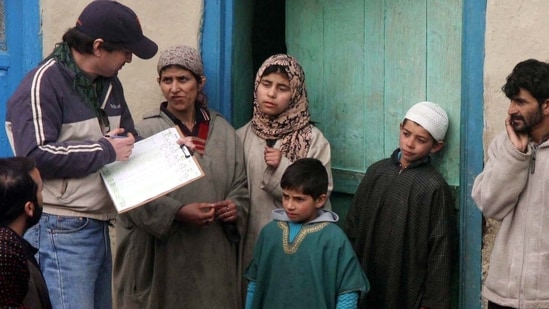
Census 2027 begins: Over 700 officials to conduct door-to-door survey, Delhi areas divided into blocks| India News
# Delhi Begins Census 2027: 700 Officials Deployed
In a decisive step toward India’s long-awaited demographic counting exercise, over 700 government officials officially launched the house-listing phase for Census 2027 in New Delhi on Thursday, April 16, 2026. Centered initially within the New Delhi Municipal Council (NDMC) and Delhi Cantonment Board (DCB) jurisdictions, this massive door-to-door survey operates by dividing the districts into **560 meticulously mapped house-listing blocks**. Each designated block covers approximately **180 households** to ensure comprehensive and manageable data collection. This foundational phase establishes the crucial logistical framework necessary to execute the nation’s first fully digital census after a six-year pandemic-induced delay.
## The Blueprint of Delhi’s House-Listing Exercise
The decennial census is arguably the most complex peacetime administrative exercise in the world, and the initial house-listing phase is its backbone. Officials coordinating the 2027 rollout have strategically divided the NDMC and DCB areas to ensure no dwelling, commercial space, or institutional building is left unaccounted for.
According to officials overseeing the initial deployment, the **560 house-listing blocks** were created using advanced Geographic Information System (GIS) mapping to define clear, overlapping-free boundaries for the enumerators. By capping the responsibility of each official at roughly **180 households**, the government aims to reduce enumerator fatigue and improve the accuracy of the data collected.
The 700-strong workforce comprises trained government school teachers, municipal clerks, and local administrative staff who have undergone rigorous orientation programs over the past three months. Their current mandate is not to collect granular demographic data regarding caste, income, or family lineage just yet, but to establish the physical registry of structures. This involves recording the material of the roof and walls, the purpose of the building (residential, commercial, or mixed-use), and the primary amenities available.
[Source: Hindustan Times | Additional: Ministry of Home Affairs Census Methodologies]
## Overcoming a Historic Delay: From 2021 to 2027
India has a proud history of conducting uninterrupted decennial censuses since 1881. However, the COVID-19 pandemic severely derailed the preparations for Census 2021. Subsequent logistical challenges, public health concerns, and political debates regarding the inclusion of specialized caste enumerations led to unprecedented postponements.
The launch of the house-listing phase in Delhi marks the definitive end of this administrative hiatus. The shift from a 2021 timeline to a 2027 framework reflects a necessary recalibration by the Registrar General and Census Commissioner of India. The new timeline provides the necessary buffer to implement upgraded technological systems and ensures that the eventual data reflects a post-pandemic demographic reality.
“The six-year delay created a significant data vacuum for policymakers relying on 2011 figures for public distribution systems and welfare targeting,” notes Dr. Harish Chandran, a demographer and public policy analyst. “By officially kicking off the house-listing phase in Delhi, the government is signaling that the administrative machinery is finally back on track. The data gathered in 2027 will be critical for redefining India’s socio-economic policies for the next decade.”
## Moving to a Fully Digital Framework
Census 2027 stands apart from all its predecessors due to its mandate to be India’s first fully digital census. The 700 officials deployed in the NDMC and DCB areas have traded traditional paper booklets and ledgers for secure, government-issued mobile tablets equipped with a proprietary census application.
This digital shift offers several monumental advantages:
* **Real-time synchronization:** Data entered by officials is encrypted and synced to centralized secure servers almost instantaneously, eliminating the years-long delays traditionally associated with manual data entry and tabulation.
* **GPS Tagging:** Every household listed in the 560 blocks is geographically tagged, creating an unparalleled spatial map of New Delhi’s infrastructure.
* **Built-in validation:** The mobile application restricts illogical entries, automatically flagging anomalies—such as claiming 50 residents in a 200-square-foot structure—prompting on-the-spot verification.
Furthermore, the digital framework will eventually roll out a self-enumeration portal, allowing tech-savvy residents to fill out their demographic details securely using their Aadhaar credentials, thereby reducing the physical burden on the enumerators during the second phase of the census.
[Source: Original RSS | Additional: Digital India Public Directives 2025-2026]
## Strategic Importance of NDMC and DCB Areas
Starting the house-listing phase in the New Delhi Municipal Council (NDMC) and Delhi Cantonment Board (DCB) areas is a calculated administrative decision. These regions house India’s top political leadership, central government ministries, diplomatic enclaves, and critical defense installations.
By treating these highly organized, relatively less densely populated zones as the launchpad, the Registrar General can stress-test the digital infrastructure, mobile apps, and enumerator protocols before expanding to the vastly more chaotic and densely populated areas under the broader Municipal Corporation of Delhi (MCD).
### Breakdown of the Initial Deployment Data
| Administrative Zone | Estimated Officials Deployed | House-Listing Blocks Created | Target Households per Block |
| :— | :— | :— | :— |
| **NDMC** | ~450 | 360 | ~180 |
| **DCB** | ~250 | 200 | ~180 |
| **Total Pilot Scope** | **700+** | **560** | **~100,000 Total Households** |
*Note: Data projected based on official block divisions and local administrative estimates for the initial phase.*
## The Shadow of Delimitation and Policy Planning
Beyond standard demographic tracking, Census 2027 carries immense political gravity. Under current constitutional provisions, the freeze on the number of seats in the Lok Sabha (the lower house of Parliament) and State Legislative Assemblies is tied to the publication of the first census conducted after the year 2026.
Because of the delay of the 2021 census, Census 2027 will effectively become the basis for this nationwide delimitation exercise. The population data recorded—starting with the foundational house-listing currently underway in Delhi—will dictate the redrawing of electoral maps and determine how political representation is distributed among states based on population growth.
“The numbers recorded during this cycle will permanently alter the political landscape of the nation,” explains political scientist Dr. Smita Verma. “Southern states that have successfully managed their population growth are watching the methodology closely, while northern states anticipate greater representation. Flawless execution, starting right at the block level in Delhi, is imperative to ensure absolute trust in the final numbers.”
[Source: Original RSS | Additional: Constitutional Delimitation Act Provisions]
## Ensuring Privacy and Citizen Security
With the shift toward a fully digital medium, privacy concerns naturally come to the forefront. The collection of highly specific household data, GPS coordinates, and asset ownership details requires robust cybersecurity measures.
The government has assured citizens that data collected during Census 2027 will be governed by stringent encryption standards and will comply with the frameworks established by the Digital Personal Data Protection (DPDP) Act. The mobile devices handed to the 700 officials in Delhi are heavily restricted; they operate on closed-loop networks, cannot access the public internet, and wipe data locally the moment it is successfully synced to the central servers in secure data parks.
To further ease public apprehension, municipal authorities are running parallel awareness campaigns across NDMC and DCB areas. Residents are being informed about the legitimacy of the census officials, how to identify official ID badges, and the mandatory nature of providing accurate house-listing data to secure future urban planning benefits.
## Conclusion: A Stepping Stone for the Nation
The deployment of 700 officials to map 560 blocks across Delhi’s NDMC and DCB areas is more than just a bureaucratic milestone; it marks the awakening of a vital national mechanism. The house-listing phase sets the stage for accurate urban planning, equitable distribution of welfare schemes, and the eventual political delimitation of the world’s largest democracy.
As these enumerators knock on doors across New Delhi, covering 180 households per block, they are testing the digital resilience of an exercise that will soon scale up to cover over 1.4 billion people. The success of Census 2027 heavily depends on the blueprints currently being drawn in the heart of the national capital. As this monumental effort unfolds, the cooperation of the citizens and the diligence of the ground staff will ultimately dictate the clarity with which India sees its own future.
**By Senior Correspondent, National Policy Desk** | April 16, 2026





