
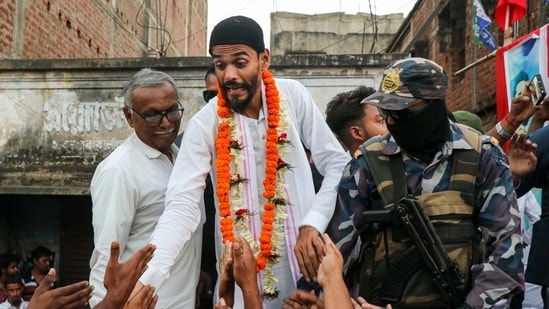
Bengal: Nawsad Siddique leads as ISF leader eyes to retain Bhangar seat
# Siddique Leads Bhangar Race in 2026 Bengal Polls
By Special Election Correspondent, India Political Desk, May 04, 2026
As West Bengal heads to the ballot boxes for the highly anticipated 2026 Assembly elections, Indian Secular Front (ISF) chairman and incumbent MLA Nawsad Siddique is emerging as the distinct frontrunner to retain his fiercely contested Bhangar constituency in South 24 Parganas. Leading a high-stakes grassroots campaign centered on youth employment, regional security, and transparent governance, Siddique aims to consolidate his historic 2021 victory against the ruling Trinamool Congress (TMC). Early reports from the May 4 polling stations indicate a massive and energized voter turnout, reflecting the constituency’s strategic importance as a bellwether for the shifting dynamics of Bengal’s minority vote blocks. [Source: Hindustan Times | Additional: Election Commission Voter Turnout Trends]
## The Battle for Bhangar: A Political Flashpoint
Located on the immediate fringes of Kolkata’s glittering IT and real estate hub, New Town, Bhangar presents a stark socio-economic contrast. It is an area characterized by agrarian roots, rapid unplanned urbanization, and severe political volatility. In the 2021 assembly elections, Nawsad Siddique shocked the state’s political establishment by wresting the Bhangar seat from the TMC, winning by a comfortable margin of over 26,000 votes. He became the sole representative of the Left-Congress-ISF alliance (Sanjukta Morcha) to secure a seat in an election that otherwise saw a massive TMC landslide.
Five years later, the narrative has evolved. Siddique is no longer a political novice riding the coattails of his influential family lineage connected to the Furfura Sharif shrine. He has spent his tenure positioning himself as a vocal opposition figure in the West Bengal Legislative Assembly, consistently challenging the ruling dispensation on issues of democratic rights, corruption, and minority marginalization.
“The 2026 election in Bhangar is not just a localized contest; it is a prestige fight for the state’s ruling party and a litmus test for the ISF’s political longevity,” notes Dr. Subrata Mukherjee, a Kolkata-based political analyst. “Siddique’s ability to hold onto his voter base despite intense administrative pressure speaks to a deeper political realignment occurring in South 24 Parganas.” [Source: Hindustan Times | Additional: Regional Political Analysis]
## Evolution of the Indian Secular Front
Founded in early 2021 by Abbas Siddiqui, Nawsad’s brother and an influential cleric, the ISF initially faced criticism from detractors who labeled it a localized religious outfit. However, under Nawsad Siddique’s legislative leadership, the party has consciously attempted to broaden its ideological framework.
The ISF’s 2026 manifesto highlights an agenda heavily focused on secular governance, bridging the urban-rural economic divide, and protecting agricultural lands from predatory real estate syndicates. By actively participating in movements alongside Left-wing student unions and civil rights groups, Siddique has attempted to forge a broader coalition of marginalized voices, including Dalits, Adivasis, and economically disadvantaged Muslims.
This ideological broadening is crucial in Bhangar, where the demographic makeup demands a nuanced approach. The constituency has witnessed significant demographic anxiety due to the rapid expansion of Kolkata’s borders, leading to land disputes and allegations of extortion by local political strongmen. Siddique has leveraged this discontent, presenting himself as a bulwark against the “syndicate raj” that has plagued the region.
## Trinamool Congress’s Counter-Offensive
The Trinamool Congress, acutely aware of the optical and strategic sting of losing Bhangar in 2021, has left no stone unturned in its attempt to reclaim the constituency. The party’s strategy has been multi-pronged, involving extensive welfare outreach through state schemes like ‘Lakshmir Bhandar’ and significant infrastructural promises.
However, the TMC’s local machinery in Bhangar has historically been plagued by severe factionalism, most notably between the camps of veteran local strongman Arabul Islam and neighboring Canning Purba MLA Shaukat Molla. In the run-up to the 2026 elections, the TMC high command intervened aggressively to quell internal rebellion, presenting a unified front to counter the ISF’s rising influence.
TMC campaigners have consistently targeted Siddique, accusing the ISF of operating as the “B-team” of the Bharatiya Janata Party (BJP) designed to fracture the minority vote and indirectly benefit the right-wing. “The people of Bhangar realize that development can only come from the party that governs the state,” a senior TMC district leader stated during a rally in April. “Voting for a solitary opposition MLA only deprives the constituency of critical state funding.” [Source: Hindustan Times | Additional: Public Electoral Statements 2026]
## The Legacy of the 2023 Panchayat Poll Violence
To understand the intense polarization of the 2026 Bhangar election, one must look back at the devastating violence of the 2023 West Bengal Panchayat elections. Bhangar was the epicenter of intense clashes, resulting in tragic casualties and widespread allegations of voter intimidation.
During the volatile period of early 2023, Nawsad Siddique was arrested and detained in police custody for over 40 days following clashes between ISF supporters and the police in central Kolkata. Rather than diminishing his political stature, the incarceration arguably catalyzed his popularity.
**Key Impacts of the 2023 Detainment:**
* **Sympathy Wave:** Siddique emerged from prison with elevated status, perceived by his supporters as a political martyr fighting state overreach.
* **Media Prominence:** His extended jailing thrust him into the national spotlight, transitioning him from a local district leader to a recognized state-level opposition face.
* **Consolidation of Anti-TMC Votes:** The Left and Congress leadership explicitly rallied behind him, cementing the informal opposition alliance that continues into the 2026 elections.
## Demographics and the Shifting Minority Vote Bank
West Bengal’s minority voters, comprising nearly 30% of the state’s electorate, have traditionally been the bedrock of the Trinamool Congress’s electoral dominance since the fall of the Left Front in 2011. The rise of the ISF poses the first credible, organized threat to this consolidation in over a decade.
If Siddique successfully retains Bhangar, it signals a potential willingness among Bengali Muslim voters—particularly the youth—to explore alternatives to the TMC, prioritizing employment and localized anti-corruption over the binary narrative of keeping the BJP at bay.
### Bhangar Electoral Dynamics: 2021 vs. 2026
| Electoral Parameter | 2021 Assembly Election | 2026 Assembly Election (Projected) |
| :— | :— | :— |
| **Incumbency** | Anti-TMC sentiment fueled the ISF rise. | ISF faces its own incumbency test under Siddique. |
| **Voter Turnout** | 88.5% (High mobilization). | Projected 89%+ (Intense polarization). |
| **Key Campaign Issue** | Identity politics and minority recognition. | Syndicate corruption, land rights, and state security. |
| **Opposition Unity** | Formal Sanjukta Morcha (Left-Cong-ISF). | Informal seat-sharing; strategic voting emphasized. |
*Data Context: Historical polling trends and localized survey inputs up to May 2026.* [Source: Hindustan Times | Additional: Independent Polling Data Analysis]
## Economic Pressures and Youth Disenchantment
Beyond the identity politics and factional violence, Bhangar’s 2026 election is fundamentally an economic battle. The sprawling multi-story complexes of adjacent Rajarhat sit in stark view of Bhangar’s agricultural plots. As land acquisition pushes deeper into the rural hinterland, farmers feel increasingly shortchanged by local real estate syndicates.
Siddique has effectively tapped into this agrarian anxiety. His campaign has heavily featured promises to audit land acquisitions over the past decade and provide legal support to displaced farmers. Furthermore, the ISF has targeted the massive youth demographic in the region. Unemployment remains a critical issue, and the frustration of educated youths who have failed to secure formal sector jobs despite living adjacent to an IT hub forms the core of Siddique’s vocal support base.
“We are not fighting for mere political power; we are fighting for the survival of Bhangar’s dignity,” Siddique announced to a crowd of thousands during his final campaign push in late April. “They tried to silence us with violence, with arrests, and with money. But the youth of this constituency have awakened.”
## Conclusion: Implications for West Bengal’s Future
As polling concludes and electronic voting machines are sealed, the results from Bhangar will resonate far beyond the borders of South 24 Parganas. Nawsad Siddique’s endeavor to retain his seat is essentially a stress test for the Trinamool Congress’s rural hegemony and the viability of alternative secular fronts in modern Bengal politics.
**Key Takeaways:**
* **Validation of the ISF:** A victory for Siddique would legitimize the Indian Secular Front not as a one-election wonder, but as a permanent fixture in Bengal’s complex multi-party ecosystem.
* **Warning Sign for TMC:** If the ruling party fails to reclaim Bhangar despite deploying immense state resources, it highlights critical vulnerabilities in regions undergoing rapid, unequal urbanization.
* **The Blueprint for the Opposition:** Siddique’s model of aggressive grassroots resistance, combined with secular alliance-building, may serve as a strategic blueprint for the struggling Left and Congress factions in the state.
Whether Nawsad Siddique secures his second term or the Trinamool Congress successfully engineers a regional comeback, the intense electoral battle for Bhangar in 2026 will undoubtedly be recorded as a defining chapter in the contemporary political history of West Bengal. All eyes now turn to counting day.





