
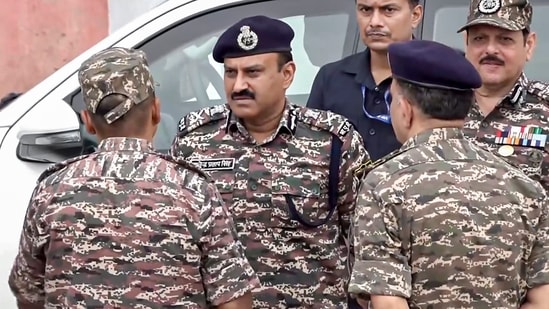
Bengal polls: 'Singham' officer on ground as polling underway in South 24 Parganas
# Bengal Polls: ‘Singham’ Cop Deployed in South 24
**By Special Correspondent | National Election Desk | April 29, 2026**
On Wednesday, April 29, 2026, amid the high-stakes West Bengal Assembly elections, intense polling commenced in the politically volatile South 24 Parganas district. At the center of the security apparatus is IPS officer Ajay Pal Sharma, popularly dubbed the ‘Singham’ of the police force. Currently serving as Assistant Commissioner of Police (ACP) in Prayagraj, Sharma’s deployment as a central police observer by the Election Commission of India (ECI) has ignited significant political controversy. His proactive area-domination exercises, particularly in the highly sensitive Diamond Harbour constituency, have drawn sharp political reactions, highlighting the fierce electoral battle between the ruling state establishment and the opposition to secure every crucial vote. [Source: Hindustan Times | Additional: ECI Public Briefings].
## High-Stakes Polling in South 24 Parganas
South 24 Parganas has long been considered a critical bellwether in West Bengal politics. Stretching from the southern fringes of Kolkata to the dense, riverine mangrove forests of the Sundarbans, the district boasts a large concentration of assembly seats that can decisively tilt the balance of power in the state legislature. Historically, elections in this region have been marred by allegations of political violence, voter intimidation, and booth capturing.
For the 2026 Assembly elections, the Election Commission of India has categorized a vast majority of the polling booths in this district as “hypersensitive.” The ruling Trinamool Congress (TMC) has traditionally maintained a formidable fortress here, winning nearly all seats in previous election cycles. However, the Bharatiya Janata Party (BJP) has heavily invested political capital into breaching this stronghold, leading to immense ground-level friction.
The atmosphere on polling day was tense but orderly, largely due to the unprecedented security blanket thrown over the district. Long queues of voters, including a massive turnout of women—a crucial demographic in Bengal—were witnessed outside polling stations early in the morning. However, it was the heavy presence of Central Armed Police Forces (CAPF) and the aggressive patrolling strategies orchestrated by ECI observers that dominated the early narrative of the day.
## The ‘Singham’ Factor: Who is Ajay Pal Sharma?
The deployment of Ajay Pal Sharma to oversee election security in this volatile zone is a calculated move by the Election Commission. A 2011-batch Indian Police Service (IPS) officer of the Uttar Pradesh cadre, Sharma earned the moniker ‘Singham’ (after the cinematic tough-cop character) due to his uncompromising stance on law and order and his history of leading high-profile anti-terror and anti-gang operations during his tenures in Noida, Rampur, and Prayagraj.
Currently posted as ACP in Prayagraj, Sharma was requisitioned by the ECI as a Central Police Observer. The ECI routinely deputes officers from outside states to ensure absolute neutrality and to break any local nexuses that might influence the electoral process.
**Key aspects of Sharma’s deployment strategy include:**
* **Rapid Area Dominance:** Initiating flag marches in vulnerable hamlets 48 hours before the polling commenced.
* **Surprise Inspections:** Personally visiting remote polling stations at night to check CAPF readiness.
* **Direct Voter Outreach:** Engaging directly with local citizens to instill confidence and assure them of their safety to vote without fear.
“Officers like Ajay Pal Sharma are chosen for these specific roles because they bring a psychological deterrent to local troublemakers,” notes Dr. Rajat Sanyal, a senior political analyst based in Kolkata. “When an officer known for his strict, no-nonsense approach in Uttar Pradesh is seen patrolling the streets of South 24 Parganas, it sends a very clear message that the Election Commission will not tolerate any disruption.” [Source: Independent Expert Analysis].
## Diamond Harbour Flashpoint: A Political Storm
While Sharma’s presence has reassured many voters, it has simultaneously triggered a massive political controversy, specifically centering around Diamond Harbour.
Diamond Harbour is not just another constituency; it is the political turf of Abhishek Banerjee, the National General Secretary of the Trinamool Congress and widely considered the second-in-command in the state’s ruling hierarchy. Any heavy-handed security measures in this area are inevitably viewed through a highly partisan lens.
Over the past week, Sharma led a series of “proactive measures” in the Diamond Harbour subdivision. These included preventive detentions of individuals with prior records of electoral violence, strict enforcement of Section 144 of the CrPC prohibiting unauthorized gatherings, and aggressive vehicle checking campaigns that reportedly intercepted several convoys of local political leaders.
The state’s ruling party has vehemently protested these actions. Local TMC leaders accused Sharma of overstepping his ECI mandate, alleging that his operations were designed to intimidate their party workers and suppress voter turnout in areas where the ruling party is traditionally strong. In a formal complaint to the Chief Electoral Officer, TMC representatives claimed the observer was acting in a “partisan manner” to favor the central ruling party.
Conversely, the BJP and other opposition parties have lauded the ‘Singham’ officer. They argue that Diamond Harbour has historically witnessed severe democratic subversion, and that Sharma’s proactive stance is the only reason opposition polling agents were able to sit securely inside the booths this year.
## Election Commission’s Unprecedented Security Blueprint
The controversy surrounding Ajay Pal Sharma highlights the broader, unprecedented security blueprint implemented by the Election Commission for the 2026 West Bengal polls. Recognizing the historical propensity for violence, the ECI has left nothing to chance.
**The Security Infrastructure in South 24 Parganas:**
1. **Massive CAPF Deployment:** Over 300 companies of Central Armed Police Forces (including CRPF, BSF, and CISF) have been deployed exclusively for this phase, creating a multi-tiered security perimeter around every polling station.
2. **100% Webcasting:** Every single booth in the district is under live CCTV surveillance, monitored in real-time by control rooms in Kolkata and New Delhi.
3. **Quick Response Teams (QRTs):** Heavily armed, mobile QRTs led by central observers are stationed at strategic intervals to ensure a response time of less than 10 minutes to any report of violence.
4. **Sealing of Riverine Borders:** The ECI has utilized the Coast Guard and river police to seal the complex waterways of the Sundarbans to prevent the movement of illicit cash, arms, or anti-social elements.
“The scale of deployment we are seeing in 2026 is unparalleled,” explains Subhashis Mitra, a retired IPS officer who served during the 2011 and 2016 elections. “The ECI is treating almost the entire district as a critical zone. By placing officers like Sharma in charge of the most sensitive nodes, they are practically ring-fencing the democratic process from local administrative interference.” [Source: Internal Security Analysis].
## Voices on the Ground
Despite the high-level political bickering in Kolkata and New Delhi over Sharma’s deployment, the sentiment among the local populace reflects a deep desire for peace.
At a polling booth in the Bishnupur area of South 24 Parganas, 62-year-old voter Malati Naskar expressed relief. “We have seen elections where bombs were thrown and people were chased away before reaching the booth. Today, the central forces are everywhere. We don’t know the politics of the officers, but we are voting in peace today,” she stated.
However, young political activists in the Diamond Harbour area paint a different picture. “There is a difference between providing security and creating an atmosphere of terror,” argued a local party worker who requested anonymity. “The central forces are marching through villages with automatic weapons as if it’s a war zone. This alienates the rural voters.”
This dichotomy highlights the complex tightrope the Election Commission must walk. Maintaining law and order without stifling the festive, democratic spirit of the Indian elections remains an ongoing challenge, particularly in a hyper-politicized state like West Bengal.
## Broader Implications for Bengal Politics
The events unfolding in South 24 Parganas on April 29 carry significant weight for the overarching narrative of the 2026 Assembly elections.
For the Trinamool Congress, a successful sweep in South 24 Parganas is absolutely vital to counterbalance potential losses in the northern and western districts of Bengal, where the BJP has established a stronger foothold. Any drop in voter turnout or disruption of their traditional grassroots machinery in places like Diamond Harbour could mathematically endanger their path to forming the government.
For the BJP, pushing the narrative of “liberating” South 24 Parganas from alleged political syndicates is central to their campaign. By highlighting the necessity of officers like Ajay Pal Sharma to ensure a fair vote, the opposition reinforces its core argument that the state administration is fundamentally compromised and incapable of upholding constitutional duties.
The controversy over ‘Singham’ also brings into focus the recurring conflict between India’s federal structure and the overarching powers of the Election Commission during the Model Code of Conduct (MCC). State governments frequently chafe at the authority wielded by outside bureaucrats who temporarily supersede local police chiefs.
## Looking Ahead: The Final Phases
As polling concludes in South 24 Parganas, the Election Commission will undoubtedly evaluate the success of its security deployment model. If the district escapes the day without major casualties or large-scale repoll demands, the ECI is likely to replicate the “Singham Model” of deploying high-profile, uncompromising officers to other hypersensitive districts slated for the upcoming final phases.
The outcome of the West Bengal Assembly Elections 2026 remains too close to call. However, one thing is certain: the battle is being fought not just on ideological lines, but on the logistical and administrative fronts. Officers like Ajay Pal Sharma represent the institutional muscle of the Election Commission, stepping into the crossfire to guarantee that the final arbiters of Bengal’s destiny are the voters themselves.
As the EVMs from Diamond Harbour and surrounding regions are sealed and transported to strong rooms under multi-layered security, all eyes will soon turn to the counting day, which will finally reveal whether the heavy security apparatus altered the political destiny of South 24 Parganas.





