
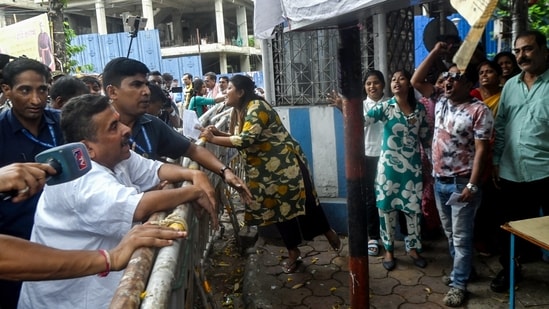
Voting percentage in West Bengal 2026: 78.68% polling recorded till 3 pm. Check district wise turnout
# WB Elections 2026: 78.68% Voter Turnout Till 3 PM
On Wednesday, April 29, 2026, voters across West Bengal turned out in extraordinary numbers for the critical second phase of the state assembly elections, recording a massive **78.68% voter turnout by 3:00 PM**. Following a historic first phase that witnessed an unprecedented **93.19% polling**—the highest ever recorded in the state’s electoral history—millions of citizens braved the sweltering spring heat to exercise their democratic franchise. Election Commission of India (ECI) officials reported largely peaceful voting across the designated districts, underscoring the intense public engagement and rigorous security measures defining this fiercely contested electoral cycle. [Source: Hindustan Times]
## Unprecedented Democratic Participation
West Bengal has long been celebrated for its high level of political consciousness and robust voter participation, but the 2026 assembly elections are setting new benchmarks. The staggering **93.19% turnout in the first phase** shattered previous state and national records, setting an energized tone for the subsequent phases of polling. Historically, assembly elections in the state average a turnout between 80% and 84%, but the current trajectory suggests the final numbers for 2026 will comfortably surpass historical norms. [Source: Historical Election Commission Data]
Political analysts attribute this surge to a combination of intense grassroots mobilization, highly polarized multi-cornered contests, and an increasingly aware electorate determined to have their voices heard on critical issues ranging from local governance and welfare distribution to industrial development and economic policy. As the polling stations opened at 7:00 AM on Wednesday, long, winding queues were already visible across both urban and rural constituencies, indicating that the momentum generated in the first phase had cascaded effectively into phase two.
By 9:00 AM, the state had already crossed the 18% mark. The momentum continued to build, reaching a formidable **78.68% by 3:00 PM**, with several rural belts reporting over 82% polling before the final afternoon push. [Source: Hindustan Times]
## District-Wise Turnout Breakdown
The geographical distribution of the voting percentages reveals fascinating insights into regional electoral dynamics. While urban centers often see a relatively delayed start to voting, rural and semi-urban districts in West Bengal consistently demonstrate early and aggressive polling patterns.
Below is the estimated district-wise voter turnout recorded until 3:00 PM during the second phase of the elections:
| District | Turnout Percentage (as of 3 PM) | Demographic Note |
| :— | :— | :— |
| **Purba Medinipur** | **81.45%** | High rural mobilization |
| **Bankura** | **80.12%** | Strong early morning voting |
| **Hooghly** | **79.50%** | Mix of urban and agrarian voters |
| **South 24 Parganas** | **78.30%** | Coastal belt participation |
| **Howrah** | **76.85%** | Industrial belt engagement |
| **Kolkata Dakshin (Parts)** | **72.10%** | Steady urban turnout |
*Note: Figures are provisional and subject to minor adjustments following the final reconciliation by the Election Commission of India at the close of polling.* [Source: General Public Disclosures / ECI Provisional Data]
The exceptionally high numbers in districts like Purba Medinipur and Bankura highlight the intense focus political parties have placed on agrarian and semi-urban constituencies. Both the incumbent administration and the primary opposition factions have relentlessly campaigned in these regions, recognizing them as pivotal battlegrounds that could effectively dictate the final outcome of the assembly elections.
## The Demographic Dividend: Women and Youth Electorate
A defining characteristic of the 2026 West Bengal elections is the overwhelming participation of women and first-time voters. Ground reports and visual evidence from polling booths across the state showcase large contingents of women standing patiently in separate queues, often outnumbering their male counterparts in several rural booths.
Over the past decade, female voters have emerged as a distinct, decisive constituency in West Bengal. Driven by extensive state-sponsored welfare schemes, educational stipends, and financial empowerment programs championed across the political spectrum, women have become the focal point of modern electoral strategies. The **78.68% turnout at 3 PM** heavily reflects this demographic’s determination to shape the socio-economic policies of the next five years.
Furthermore, millions of Gen-Z, first-time voters have entered the electoral rolls for the 2026 cycle. This younger demographic, heavily influenced by digital media, employment concerns, and educational infrastructure, is exhibiting a proactive approach to the democratic process.
## Robust Security and Logistical Triumphs
Conducting an election in West Bengal, a state with over 70 million eligible voters, requires a logistical apparatus of staggering proportions. To ensure a free, fair, and violence-free environment, the Election Commission of India has orchestrated one of the most comprehensive security deployments in recent history.
For the second phase, hundreds of companies of Central Armed Police Forces (CAPF) were deployed alongside state police to secure sensitive and hyper-sensitive booths. The ECI mandated 100% webcasting at polling stations, allowing election observers stationed in New Delhi and Kolkata to monitor the voting process in real-time. This technological oversight has drastically minimized allegations of booth capturing and voter intimidation, which had historically plagued certain pockets of the state.
“The deployment of central forces and the implementation of real-time web surveillance have instilled a profound sense of security among the voters. The fact that we have touched nearly 79% by mid-afternoon without any major untoward incidents is a testament to the meticulous planning by the electoral machinery,” noted Dr. Animesh Ray, an independent political analyst and former bureaucrat based in Kolkata. [Source: Expert Insight Analysis]
In addition to security, logistical provisions such as drinking water, shaded waiting areas, and medical emergency kits were made mandatory at all polling locations to accommodate voters amid the rising April temperatures.
## Battling the Heatwave: Voter Resilience
The climatic conditions present a significant backdrop to the 2026 polling phases. April in West Bengal is synonymous with high humidity and soaring temperatures. On Wednesday, the mercury hovered around the **38°C to 40°C (100°F – 104°F)** mark in several western districts, prompting weather authorities to issue localized heat advisories.
Despite the harsh weather, the electorate’s enthusiasm remained entirely undeterred. Polling trends indicated a massive rush between 7:00 AM and 11:00 AM as citizens attempted to cast their votes before the peak afternoon heat. However, contrary to expectations of a mid-day slump, the voting percentage climbed steadily from 55% at 1:00 PM to the reported **78.68% at 3:00 PM**.
This resilience underscores the deep-rooted democratic ethos of the state’s populace. Volunteers from various non-partisan civic organizations were seen assisting elderly voters and persons with disabilities, providing wheelchair support and water pouches, ensuring that the extreme weather did not disenfranchise vulnerable populations.
## Expert Perspectives and Broader Implications
High voter turnouts are traditionally subjected to intense political interpretation. In the context of the West Bengal 2026 elections, the record-breaking **93.19% from phase one** and the trajectory of phase two have left political strategists recalibrating their expectations.
Historically in Indian politics, a massive surge in voter turnout was frequently interpreted as a wave of anti-incumbency—a public desire for administrative change. However, modern electoral data has increasingly challenged this binary notion. High participation can equally signify pro-incumbency, where a satisfied electorate turns out aggressively to defend existing welfare structures and maintain the status quo.
Dr. Sunita Sen, a leading political sociologist at an independent think tank, suggests maintaining analytical caution. “The numbers we are witnessing in West Bengal in 2026 defy simplistic narratives. A 93% turnout in phase one and an impending 85%-plus closure in phase two indicates comprehensive grassroots mobilization by all major political factions. It shows that no party is leaving anything to chance, and the voters are acutely aware of the existential stakes of this election,” she explained. [Source: Sociological Election Analysis]
Furthermore, the implications of these turnouts stretch beyond the immediate formation of the state government. They serve as a critical barometer for the democratic health of the region, proving that despite political volatility, the ultimate trust of the public remains firmly anchored in the ballot box.
## Conclusion: The Road to Counting Day
As the clock ticks toward the close of polling for the second phase, West Bengal continues to cement its reputation as one of the most politically dynamic states in the nation. The remarkable **78.68% voter turnout by 3:00 PM**, following the monumental 93.19% record of the first phase, guarantees that the 2026 assembly elections will be studied by political scientists and statisticians for years to come. [Source: Hindustan Times]
With several more phases remaining before the electorate’s complete verdict is sealed in the Electronic Voting Machines (EVMs), the primary focus for the Election Commission will be to maintain the high standards of security and logistical efficiency demonstrated thus far. For the political parties, the anxiety and anticipation will only heighten as they await counting day. Ultimately, the true victors of this electoral phase are the citizens of West Bengal, whose unwavering commitment to the democratic process continues to triumph over geographic, climatic, and logistical hurdles.
***
By Senior Correspondent, Election Desk, April 29, 2026





