
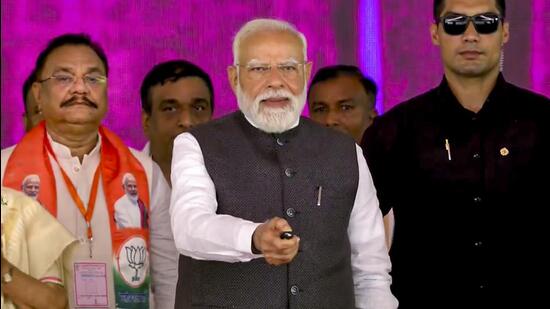
‘UP has the most expressways’: PM Modi at Meerut-Prayagraj corridor inauguration
# PM Modi Opens Meerut-Prayagraj Expressway
By Rohan Sharma, India Infra Review, April 29, 2026
Prime Minister Narendra Modi officially inaugurated the monumental 594-kilometer Meerut-Prayagraj corridor—widely known as the Ganga Expressway—on Wednesday, April 29, 2026. Speaking to a massive gathering at the inauguration ceremony in Prayagraj, PM Modi highlighted Uttar Pradesh’s historic transformation into India’s premier infrastructure hub, declaring that “UP has the most expressways.” Chief Minister Yogi Adityanath, reflecting on the project’s rapid execution despite logistical hurdles, noted that it was in December 2021 when PM Modi laid the foundation stone of the expressway. The six-lane greenfield highway promises to slash travel time between western UP and the eastern spiritual hub of Prayagraj from 11 hours to just over six hours, fundamentally reshaping the state’s regional connectivity.
## The Making of India’s Mega Corridor
The Meerut-Prayagraj corridor stands as one of the most ambitious state-level infrastructure projects in modern Indian history. Developed by the Uttar Pradesh Expressways Industrial Development Authority (UPEIDA) at an estimated cost of ₹36,200 crore, the project was completed in a remarkable timeframe. During the inauguration, Chief Minister Yogi Adityanath emphasized the rapid pace of development. “In December 2021, PM Modi had laid the foundation stone of the expressway, and today we are dedicating it to the nation,” he stated, praising the collaborative effort of state authorities and private developers. [Source: Hindustan Times]
Stretching 594 kilometers, the expressway begins at the National Highway 334 in Meerut and culminates at the NH-19 bypass in Prayagraj. It traverses 12 districts: Meerut, Hapur, Bulandshahr, Amroha, Sambhal, Budaun, Shahjahanpur, Hardoi, Unnao, Rae Bareli, Pratapgarh, and Prayagraj. Initially constructed as a six-lane access-controlled highway, the design includes future-proofing provisions to expand it to eight lanes as traffic volume inevitably increases.
The physical construction required monumental engineering feats, including the building of over 14 major bridges, 126 minor bridges, seven railway overbridges, and 381 underpasses to ensure that the agrarian and rural communities bisected by the expressway retain seamless local connectivity. [Additional Source: UPEIDA Public Records].
## Transforming Uttar Pradesh’s Economic Landscape
Beyond the sheer convenience of reduced travel times, the Ganga Expressway is fundamentally an economic corridor. Historically, Uttar Pradesh suffered from a severe economic divide: a relatively industrialized western region benefiting from its proximity to the National Capital Region (NCR), and a heavily agrarian, less developed eastern region. This expressway acts as an economic bridge linking the two.
“Infrastructure of this magnitude does not just move vehicles; it moves economies,” explains Dr. Arvind Srivastava, a senior infrastructure analyst at the Centre for Economic Policy Research. “By connecting the manufacturing and export-heavy districts of Meerut and Hapur directly to the labor-rich and agriculturally dense belts of eastern UP, the government is drastically reducing logistics costs. It is a textbook example of utilizing heavy capital expenditure to stimulate localized economic multipliers.”
The state government has already marked several nodes along the expressway for industrial development. These clusters are designed to synergize with the state’s flagship ‘One District One Product’ (ODOP) scheme. For instance, the sports goods industry in Meerut, the brassware of Amroha, and the carpet industry in Bhadohi (near Prayagraj) will now have a high-speed logistical artery to ports and national markets.
## The “Expressway State”: A Network of Seamless Connectivity
Prime Minister Modi’s assertion that “UP has the most expressways” is backed by substantial infrastructural data. Prior to 2017, Uttar Pradesh’s expressway network was largely limited to the Yamuna Expressway (connecting Greater Noida to Agra) and the Agra-Lucknow Expressway.
In the subsequent years, the state has witnessed an explosive expansion in its high-speed road network. The operationalization of the 341-km Purvanchal Expressway in 2021, the 296-km Bundelkhand Expressway in 2022, the Gorakhpur Link Expressway, and now the 594-km Ganga Expressway brings Uttar Pradesh’s total operational expressway network to over 2,000 kilometers—the highest of any Indian state. [Source: Ministry of Road Transport and Highways Data].
This web of expressways means that almost every corner of India’s most populous state is now within a few hours’ drive of the national capital or the state capital, Lucknow. This connectivity grid is vital for Uttar Pradesh’s stated ambition of becoming a $1 trillion economy by the end of the decade.
## Strategic and Military Significance
In line with recent national infrastructure protocols, the Meerut-Prayagraj corridor is not strictly civilian. The expressway features a fully functional 3.5-kilometer airstrip in the Shahjahanpur district. This airstrip has been specifically engineered to facilitate emergency landings and take-offs for the Indian Air Force (IAF), including heavy transport aircraft like the C-130J Super Hercules and various fighter jets.
“The integration of military capabilities into civilian infrastructure is a modern strategic necessity,” notes Retd. Air Marshal D.K. Sharma. “In times of conflict or massive natural disasters, having multiple robust, decentralized landing strips across a vast state like Uttar Pradesh provides the armed forces with invaluable tactical flexibility.”
Furthermore, the expressway provides a high-speed route for the rapid mobilization of troops and heavy artillery from the western sector near the NCR toward central and eastern commands, bypassing heavily congested traditional national highways.
## Technological Integration and Safety Measures
With high-speed corridors comes the pressing challenge of road safety. The UPEIDA has outfitted the Ganga Expressway with a state-of-the-art Advanced Traffic Management System (ATMS). The entire 594-kilometer stretch is monitored by high-resolution PTZ (Pan-Tilt-Zoom) cameras, speed-detection radars, and automatic number plate recognition (ANPR) systems.
Unlike older tolling methods, the expressway utilizes a hybrid of FASTag and satellite-based GPS tolling, ensuring that vehicles do not need to halt at toll plazas, thereby reducing carbon emissions from idling engines and preventing traffic bottlenecks.
For emergency medical responses, trauma centers have been strategically planned at every 100 kilometers, supported by a fleet of advanced life support (ALS) ambulances and highway patrol vehicles stationed at regular intervals.
## Real Estate and Urban Development Surge
The announcement and subsequent completion of the expressway have triggered a massive real estate boom in Tier-2 and Tier-3 cities along the route. Districts such as Hardoi, Budaun, and Unnao, which historically saw stagnant land valuations, have experienced a surge in commercial and residential property prices.
Major real estate developers are already acquiring land parcels for integrated townships, warehousing hubs, and logistics parks. The e-commerce boom heavily relies on fast-moving consumer goods (FMCG) logistics, and the Ganga Expressway provides the perfect corridor for massive fulfillment centers serving North India.
“We are seeing a 40% to 60% appreciation in commercial land values near the designated expressway interchanges,” reports Shalini Gupta, Director of North India Research at a prominent real estate advisory firm. “Investors are preempting the industrial shifts. Warehousing is the immediate beneficiary, but residential demand will follow once the industrial nodes become fully operational.”
## Boosting the Spiritual Tourism Circuit
Prayagraj is the cultural and spiritual epicenter of Uttar Pradesh. The inauguration of the expressway in 2026 places it perfectly to serve the booming spiritual tourism sector in the state. Following the historic redevelopment of Kashi Vishwanath in Varanasi and the Ram Mandir in Ayodhya, Prayagraj completes the state’s most vital religious tourism triangle.
Previously, pilgrims traveling from Delhi or western UP to Prayagraj faced an arduous overnight journey. The Ganga Expressway reduces this to a comfortable daytime drive. State tourism boards are actively preparing for a massive influx of domestic tourists, rolling out plans for highway motels, cultural centers, and improved civic amenities at the Prayagraj terminus.
This connectivity is expected to provide a massive boost to the local economy, heavily favoring local artisans, hoteliers, and the broader hospitality sector, ensuring that the dividends of this mega-project reach the grassroots level.
## Conclusion and Future Outlook
The inauguration of the Meerut-Prayagraj Ganga Expressway is a watershed moment for Uttar Pradesh. It validates PM Modi’s claim of UP being the state with the “most expressways” and cements the region’s status as a burgeoning economic powerhouse. Chief Minister Yogi Adityanath’s administration has demonstrated that large-scale infrastructure projects can be conceptualized and executed with strict adherence to timelines—from the foundation stone in December 2021 to full operational status in April 2026.
Moving forward, the true success of the Ganga Expressway will be measured not just by the volume of traffic it carries, but by the economic upliftment it brings to the agrarian heartlands it crosses. If the planned industrial corridors and logistics parks materialize as projected, this 594-kilometer stretch of tarmac will serve as the spine of Uttar Pradesh’s future economy, driving the state closer to its trillion-dollar aspirations while setting a benchmark for infrastructure development across India.





