
‘BJP brought people from outside’: Mamata on Assam polls a day after voting| India News
# Mamata Slams BJP Over Outsiders In Assam Polls
**By Senior Political Correspondent, National News Desk, April 10, 2026**
A day after the single-phase election for the 126-member Assam Legislative Assembly concluded on Thursday, West Bengal Chief Minister and Trinamool Congress (TMC) supremo Mamata Banerjee has leveled serious allegations against the Bharatiya Janata Party (BJP), accusing the ruling party of bringing in “people from outside” to illegally influence the voting process. Speaking at a press briefing on Friday, April 10, 2026, Banerjee claimed that the BJP orchestrated a massive cross-border mobilization to sway electoral outcomes in highly contested constituencies. The high-stakes Assam elections, viewed as a critical litmus test for the BJP’s dominance in the Northeast and the opposition’s regional resurgence, witnessed robust voter turnout, but the aftermath has been immediately overshadowed by these fiery political accusations.
[Source: Original RSS via Hindustan Times | Additional: Press Trust of India / Election Commission of India Public Briefings]
## The Resurgence of the ‘Outsider’ Narrative
The accusation that a political opponent is utilizing external actors to manipulate local democratic processes is not a new rhetorical device for Mamata Banerjee. This strategy formed the cornerstone of the TMC’s highly successful 2021 West Bengal assembly election campaign, where the slogan “Bengal wants its own daughter” was heavily juxtaposed against the BJP’s central leadership, who were frequently branded as *bohiragoto* (outsiders). Now, Banerjee appears to be exporting this exact political narrative to neighboring Assam.
During her Friday address, Banerjee did not mince words. She asserted that thousands of individuals were strategically transported from neighboring states, including Tripura and parts of North Bengal, into Assam’s border districts in the days leading up to the April 9 polls. **”They know they are losing the ground reality in Assam, which is why the BJP brought people from outside to intimidate voters and cast false votes,”** Banerjee alleged, though she stopped short of providing concrete documentary evidence to back these specific claims.
The Trinamool Congress has been attempting to carve out a political foothold in Assam, particularly targeting the Bengali-speaking demographics in the Barak Valley and lower Assam regions. By utilizing the outsider narrative, Banerjee is attempting to position her party as a defender of genuine regional autonomy against what she portrays as an overbearing, centrally controlled BJP apparatus.
## High Stakes in the 126-Member Assembly
The electoral landscape in Assam is fiercely competitive, characterized by complex fault lines of ethnicity, language, and religion. Thursday’s single-phase election for all 126 constituencies was a massive logistical undertaking, requiring heightened security and extensive deployment of central paramilitary forces.
[Source: Original RSS via Hindustan Times | Additional: Historical Assam Electoral Demographics]
In the previous assembly elections of 2021, the BJP comfortably retained power by securing 60 seats, while its allies, the Asom Gana Parishad (AGP) and the United People’s Party Liberal (UPPL), secured 9 and 6 seats respectively. The opposition, led by the Indian National Congress and the All India United Democratic Front (AIUDF), put up a strong fight but ultimately fell short.
For the 2026 cycle, the dynamics have shifted. The BJP, under the leadership of Chief Minister Himanta Biswa Sarma, has campaigned aggressively on a platform of rapid infrastructure development, internal security, and targeted welfare schemes. Conversely, the opposition has attempted to capitalize on anti-incumbency sentiments, economic anxieties, and the lingering social friction caused by the Citizenship Amendment Act (CAA) and the National Register of Citizens (NRC).
**Key Factors Influencing the 2026 Assam Polls:**
* **Welfare Economics:** The incumbent government’s Orunodoi scheme, which provides direct cash transfers to women, has been a major vote-gatherer.
* **Identity Politics:** The ongoing debate over indigenous rights versus the rights of Bengali-speaking Hindus and Muslims continues to polarize the electorate.
* **Delimitation Impact:** The recent redrawing of electoral constituencies by the Election Commission has significantly altered the demographic math in several key seats, leading to uncertainty for both the ruling alliance and the opposition.
## TMC’s Strategic Push in the Northeast
Mamata Banerjee’s vocal intervention in the Assam elections is indicative of her broader national ambitions. Following a resounding victory in West Bengal in 2021, the TMC has actively sought to expand its footprint beyond its home turf, setting its sights on Northeastern states like Meghalaya, Tripura, and Assam.
In Assam, the TMC’s strategy heavily revolves around acting as a counterweight to the BJP in Bengali-majority areas like Silchar and Karimganj. The party has consistently positioned itself as the sole uncompromising opponent of the CAA and NRC, legislations that have deeply unsettled many Bengali residents in Assam who fear disenfranchisement.
However, political analysts point out that the TMC’s path in Assam is fraught with challenges. The party is often viewed with suspicion by the Assamese-speaking majority in the Brahmaputra Valley, who remain wary of West Bengal’s political influence. By accusing the BJP of bringing in “outsiders,” Banerjee is attempting to thread a delicate needle: appealing to her core Bengali base while simultaneously trying to sound protective of Assam’s territorial and electoral integrity.
## Expert Perspectives and Political Analysis
Political commentators suggest that Banerjee’s post-poll allegations serve a dual purpose: setting the stage for a potential opposition narrative in the event of a BJP victory, and keeping the TMC relevant in the national media cycle.
**”The ‘outsider’ narrative is a highly effective, emotionally charged weapon that Mamata Banerjee wields with great skill,”** notes Dr. Sanjay Bhattacharya, an independent political analyst specializing in Northeast Indian politics. **”While it worked flawlessly in Bengal to unite local pride against a national party, its application in Assam is more complex. Assam has its own historical anxieties regarding outsiders, primarily migrants. By accusing the BJP of importing political outsiders, she is attempting to tap into that inherent local anxiety, albeit for a different electoral purpose.”**
Furthermore, experts argue that these claims highlight the intense anxiety gripping opposition parties regarding the BJP’s organizational machinery. The saffron party is renowned for its micro-management of elections, often moving *panna pramukhs* (page in-charges) and campaign managers across state lines to bolster local efforts. While this is a standard political practice, opposition parties frequently frame it as an unnatural and hostile takeover of local democracy.
[Source: Additional Political Analysis / General Knowledge base on Indian Electoral Strategies]
## BJP’s Rebuttal and Counter-Allegations
The BJP has swiftly dismissed Mamata Banerjee’s allegations as baseless and symptomatic of political desperation. Senior BJP leaders in Assam have vehemently denied any foul play, pointing to the Election Commission’s stringent protocols as proof of a free and fair election.
A regional BJP spokesperson, addressing the media shortly after Banerjee’s remarks, stated, **”The Trinamool Congress has no base in Assam. These statements are merely the preemptive excuses of a party that knows it has been overwhelmingly rejected by the people. The only ‘outsiders’ trying to disturb the peace and progress of Assam are political tourists from West Bengal who visit only during elections.”**
The BJP asserts that its campaign was strictly driven by local cadres and indigenous leaders who understand the pulse of Assam. Furthermore, the ruling party has counter-accused the TMC and its broader alliance partners of attempting to polarize voters along religious lines in the final days of campaigning, particularly in the minority-dominated constituencies of lower Assam.
## Voting Day Mechanics and Election Commission Security
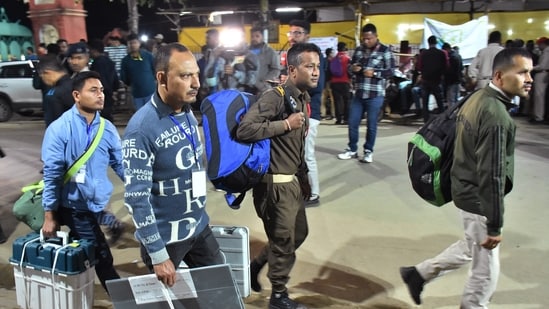
Despite the high political temperature, the single-phase election on Thursday was largely conducted peacefully, barring a few isolated incidents of electronic voting machine (EVM) glitches and minor scuffles near polling booths. The Election Commission of India (ECI) had deployed hundreds of companies of Central Armed Police Forces (CAPF) to secure the 126 constituencies.
To prevent the very type of cross-border infiltration that Mamata Banerjee is alleging, the ECI had strictly sealed the interstate borders sharing boundaries with West Bengal, Tripura, Meghalaya, and Arunachal Pradesh 48 hours prior to the polls. Additionally, the international borders with Bangladesh and Bhutan were under heightened surveillance by the Border Security Force (BSF) and the Sashastra Seema Bal (SSB).
Webcasting facilities were installed in over 50% of the polling stations, allowing election officials in Delhi and Guwahati to monitor the process in real-time. Given these robust security measures, electoral observers suggest that executing mass voter fraud by bringing in undocumented “outsiders” on polling day would be highly improbable without immediate detection.
## Conclusion: Awaiting the Verdict
As the dust settles on the crucial single-phase Assam assembly election, Mamata Banerjee’s accusations ensure that the political atmosphere remains highly charged. Whether her claims of “outsider” interference are based on actionable intelligence or are simply strategic political posturing will likely be debated in the weeks to come.
The immediate focus now shifts to the EVM strongrooms, which are under heavy centralized guard. With the vote counting scheduled for early May, the results of the 126-member assembly will not only determine the next government in Dispur but will also provide a definitive verdict on whether the BJP’s developmental pitch has successfully overridden the opposition’s intense regional and identity-based narratives.
If the BJP returns to power, it will cement Himanta Biswa Sarma’s stature as the undisputed political heavyweight of the Northeast. Conversely, a strong showing by the opposition, or any unexpected gains by the Trinamool Congress, will validate Mamata Banerjee’s aggressive expansionist tactics, setting the stage for an even more fractured and fiercely competitive national political landscape ahead. Until the ballots are counted, the war of words over who truly represents the soul of Assam is guaranteed to continue.





