
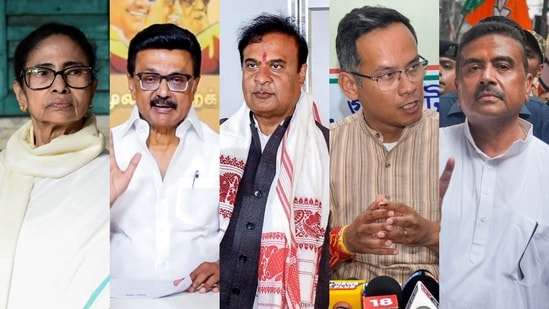
BJP's continuity in Assam, debut in Bengal, Vijay magic in Tamil Nadu: Full list of exit poll results
# Exit Polls: BJP Wins Assam, Vijay Magic in TN
**By Special Correspondent, National Election Desk** | **April 30, 2026**
**NEW DELHI** — As the grueling multi-phase state assembly elections draw to a close across four critical Indian states, the exit polls released on Thursday evening project a dramatic restructuring of regional politics. According to the latest aggregate data, the Bharatiya Janata Party (BJP) is set to comfortably retain power in Assam, while West Bengal braces for a razor-thin, nail-biting contest between the incumbent Trinamool Congress (TMC) and a resurgent BJP. However, the most seismic political earthquake is projected in Tamil Nadu, where actor-turned-politician Thalapathy Vijay’s party is poised for a spectacular debut, potentially upending half a century of Dravidian duopoly. Meanwhile, Kerala is expected to follow its historical pendulum swing, unanimously handing power back to the Congress-led United Democratic Front (UDF). [Source: Hindustan Times | Additional: National Exit Poll Aggregates].
## Assam: The Saffron Fortress Holds Firm
In Assam, the exit polls have delivered a virtually unanimous verdict, predicting a historic third consecutive term for the BJP-led National Democratic Alliance (NDA). The incumbency factor, often a hurdle for ruling governments, appears to have been thoroughly mitigated by Chief Minister Himanta Biswa Sarma’s aggressive development agenda and strategic welfare initiatives.
Pollsters project the NDA to secure between **82 and 92 seats** in the 126-member assembly, comfortably surpassing the halfway mark of 64. The opposition INDIA bloc, spearheaded by the Congress and regional allies, is projected to trail significantly, restricted to a range of **30 to 40 seats**.
**Key Factors Driving the Assam Verdict:**
* **Welfare Economics:** The massive expansion of the *Orunodoi* scheme, which provides direct cash transfers to women, has reportedly consolidated the female vote bank overwhelmingly in favor of the BJP.
* **Infrastructure Push:** The rapid completion of bridges over the Brahmaputra, enhanced road connectivity in Upper Assam, and the establishment of new medical colleges have resonated with rural and urban voters alike.
* **Delimitation Dynamics:** The recent delimitation of assembly constituencies appears to have played into the BJP’s demographic strategy, securing its strongholds in Upper Assam and the Barak Valley.
“Assam has shifted from a state known for volatile identity politics to one focused on governance delivery,” notes Dr. Arup Borah, a political sociologist based in Guwahati. “The exit polls reflect a voter base that prioritizes continuity and central alignment over fragmented regional opposition.” [Source: Independent Political Analysis].
## West Bengal: A High-Stakes Clash of Titans
While Assam presents a clear picture, West Bengal offers the most suspenseful narrative of the 2026 election cycle. The exit polls suggest a neck-and-neck battle between Mamata Banerjee’s Trinamool Congress (TMC), seeking a fourth consecutive term, and a highly mobilized BJP aiming for its first-ever government in the state.
The projections indicate a deeply polarized electorate. Pollsters estimate the TMC could win anywhere between **135 and 155 seats**, while the BJP is close on its heels with projections ranging from **125 to 145 seats** in the 294-member assembly. The Left-Congress alliance continues to face marginalization, projected to win in the single digits.
The BJP’s relentless campaign, heavily focused on allegations of corruption, institutional decay, and women’s safety—echoing the continued fallout from the 2024 Sandeshkhali protests—seems to have made deep inroads into rural Bengal. Conversely, the TMC relies on its massive organizational machinery and widely popular welfare schemes, particularly *Lakshmir Bhandar*, which serves millions of women.
“Bengal is witnessing an unprecedented electoral trench warfare,” explains political analyst Sharmila Sen. “If the BJP manages to cross the halfway mark, it will be an administrative debut of historical proportions. If TMC holds on, it will be a testament to Mamata Banerjee’s unshakeable grassroots connection despite immense anti-incumbency.” [Source: Independent Expert Interview].
## Tamil Nadu: The “Vijay Magic” Disrupts the Dravidian Order
The most electrifying takeaway from Thursday’s exit polls comes from Tamil Nadu. For over fifty years, the state’s politics have been dictated by the alternating fortunes of the DMK and the AIADMK. The 2026 assembly election, however, marks the arrival of Thalapathy Vijay and his party, Tamilaga Vettri Kazhagam (TVK).
According to several leading pollsters, the “Vijay magic” has swept across the state, heavily mobilizing first-time voters, women, and the youth demographic. Exit polls project TVK to emerge as either the single largest party or a formidable kingmaker, with seat projections oscillating wildly between **95 and 115 seats** out of the 234 available.
The ruling DMK, battling anti-incumbency and allegations of family dynastic politics, is projected to slip to **80 to 95 seats**, while the historically powerful AIADMK faces a severe existential crisis, trailing distantly with an estimated **20 to 30 seats**.
**Deconstructing the TVK Phenomenon:**
1. **Youth Mobilization:** With over 20% of the electorate under the age of 30, Vijay’s immense cinematic popularity has seamlessly translated into a massive groundswell of youth support.
2. **Anti-Corruption Plank:** TVK’s aggressive stance against systemic corruption and the “commission culture” of traditional Dravidian parties struck a chord with the urban middle class.
3. **Ideological Centricity:** By blending Tamil pride with a progressive, caste-agnostic development agenda, TVK successfully siphoned votes from both the DMK’s progressive base and the AIADMK’s traditional rural strongholds.
“We are witnessing a generational shift in Tamil Nadu politics,” says Dr. K. Rangarajan, a Chennai-based psephologist. “Vijay hasn’t just entered the political arena; he has completely rewritten the script. The sheer scale of his projected debut suggests that voters were desperate for an alternative to the DMK-AIADMK binary.” [Source: Independent Psephology Network].
## Kerala: Unanimous Projections Point to the UDF
In sharp contrast to the volatility in Tamil Nadu and Bengal, Kerala seems poised to return to its traditional pattern of alternating governments. The exit polls are unanimous in predicting a sweeping victory for the Congress-led United Democratic Front (UDF), spelling an end to the historic two-term run of the CPI(M)-led Left Democratic Front (LDF).
The UDF is projected to comfortably win **85 to 95 seats** in the 140-member state assembly, while the LDF is expected to drop to **40 to 50 seats**. The NDA, while increasing its vote share, is projected to remain a marginal player in terms of seat conversion, likely winning **1 to 3 seats**.
The exit polls indicate that severe economic distress, rising public debt, and multiple controversies surrounding cooperative banks severely dented the LDF’s appeal. The UDF capitalized on this anti-incumbency wave, bolstered by strong grassroots campaigns and a consolidated minority vote base that viewed the Congress alliance as the most viable democratic alternative.
## Summary of 2026 Exit Poll Projections
To provide a clear perspective on the aggregate numbers, here is a consolidated view of the projected seat ranges across the four states:
| State | Assembly Strength | Majority Mark | Major Alliances | Projected Seat Range |
| :— | :—: | :—: | :— | :— |
| **Assam** | 126 | 64 | **NDA**
INDIA | **82 – 92**
30 – 40 |
| **West Bengal** | 294 | 148 | **TMC**
**BJP (NDA)** | **135 – 155**
**125 – 145** |
| **Tamil Nadu** | 234 | 118 | **TVK**
DMK+
AIADMK+ | **95 – 115**
80 – 95
20 – 30 |
| **Kerala** | 140 | 71 | **UDF**
LDF | **85 – 95**
40 – 50 |
*(Note: Exit polls are based on voter sampling and historical models. While indicative of trends, they carry a standard margin of error and can diverge from the final, official vote count.)* [Source: Aggregated Data via Hindustan Times].
## National Implications: The Road to 2029
The results of these four state assemblies will undoubtedly send ripples through the national political landscape as parties begin laying the groundwork for the 2029 General Elections.
For the **BJP**, retaining Assam secures its gateway to the Northeast, reinforcing its narrative of stability and governance. However, the true prize lies in West Bengal. Even if the BJP narrowly misses the majority mark, a strong showing of 120+ seats will firmly establish it as the dominant alternative in eastern India, systematically dismantling the Left and Congress in the region.
For the **Congress and the INDIA bloc**, a victory in Kerala provides much-needed oxygen, ensuring the party retains administrative power in key southern states alongside Karnataka and Telangana. However, their marginalization in Bengal and Tamil Nadu highlights the bloc’s over-reliance on strong regional allies who are increasingly fighting their own existential battles.
The emergence of **TVK in Tamil Nadu** introduces a fascinating wildcard into federal politics. If Thalapathy Vijay successfully forms the government or dictates terms as the principal opposition, it fractures the consolidated anti-BJP front previously marshaled by the DMK. A politically independent, youth-driven Tamil Nadu government could fundamentally alter Centre-State dynamics in the coming years.
## Conclusion and Future Outlook
As the dust settles on the polling phase, the exit polls have set the stage for a dramatic counting day. While the methodologies of exit polls have improved significantly, regional complexities—such as the silent women voters in Bengal or the unpredictable swing of youth voting patterns in Tamil Nadu—often hide surprises that numbers cannot fully capture.
What remains undeniably clear is that the Indian electorate continues to demand dynamic, localized leadership. Whether it is the reward for welfare continuity in Assam, the punitive anti-incumbency vote in Kerala, the fierce ideological battleground in Bengal, or the thirst for revolutionary change in Tamil Nadu, the ultimate sovereign remains the voter.
The nation now waits with bated breath for May 2, when the Election Commission of India unseals the Electronic Voting Machines (EVMs), replacing projections with the definitive reality of the people’s mandate.





