
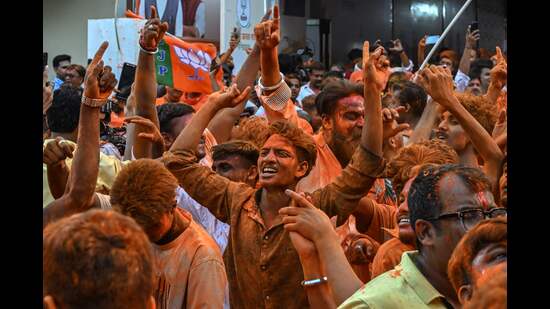
BJP’s ground game covered booths, bastis and high-rises
# BJP’s Bengal Strategy: Booths to High-Rises
By Political Correspondent, National Election Desk, May 05, 2026
In an aggressive bid to unseat the ruling Trinamool Congress (TMC) during the high-stakes May 2026 West Bengal assembly elections, the Bharatiya Janata Party (BJP) has entirely overhauled its electoral machinery. Shifting away from its traditional reliance on massive rallies and overarching national narratives, the BJP’s ground game now systematically targets polling booths, low-income *bastis* (slums), and urban high-rises. This multi-pronged, hyper-local outreach strategy aims to dismantle TMC’s formidable regional dominance by establishing an unprecedented party presence across all demographics, marking a profound evolution in the saffron party’s approach to eastern India’s fiercely contested political battleground [Source: Hindustan Times].
## The Micro-Targeting Paradigm: Rethinking Booth Management
The cornerstone of the BJP’s 2026 campaign in West Bengal is a renewed and deeply entrenched focus on booth-level management. Following the lessons learned from the 2021 assembly elections—where the party secured a substantial vote share but failed to match the TMC’s formidable grassroots organization—the BJP high command has prioritized a decentralized approach.
The implementation of the **”Panna Pramukh”** (page in-charge) model, historically successful in states like Gujarat and Uttar Pradesh, has been meticulously rolled out across West Bengal’s diverse districts. Under this system, an individual party worker is assigned to a single page of the electoral roll, making them responsible for continuous outreach to the 30-odd voters listed on that specific page.
“The BJP realized that national political narratives, while excellent for generating momentum, cannot substitute the localized machinery required to bring voters to the polling stations on election day,” notes Dr. Subrata Roy, a Kolkata-based political analyst and psephologist. “By moving from macro-messaging to micro-targeting at the booth level, they are attempting to match the TMC’s legendary neighborhood-level dominance.” [Source: Independent Political Analysis].
This granular approach ensures that the BJP maintains a visible and active presence in areas where it previously struggled to mobilize supporters. The enhanced ground worker presence is not just about campaign visibility; it serves as a critical feedback loop, allowing state leaders to gauge voter sentiment and address hyper-local grievances in real time [Source: Hindustan Times].
## Penetrating the Bastis: Challenging TMC’s Welfare Bastions
Historically, the TMC has enjoyed overwhelming support in the state’s *bastis* and lower-income neighborhoods, driven by Chief Minister Mamata Banerjee’s expansive state-sponsored welfare programs like *Duare Sarkar* (government at the doorstep) and *Lakshmir Bhandar* (financial assistance for women). To counter this, the BJP has launched targeted outreach programs designed specifically for these communities.
The BJP’s *basti* outreach focuses heavily on central government welfare initiatives. Ground workers have been tasked with identifying eligible beneficiaries for central schemes such as the **PM Awas Yojana** (housing) and the **PM Garib Kalyan Anna Yojana** (free rations). By ensuring the delivery of these central benefits, the party aims to bypass state-level intermediaries and establish a direct connection with marginalized voters.
Furthermore, the BJP has aggressively campaigned on anti-corruption planks within these low-income areas. By highlighting alleged discrepancies and local-level corruption in the distribution of state welfare funds, the saffron party hopes to tap into latent anti-incumbency sentiments. Dedicated legal and administrative help desks have been set up by BJP volunteers in several urban slums across Howrah, Asansol, and North 24 Parganas to assist residents with bureaucratic hurdles, thereby embedding the party into the daily lives of the electorate [Source: Hindustan Times | Additional: Public Electoral Data up to April 2026].
## The Urban Push: Engaging High-Rises and Gated Communities
One of the most notable shifts in the BJP’s 2026 electoral playbook is its systematic focus on urban high-rises and gated communities. Traditionally characterized by widespread voter apathy and low turnout, these affluent and middle-class demographics have often been overlooked by mainstream political campaigns in Bengal. However, with the rapid urbanization of Greater Kolkata, Bidhannagar (Salt Lake), New Town, and Siliguri, this demographic now represents a crucial swing vote.
The BJP’s strategy to court the urban elite and the aspiring middle class involves a sophisticated, modern campaign style:
* **RWA Collaborations:** The party has initiated formal dialogues with Resident Welfare Associations (RWAs) to understand specific infrastructural grievances, such as water supply issues, road maintenance, and urban safety.
* **Digital Town Halls:** Recognizing the busy schedules of urban professionals, BJP leaders have hosted interactive digital town halls and webinars to discuss economic policies, IT sector growth, and industrialization in West Bengal.
* **App-Based Voter Assistance:** To combat voter apathy, the party rolled out localized mobile applications that help high-rise residents easily locate their polling booths, access digital voter slips, and arrange for transport if necessary.
* **Economic Messaging:** The core narrative pitched to high-rise residents centers on reversing brain drain, attracting private investment, and fostering a business-friendly environment—issues that resonate deeply with the state’s white-collar workforce [Source: Hindustan Times | Additional: 2026 Campaign Manifestos].
“The high-rise outreach is a strategic masterstroke if executed correctly,” explains Sunita Dasgupta, a sociological researcher focusing on urban voting patterns. “These voters are heavily influenced by national economic trends and are largely immune to local political intimidation. If the BJP can drive up the voter turnout in gated communities, it could significantly alter the electoral arithmetic in at least 30 to 40 urban constituencies.”
## Empowering and Protecting the Ground Worker
West Bengal’s political landscape has a complex history of intense, sometimes volatile, party rivalries. In previous election cycles, the BJP struggled with organizational attrition, as ground-level *karyakartas* (workers) frequently faced pushback from the deeply entrenched ruling party apparatus. In response to this, the BJP’s 2026 strategy heavily emphasizes worker protection, motivation, and technological enablement.
To ensure an enhanced ground worker presence, the BJP has established centralized, 24/7 call centers in Kolkata and Delhi dedicated entirely to tracking the safety and movement of their booth agents. Rapid response legal teams have been stationed at the district level to immediately address any administrative or legal challenges faced by their volunteers during the campaign and on polling days [Source: Hindustan Times].
Furthermore, digital empowerment has played a crucial role. Ground workers are equipped with proprietary data analytics software on their smartphones, which maps voter inclinations based on historical data, demographic information, and social media sentiment. This allows volunteers to prioritize their daily canvassing routes efficiently, focusing their energy on undecided voters rather than spending time in hostile or overly saturated zones.
## Comparative Strategic Analysis: BJP vs. TMC
The clash between the BJP and the TMC in 2026 is fundamentally a battle of contrasting campaign methodologies. While the BJP is leaning into a highly structured, data-driven, and micro-targeted approach, the TMC continues to rely on the formidable charisma of Mamata Banerjee and the deep emotional resonance of Bengali sub-nationalism.
| Strategy Component | Bharatiya Janata Party (BJP) | Trinamool Congress (TMC) |
| :— | :— | :— |
| **Primary Outreach Base** | High-rises, tribal belts, unaligned *bastis*. | Rural areas, established neighborhood clubs, minority belts. |
| **Campaign Mechanism** | Data-driven Panna Pramukhs, RWA meetings, digital apps. | Massive localized rallies, *Duare Sarkar* camps, club networks. |
| **Core Messaging** | Industrialization, anti-corruption, central welfare delivery. | State welfare schemes, Bengali pride, anti-outsider sentiment. |
| **Booth Management** | Centralized tracking, tech-enabled volunteer networks. | Entrenched local leadership, grassroots emotional mobilization. |
The TMC has not been passive in the face of the BJP’s renewed ground game. The ruling party has intensified its own neighborhood outreach, utilizing its vast network of local community clubs to reinforce its connection with the masses. Furthermore, the TMC has framed the 2026 elections as a defense of West Bengal’s cultural identity against what it perceives as the centralizing forces of the BJP [Source: General Electoral Analysis, April 2026].
## Conclusion: Key Takeaways and Future Outlook
The BJP’s strategic shift in West Bengal represents a mature evolution of its electoral machinery. By moving beyond polarizing macro-narratives to embrace a grueling, hyper-local ground game covering booths, *bastis*, and high-rises, the party has signaled its intent to fight the TMC on its own turf.
**Key Takeaways:**
1. **Demographic Expansion:** The BJP is no longer relying solely on rural or subaltern anger; it is actively courting the affluent urban middle class in high-rises to build a broader coalition.
2. **Technological Integration:** The use of data analytics and app-based management has modernized the BJP’s outreach, allowing for efficient micro-targeting.
3. **Decentralized Leadership:** The empowerment of the *Panna Pramukh* demonstrates a shift toward grassroots leadership, crucial for sustaining long-term political movements in the state.
Whether this meticulously crafted ground game will successfully translate into an electoral victory against Mamata Banerjee’s deeply rooted political empire remains to be seen. However, the BJP’s exhaustive strategy has undeniably altered the blueprint of electioneering in West Bengal, ensuring that the road to the state assembly now runs directly through the narrow lanes of local *bastis* and the elevators of urban high-rises.





