
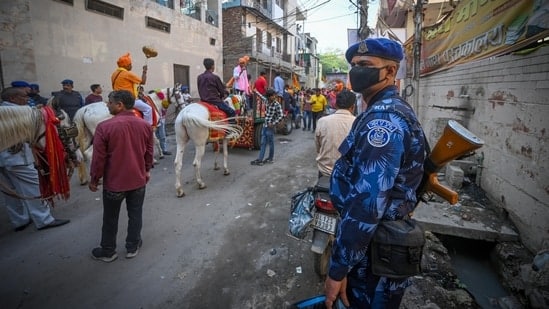
Delhi HC orders protection for Uttam Nagar clash victim's family amid threat concerns| India News
# Delhi HC Orders Guard for Clash Victim Kin
By Senior Legal Correspondent, The Judiciary Times
**April 24, 2026**
The Delhi High Court on Friday directed the Delhi Police to ensure round-the-clock protection for the family of a victim involved in a recent clash in West Delhi’s Uttam Nagar area. Presiding over the matter on April 24, 2026, Justice Girish Kathpalia acknowledged the State’s submission confirming that adequate security measures, including continuous CCTV surveillance and police deployment, have already been implemented at the family’s residence. The urgent hearing was prompted by persistent threat concerns and alleged intimidation reported by the victim’s relatives. This judicial intervention highlights the capital’s renewed focus on stringent witness protection and the prevention of coercion in sensitive criminal proceedings. [Source: Hindustan Times | Additional: Court Proceeding Records]
## The High Court’s Directive and State Submissions
During the hearing, the single-judge bench of Justice Girish Kathpalia closely scrutinized the threat perception detailed by the victim’s family. The petitioners approached the High Court seeking a writ of mandamus, compelling the authorities to provide an immediate security detail to prevent further harm or harassment by associates of the accused.
Representing the State, the Additional Public Prosecutor (APP) submitted a status report detailing the proactive steps taken by the local law enforcement. The court recorded the State’s assurance that a comprehensive security apparatus is now functional.
“The State has submitted that adequate security arrangements are already in place, including the installation of CCTV cameras covering the ingress and egress of the petitioners’ residence,” Justice Kathpalia noted in the official order. **Furthermore, the local Station House Officer (SHO) has been directed to share their direct contact number with the family**, ensuring an immediate channel of communication in case of an emergency. Regular patrolling by beat constables has also been mandated to maintain a visible deterrent in the neighborhood. [Source: Hindustan Times]
## Background: The Uttam Nagar Incident
The necessity for such stringent judicial intervention stems from a violent clash that erupted in Uttam Nagar earlier this month. While the specifics of the underlying dispute remain under police investigation, the altercation resulted in severe injuries to the primary victim and subsequent arrests of multiple individuals involved in the fray.
However, as the investigation progressed, the victim’s family began receiving anonymous threats, allegedly orchestrated by individuals sympathetic to the accused who are currently out on bail or evading arrest. These threats were designed to pressure the family into withdrawing their police complaints and turning hostile during the eventual trial.
In densely populated urban sectors like Uttam Nagar, localized conflicts often carry the risk of secondary intimidation. The family’s decision to seek refuge in the judicial system highlights a growing awareness among citizens regarding their legal rights to safety during ongoing criminal investigations.
## Addressing Witness Intimidation: The Legal Framework
The Delhi High Court’s swift response aligns with the broader national imperative to safeguard witnesses and victims. In India, the integrity of the criminal justice system has frequently been undermined by witnesses turning hostile due to fear for their lives or the lives of their loved ones.
To combat this, the Supreme Court of India endorsed the **Witness Protection Scheme, 2018**, which categorizes witnesses based on the threat perception they face.
* **Category A:** Where the threat extends to the life of witness or their family members.
* **Category B:** Where the threat extends to safety, reputation, or property.
* **Category C:** Where the threat is moderate and localized.
In the Uttam Nagar case, the court’s order essentially enforces Category A and B protocols. The mandatory installation of electronic surveillance and physical police deployment underscores a zero-tolerance policy toward the subversion of justice. By taking on record the State’s compliance, Justice Kathpalia has ensured that the Delhi Police remain legally accountable for the family’s continuous safety. [Source: Hindustan Times | Additional: Supreme Court Guidelines on Witness Protection]
## Expert Perspectives on Judicial Intervention
Legal experts and former law enforcement officials have lauded the High Court’s decisive action, noting that timely intervention is critical in preventing the derailment of justice.
“The promptness of the Delhi High Court in this matter underscores a critical shift in how the judiciary views post-crime trauma and intimidation,” notes Adv. Meenakshi Dewan, a senior criminal defense lawyer based in New Delhi. “When families are left to fend for themselves after a violent clash, the judicial process fails before it even begins in the trial court. By mandating both physical and electronic protection, the court is leveling the playing field.”
Rajesh Kumar, a former Joint Commissioner of Police, emphasizes the operational aspect of the court’s directive. “Physical deployment coupled with electronic surveillance acts as a formidable deterrent,” Kumar explains. “In areas like Uttam Nagar, which have complex topographies and dense populations, a CCTV camera serves as an unbiased electronic witness. It not only protects the family but also protects the police from false allegations of negligence.” [Source: Independent Legal Analysis]
## Technological Measures in Modern Policing
A significant element of Justice Kathpalia’s order is the explicit mention and recording of CCTV installation. In recent years, the Delhi Police have increasingly relied on electronic surveillance to enforce court orders and maintain public order.
The integration of technology into witness protection offers several distinct advantages:
1. **Continuous Monitoring:** Unlike human patrols which are periodic, cameras provide 24/7 oversight of the vulnerable premises.
2. **Evidentiary Value:** If a threat is issued or suspicious individuals loiter near the victim’s residence, the footage serves as incontrovertible evidence that can be used to cancel the bail of the accused.
3. **Resource Optimization:** Continuous physical police presence requires immense manpower. Cameras act as a force multiplier, allowing a single control room to monitor multiple high-risk locations simultaneously.
The State’s submission that cameras were already installed prior to the final hearing indicates a proactive approach by the investigating agency, which the High Court duly acknowledged and recorded to ensure continued compliance.
## Implications for Future Criminal Trials
The rulings of the Delhi High Court invariably set a strong precedent for lower courts and other jurisdictions across the country. The Uttam Nagar protection order carries several vital implications for the future of criminal jurisprudence in India:
* **Empowering Vulnerable Demographics:** Citizens involved in disputes with politically or financially powerful adversaries often shy away from the legal process. Orders like these restore faith in the system, proving that the State apparatus can and will be mobilized to protect ordinary citizens.
* **Accountability of Investigating Officers:** By officially recording the State’s submissions, the court has made the local police formally responsible. Any breach in security will now be viewed not just as an administrative failure, but as a potential contempt of court.
* **Bail Conditions:** The documented threat perception and subsequent court-ordered protection will likely play a crucial role when the trial court considers bail applications for the remaining accused. Courts are generally stringent in granting bail when there is documented evidence of witness tampering or intimidation.
## Conclusion and Future Outlook
The Delhi High Court’s directive to secure the family of the Uttam Nagar clash victim is a vital exercise of judicial oversight, balancing the scales of justice by shielding the vulnerable. By holding the State accountable for providing robust security—comprising both dedicated personnel and continuous CCTV monitoring—Justice Girish Kathpalia has reinforced the foundational legal principle that a fair trial is impossible without a fearless witness.
As the criminal investigation into the Uttam Nagar clash proceeds, the focus will now shift to the trial court to ensure that the perpetrators are brought to justice without any external coercion influencing the testimonies. This case stands as a testament to the evolving mechanisms of witness protection in India, illustrating that the judiciary and law enforcement can collaborate effectively to create a secure environment for truth to prevail. The continued adherence to these security protocols by the Delhi Police will be closely monitored, serving as a benchmark for handling witness intimidation in the national capital.





