
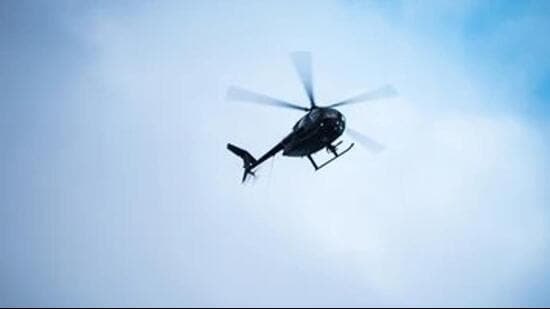
Probe ordered after Coast Guard chopper seen flying low over Sabarimala temple: Police| India News
# Chopper Over Sabarimala: Probe Ordered
**By Senior Correspondent, National News Desk, April 24, 2026**
A formal police investigation has been launched in Kerala after an Indian Coast Guard (ICG) helicopter was spotted flying at an unusually low altitude over the sacred Sabarimala temple on Friday afternoon. The sudden appearance of the military-grade aircraft over the highly sensitive and heavily guarded Hindu shrine in the Pathanamthitta district triggered immediate security alerts among temple administrators. According to official statements from the Indian Coast Guard, the helicopter was engaged in a routine training sortie originating from Kochi. Authorities explained that the pilots were forced to drastically lower their altitude and alter their flight path directly over the temple complex due to sudden high cloud formations and rapidly deteriorating weather conditions in the Western Ghats. [Source: Hindustan Times | Additional: Kerala State Police Statements].
## The Incident: A Sudden Aviation Deviation
The incident occurred early Friday afternoon, a time when the weather dynamics over the Western Ghats can shift unpredictably. Eyewitnesses and on-duty security personnel at the Sabarimala Sannidhanam (the main temple complex) reported hearing the heavy rotor wash of an approaching helicopter before spotting the aircraft breaking through the low-hanging cloud cover.
Given the remote location of Sabarimala, which is nestled deep within the dense forests of the Periyar Tiger Reserve, unauthorized aerial activity is exceptionally rare and strictly monitored. The low-altitude flyover immediately prompted the Travancore Devaswom Board (TDB), the autonomous body that manages the shrine, to notify the local police and state intelligence units.
The Indian Coast Guard quickly issued a clarification to defuse the growing security concerns. According to the ICG’s regional command based in Kochi, the helicopter—reportedly an Advanced Light Helicopter (ALH) Dhruv—was not conducting any surveillance or unapproved maneuvers.
“The aircraft was on a scheduled, routine training sortie inland. As the crew approached the forested hilly terrain, they encountered unexpected high clouds and a sudden drop in visibility,” noted a preliminary summary of the event provided by defense sources. “To maintain visual reference with the ground and ensure the safety of the aircraft and crew, the pilots were compelled to descend, which inadvertently brought them over the temple airspace.” [Source: Hindustan Times].
## Navigating the Unpredictable Western Ghats
Aviation experts note that flying rotary-wing aircraft over the Western Ghats during the pre-monsoon season presents significant meteorological challenges. April in Kerala is characterized by intense heat and humidity, which frequently results in sudden, localized convective cloud buildups—commonly known as ‘Mango showers’.
These rapid weather changes can force pilots flying under Visual Flight Rules (VFR) to immediately drop altitude to avoid flying blindly into cumulonimbus storm clouds, which pose extreme risks of turbulence, lightning, and disorientation.
“When a helicopter is caught in rapidly deteriorating weather over mountainous terrain, the standard operating procedure is to seek a lower altitude to maintain a visual line of sight with the ground,” explained Capt. Rajiv Menon, a retired military aviator and independent aviation safety consultant. “The Sabarimala temple sits in a valley-like depression surrounded by hills. If a pilot is pushed down by a cloud ceiling, passing over that specific coordinate might become unavoidable to safely exit the weather system.” [Source: Independent Aviation Expert Analysis].
## Sabarimala’s Unique Security Dynamics
Despite the plausible meteorological explanation, the Kerala Police are leaving nothing to chance. Sabarimala is not merely a religious site; it is considered one of the highest-security zones in southern India. During the peak Mandala-Makaravilakku pilgrimage season, the temple attracts millions of devotees, necessitating vast deployments of state police, rapid action forces, and disaster management teams.
Even during the off-season or monthly pooja periods, the shrine remains under strict surveillance due to historic threat perceptions from extremist groups and the sheer logistical complexity of protecting a site located deep within a tiger reserve.
Airspace over critical religious sites in India is often heavily restricted, although formally gazetted “No-Fly Zones” (NFZs) are reserved for a select few locations like the Taj Mahal, Parliament House, and specific defense installations. However, aviation authorities generally issue advisories requesting civilian and military aircraft to maintain a minimum clearance altitude over major religious congregations to prevent panic, noise disturbance, and potential security breaches.
## The Scope of the Police Investigation
The probe ordered by the local police aims to officially verify the sequence of events and ensure there were no lapses in inter-agency communication. Authorities will likely examine a variety of data points to close the investigation.
**Key areas of the police probe will include:**
* **Flight Data Verification:** Cross-referencing the helicopter’s GPS and altimeter logs with Air Traffic Control (ATC) radar data from Thiruvananthapuram and Kochi to confirm the altitude and exact flight path.
* **Meteorological Reports:** Analyzing local weather data at the exact time of the flyover to corroborate the pilot’s claim of sudden cloud cover and poor visibility.
* **Communication Logs:** Reviewing the radio transmissions between the Coast Guard pilots and the regional ATC to see when the weather deviation was first reported.
* **Standard Operating Procedures (SOPs):** Evaluating whether the Coast Guard crew followed proper protocols for reporting an emergency deviation over a sensitive civilian area.
“The police investigation is standard protocol whenever there is an unexplained breach of the airspace over Sabarimala,” stated Dr. V. R. Nair, a former Kerala police official specializing in state security. “The intention is not to penalize the Coast Guard, but to formalize the incident report, rule out any malicious intent, and update our security matrix. When the local police hear a low-flying chopper that isn’t on their daily VIP or medical evacuation schedule, they are obligated to investigate.” [Source: Security Operations Context].
## Ecological and Environmental Concerns
Beyond the immediate security and religious sensitivities, the incident has highlighted ongoing ecological concerns regarding aerial activity over the Periyar Tiger Reserve. The dense forests surrounding the Sabarimala temple are home to a fragile ecosystem, including endangered Bengal tigers, Indian elephants, and unique avian species.
The Supreme Court of India and the Kerala High Court have previously issued stringent guidelines regarding noise pollution, artificial lighting, and human interference in the Sabarimala region to balance religious rights with wildlife conservation. Low-flying helicopters generate immense acoustic footprints—often exceeding 100 decibels—which can cause severe panic among wildlife, leading to stampedes or the abandonment of habitats.
While emergency medical evacuations and official VIP transport (such as for the Chief Minister or central dignitaries) are occasionally permitted via the designated helipads in Nilakkal, routine training flights are generally routed away from the core zones of the tiger reserve to minimize acoustic trauma to the fauna. The outcome of the police probe will likely be shared with the State Forest Department to assess if any ecological disruption occurred. [Source: Kerala High Court Directives on Sabarimala Ecosystem].
## Coast Guard Aviation Protocols
The Indian Coast Guard’s aviation wing plays a critical role in maritime reconnaissance, search and rescue (SAR), and coastal security. Operating primarily out of the ICG Air Enclave in Kochi, their aircrews must be highly proficient in both over-water and overland navigation.
Training sorties inland over the varied topography of Kerala are essential for preparing pilots to execute SAR missions during natural disasters, such as the devastating floods and landslides that struck the state in recent years. During these real-world emergencies, Coast Guard helicopters must frequently navigate the treacherous, cloud-covered valleys of the Western Ghats to rescue stranded civilians.
Therefore, while the deviation over Sabarimala was unintended, the inland route itself was part of necessary operational readiness training. Defense sources have reiterated that safety is the paramount concern in military aviation, and the pilot’s decision to descend rather than risk spatial disorientation in the clouds was technically sound.
## Conclusion: Balancing Security and Aviation Safety
The incident over Sabarimala temple underscores the delicate balance between aviation safety, religious sanctity, and high-level security protocols. While the sudden appearance of the Coast Guard helicopter understandably triggered alarm among the Travancore Devaswom Board and the Kerala Police, the initial evidence strongly points to a weather-induced emergency maneuver rather than a lapse in discipline or a security threat.
The ongoing police probe is expected to conclude rapidly once the flight data and meteorological reports are cross-verified. The primary takeaway from this event will likely be a renewed discussion between civil aviation authorities, the Ministry of Defence, and state temple administrations regarding flight corridors.
Moving forward, there may be calls to establish a more robust real-time communication channel between military ATC units and the local police command centers at sensitive sites like Sabarimala. If an aircraft is forced to deviate into a highly secure airspace due to weather, an immediate automated alert to ground security forces could prevent panic and save valuable investigative resources in the future.
As pre-monsoon weather patterns continue to cause unpredictable conditions across southern India, aviation crews and ground authorities alike must remain vigilant and deeply coordinated to ensure both the safety of the skies and the sanctity of the ground below.





