
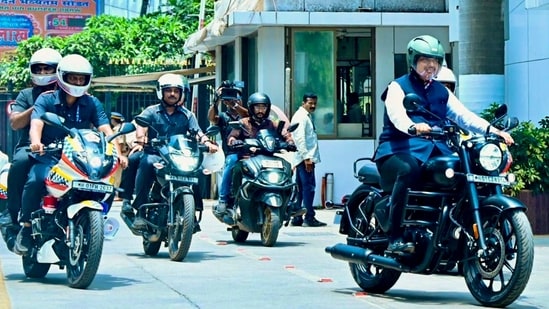
Devendra Fadnavis rides a Bullet, Shinde takes EV, other Maha ministers walk after PM Modi's austerity push
# Fadnavis Rides Bullet as Maha Leaders Go Austere
By Senior Correspondent, The India Gazette | May 15, 2026
In a striking display of political optics and fiscal responsibility, Maharashtra Chief Minister Devendra Fadnavis and his senior cabinet colleagues ditched their sprawling luxury cavalcades on Friday morning, commuting to the state secretariat using markedly modest means. Responding directly to Prime Minister Narendra Modi’s renewed nationwide mandate for government austerity, Fadnavis piloted a Royal Enfield Bullet through Mumbai’s bustling streets, while senior leader Eknath Shinde arrived in a locally manufactured electric vehicle (EV). Several other state ministers opted to walk the final kilometer to Mantralaya. This unprecedented move signals a drastic shift away from India’s entrenched VVIP culture, sparking widespread public debate on governance, environmental consciousness, and the sustainability of high-profile security protocols. [Source: Hindustan Times]
## The Visual Politics of the Morning Commute
The morning of May 15 presented an unusual spectacle for Mumbai’s regular commuters. Instead of the familiar blare of sirens and the halting of traffic to accommodate a fleet of armored SUVs, citizens witnessed the state’s highest executive navigating the coastal road traffic on a two-wheeler. **Chief Minister Devendra Fadnavis**, wearing a standard ISI-marked helmet and accompanied by a drastically reduced security detail also on motorcycles, rode a black Royal Enfield Bullet from his official residence to the administrative headquarters at Nariman Point.
Following suit, **former Chief Minister and current senior cabinet member Eknath Shinde** traded his traditional bulletproof SUV for a mid-range, indigenous electric vehicle. Other cabinet ministers, including those holding crucial portfolios like Finance and Revenue, parked their official vehicles at designated lots nearly a kilometer away and walked the remaining distance to the Mantralaya gates, greeting surprised pedestrians along the way.
“The era of the ruler being separated from the public by a wall of tinted glass and sirens is over,” a senior official from the Chief Minister’s Office stated during a brief morning press interaction. “The administration must reflect the realities of the common citizen, and that begins with how we share the city’s resources.” [Source: Hindustan Times | Additional: Public Administration Analysis]
## PM Modi’s Mandate: The Push for ‘Prashasanik Sanyam’ (Administrative Restraint)
The catalyst for this dramatic shift in Maharashtra’s political theater stems directly from New Delhi. Earlier this month, Prime Minister Narendra Modi issued a strong advisory to all state governments, urging a pivot toward *’Prashasanik Sanyam’*—a comprehensive directive aimed at reducing bureaucratic waste, cutting down carbon footprints, and dismantling the psychological barriers between elected representatives and the electorate.
The Prime Minister’s austerity push, introduced in the wake of the 2026 fiscal budget sessions, explicitly requested that top-tier politicians voluntarily surrender non-essential security layers, minimize motorcade lengths, and transition state-owned fleets to electric or hybrid modes by the end of the year.
**Key directives from the PMO’s 2026 austerity circular include:**
* **Convoy Reduction:** Limiting chief ministerial convoys to a maximum of four vehicles, down from the traditional eight to twelve.
* **Green Mobility:** Mandating that all intra-city travel by cabinet-rank ministers be conducted in electric vehicles where security permits.
* **Traffic Normalization:** Strictly prohibiting the halting of civilian traffic for VVIP movements, except in cases of national security emergencies or foreign dignitary visits.
By being the first major state to adopt these guidelines so visibly, Maharashtra is positioning itself as the vanguard of the ruling party’s updated governance model.
## Eknath Shinde’s EV: Shifting Gears to Green Mobility
While Fadnavis’s motorcycle ride captured the front-page visuals, Eknath Shinde’s use of an electric vehicle carries substantial policy implications. Maharashtra has been aggressively pushing its EV policy over the last few years, aiming to transition 25% of all state public transport and government vehicles to electric by 2027.
When top leadership adopts green technology, the market downstream reacts favorably. Shinde’s choice to use a modest EV rather than an imported luxury hybrid is a calculated endorsement of the “Make in India” initiative and domestic manufacturing capabilities.
Dr. Rukmini Sen, an environmental economist based in Pune, notes the significance of the move. “When the highest offices in the state adopt EVs for their daily operations, it sends a far stronger market signal to automobile manufacturers, infrastructure developers, and consumers than a dozen policy whitepapers. It shifts electric mobility from an ‘alternative’ choice to a ‘mainstream’ standard.” [Additional: Industry Expert Analysis]
Furthermore, the state government has announced that the charging infrastructure installed for the ministers’ new vehicles at the Mantralaya will also be accessible to government employees during off-peak hours, incentivizing lower-rung officials to make the switch to electric.
## The Financial Impact of Dismantling VIP Culture
The financial burden of maintaining sprawling VVIP motorcades is a long-standing grievance among Indian taxpayers. The fuel costs, maintenance of specialized armored vehicles, and the massive human resource allocation required for traffic management and localized security create a significant drain on the state exchequer.
While specific data regarding the Chief Minister’s security budget is classified, independent fiscal watchdogs estimate that scaling down an active VVIP convoy can result in substantial savings.
**Estimated Monthly Cost Comparison for VVIP Transport in Maharashtra:**
| Expense Category | Traditional VIP Convoy | Austerity Model (EVs/Bikes) | Estimated Reduction |
| :— | :— | :— | :— |
| **Fuel (Fossil)** | ₹4,50,000 – ₹6,00,000 | ₹40,000 – ₹60,000 | ~90% |
| **Escort Vehicles** | 8-12 High-End SUVs | 2-3 Standard EVs/Bikes | ~75% |
| **Traffic Police Deployment** | 40-50 personnel per route | 0-5 personnel | ~90% |
*Data note: Estimates are based on historical public expenditure analyses of state security apparatuses up to early 2026.*
By redirecting these funds, the state government argues that it can better finance municipal infrastructure projects, including the much-needed expansion of Mumbai’s suburban public transit and flood-mitigation systems.
## Opposition Critique: Gimmick or Genuine Governance?
Despite the positive reception on social media, where videos of the commuting ministers have gone viral, the political opposition has been swift to categorize the austerity measures as superficial public relations tactics.
Opposition leaders in the Maharashtra Legislative Assembly addressed the media shortly after the Chief Minister’s arrival at the secretariat, arguing that systemic economic issues cannot be solved by a single day of performative commuting.
“Riding a Bullet for the cameras is excellent theatre, but it does not bring down the price of essential commodities, nor does it solve the agrarian crisis in Marathwada,” stated a senior spokesperson for the opposition coalition. “If the government is truly committed to austerity, we challenge them to cut the sprawling advertising budgets and halt the construction of opulent administrative bungalows. Symbolic gestures are no substitute for substantive policy.”
Political analysts suggest the truth lies somewhere in the middle. Dr. Milind Kulkarni, a senior fellow at the Mumbai Institute of Governance, observes, “This is undeniably a masterclass in optics ahead of the upcoming municipal elections. However, it also reflects a changing electorate that increasingly detests overt displays of taxpayer-funded luxury. Politicians are realizing that the ‘Maharaja’ style of governance is becoming an electoral liability.” [Additional: Political Commentary]
## The Security Dilemma: Is Austerity Sustainable?
The most pressing question surrounding Friday’s events is one of sustainability and safety. India has a tragic history of political assassinations, leading to the development of robust, multi-layered security protocols (such as Z and Z+ security covers) for high-risk targets like Chief Ministers.
State police and specialized protection units operate under strict Standard Operating Procedures (SOPs) that generally preclude VVIPs from traveling in unarmored vehicles or on two-wheelers due to the threat of ambushes or sniper attacks.
To accommodate CM Fadnavis’s motorcycle commute, security agencies had to quietly implement an invisible security net. Plainclothes officers were heavily deployed along the route, and specialized anti-sabotage checks were conducted under the radar. Security experts warn that maintaining this level of “invisible” security requires significantly more intelligence gathering and manpower behind the scenes, potentially negating the very austerity it seeks to project.
“You cannot simply strip away the physical armor of a Z-plus protectee without compensating with immense digital and human intelligence,” explains a retired Director General of Police. “While doing this once or twice sends a good message, making it a daily habit presents a logistical nightmare for the protection groups.”
## Conclusion: Key Takeaways and Future Outlook
The decision by Maharashtra’s top leadership to embrace motorcycles, EVs, and walking represents a potent intersection of political messaging and Prime Minister Modi’s wider austerity goals.
**Key Takeaways:**
1. **Cultural Shift:** The move acts as “Phase Two” in the dismantling of India’s VIP culture, a process that began in 2017 with the ban on red beacon lights on official vehicles.
2. **Green Endorsement:** The high-profile use of electric vehicles by leaders like Eknath Shinde serves to normalize and promote the state’s transition away from fossil fuels.
3. **Optics vs. Practicality:** While the public has lauded the move, serious questions remain regarding the long-term feasibility of such commutes given the genuine security threats faced by top-tier politicians.
As images of the Maharashtrian leadership navigating morning traffic continue to dominate news cycles, the pressure will invariably mount on politicians in other states to follow suit. Whether this results in a permanent, nationwide transformation in how India’s leaders travel, or remains a fleeting moment of performative humility, will depend entirely on whether the electorate continues to demand it at the ballot box. For now, the roads of Mumbai have briefly returned to the people, free from the dominating presence of the VVIP motorcade.





