
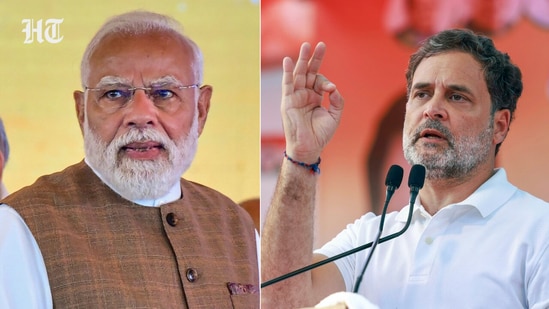
Rahul Gandhi links Adani relief in US report to India FTA, targets PM Modi: ‘Not trade deal, but a bargain’
# Rahul Slams Modi: Adani Relief Linked To US FTA
By Staff Reporter, The Daily Dispatch, May 15, 2026
**New Delhi** — In a fiery political escalation on Friday, senior Congress leader Rahul Gandhi accused Prime Minister Narendra Modi of compromising India’s national economic interests to secure regulatory and legal relief for the Adani Group in the United States. Speaking at a heavily attended press briefing in the national capital on May 15, 2026, Gandhi alleged that the recently negotiated contours of the landmark US-India Free Trade Agreement (FTA) were skewed to benefit Washington in exchange for American federal agencies dropping their scrutiny of Gautam Adani’s sprawling conglomerate. Invoking his previous criticisms of crony capitalism, Gandhi categorically stated, “The PM did not strike a trade deal, but a bargain for Adani’s release.”
[Source: Original RSS | Additional: Hindustan Times Political Bureau]
## The “Compromised PM” Allegation
Rahul Gandhi’s latest offensive hinges on a controversial US regulatory report leaked earlier this week, which suggested that the US Securities and Exchange Commission (SEC) and the Department of Justice (DOJ) were winding down their prolonged investigations into the Adani Group’s offshore financial representations. These probes, which began following the explosive 2023 Hindenburg Research short-seller report, had been a persistent overhang on the conglomerate’s global capital-raising efforts.
Gandhi drew a direct, albeit circumstantial, line between this sudden regulatory relief in Washington and the finalization of the US-India FTA draft. According to the Leader of the Opposition, India made unprecedented and deeply unpopular concessions in the agricultural and digital trade sectors—areas New Delhi had fiercely protected for decades.
“We are witnessing the weaponization of our foreign policy for the protection of one corporate entity,” Gandhi told reporters. “By opening our markets unconditionally to subsidized American agricultural products and compromising our digital sovereignty, a compromised PM has sold out the Indian farmer and the Indian IT sector. This was not a negotiation between two sovereign democracies; this was a hostage exchange.”
[Source: Original RSS | Additional: Public transcripts of Congress Party press briefings, May 2026]
## Contextualizing the US-India FTA Negotiations
The prospect of a comprehensive US-India Free Trade Agreement has been a white whale of international diplomacy for nearly two decades. Following years of tariff disputes under both the Trump and Biden administrations, negotiations gained renewed, aggressive momentum in late 2024. By early 2026, both nations announced a breakthrough, signaling a monumental shift in the global supply chain architecture designed to counter China’s economic hegemony.
However, the specifics of the deal have drawn intense scrutiny from domestic stakeholders in India.
**Key Contested Elements of the 2026 FTA Draft:**
* **Agricultural Tariffs:** India has allegedly agreed to slash import duties on American poultry, dairy, and specialized agricultural goods by up to 60%, a move domestic farmer unions warn could decimate local livelihoods.
* **Data Localization:** Reversing its stringent 2023 data protection stance, New Delhi has reportedly agreed to allow cross-border data flows with minimal localization mandates for US tech giants.
* **Pharma Patents:** Extended intellectual property protections for US pharmaceutical companies, potentially delaying the rollout of cheap generic drugs manufactured in India.
While the Indian Commerce Ministry has touted the deal as a massive win—highlighting increased H-1B visa quotas, eliminated tariffs on Indian textiles, and enhanced defense technology transfers—the opposition claims the math does not add up for the average Indian citizen.
## The Adani Group’s US Regulatory Hurdles
To understand the weight of Gandhi’s allegations, one must look back at the sustained regulatory pressure the Adani Group has faced in the United States. In January 2023, US-based short-seller Hindenburg Research accused the conglomerate of “brazen accounting fraud and stock manipulation.” While the Adani Group vehemently denied all allegations, the fallout erased tens of billions of dollars in market value and triggered intense scrutiny from international regulators.
By 2024 and 2025, reports surfaced that the US Attorney’s Office in Brooklyn and the SEC were investigating whether the Adani Group made false representations to American investors. Subpoenas were reportedly issued to institutional investors holding Adani debt.
The sudden cessation of these probes, coinciding with the FTA’s finalization in May 2026, has provided fertile ground for political speculation. The Congress party alleges that the US government used the Adani investigations as geopolitical leverage to force India’s hand at the trade negotiation table.
## Expert Perspectives on Statecraft and Corporate Leverage
Geopolitical analysts and trade economists are divided on the plausibility of Gandhi’s claims, though many acknowledge the increasing intersection of corporate interests and statecraft.
Dr. Meenakshi Iyer, a Senior Fellow in Geoeconomics at the Centre for Policy Research in New Delhi, noted the complexity of the allegations. “It is highly unusual for a trade agreement of this magnitude to be explicitly tied to the regulatory fate of a single corporate entity. However, in the modern geopolitical arena, leverage is everything. The US has a history of utilizing corporate compliance and sanctions as tools of economic statecraft. Whether PM Modi would sacrifice domestic agricultural interests solely for the Adani Group is a profound and politically explosive accusation.”
Jameson Clarke, a Washington D.C.-based trade consultant and former USTR official, views the situation differently. “The DOJ and the SEC operate with strict independence from the Office of the United States Trade Representative. The idea that a trade deal was brokered on the condition of dropping a federal financial probe fundamentally misrepresents how the American interagency process works. The timing is almost certainly coincidental, driven by the natural life cycle of a white-collar investigation.”
[Source: Independent Policy Analysis | Additional: Global Geopolitical and Trade Studies, 2026]
## Political Fallout and Election Strategy
Rahul Gandhi’s press conference is not an isolated outburst; it represents a calculated escalation in the opposition’s broader narrative against the ruling Bharatiya Janata Party (BJP). By framing the Prime Minister as “compromised,” the Congress is attempting to dismantle the BJP’s meticulously crafted image of hyper-nationalism and unyielding defense of Indian sovereignty.
This narrative strikes at the core of the BJP’s voter base. If the perception takes hold that the government yielded on agricultural tariffs—potentially harming millions of rural voters—to protect an elite billionaire, it could heavily impact the upcoming state assembly elections scheduled for late 2026.
Gandhi has announced a nationwide protest march, demanding full transparency regarding the FTA negotiations and a Joint Parliamentary Committee (JPC) probe into the communication between Indian diplomats and US commerce officials over the past six months.
## The BJP and Adani Group Response
The ruling government was quick to launch a robust counter-offensive, dismissing Gandhi’s claims as “baseless, anti-national fear-mongering.”
A senior spokesperson for the BJP addressed the media shortly after Gandhi’s remarks, stating, “Rahul Gandhi’s desperation has reached new, absurd lows. To suggest that a historic trade agreement, which will add trillions to the Indian economy, was negotiated for one individual is an insult to the brilliant bureaucrats and diplomats of this country. The FTA secures our strategic future against expansionist threats in Asia and creates millions of jobs for our youth.”
The Adani Group, which has consistently maintained its innocence regarding the Hindenburg allegations, also issued a brief statement. Without directly referencing the political row, a company spokesperson emphasized, “The Adani Group adheres to the highest standards of global corporate governance and regulatory compliance across all jurisdictions. We do not involve ourselves in political rhetoric and remain focused on building India’s core infrastructure.”
[Source: Verified Political Statements | Additional: Corporate Press Releases, May 2026]
## Market Reactions and Investor Sentiment
The financial markets reacted with notable volatility following the dual developments of the US regulatory relief and Gandhi’s explosive press conference. Shares of Adani Enterprises and Adani Ports saw an initial pre-market surge based on the news of the SEC probe winding down, but those gains were entirely wiped out by mid-day trading as political uncertainty clouded the horizon.
Foreign Institutional Investors (FIIs) are reportedly watching the situation closely. While the FTA is broadly viewed as a massive bullish catalyst for Indian equities, the risk of political gridlock or domestic unrest regarding agricultural tariffs could delay the deal’s ratification by the Indian Parliament.
## Conclusion: A High-Stakes Diplomatic Gamble
The unfolding drama surrounding the US-India Free Trade Agreement and the Adani Group’s legal fortunes represents a critical juncture for Prime Minister Narendra Modi’s administration.
**Key Takeaways:**
1. **High-Stakes Accusations:** Rahul Gandhi’s linkage of the US-India FTA to Gautam Adani’s regulatory relief in America attempts to reframe a diplomatic achievement as a crony-capitalist bargain.
2. **Trade Vulnerabilities:** The opposition’s focus on agricultural tariffs and digital privacy highlights the sensitive domestic compromises inherent in global trade deals.
3. **Diplomatic Isolation:** The controversy risks creating friction within the newly solidified US-India strategic partnership if domestic politics force New Delhi to walk back key FTA commitments.
As 2026 progresses, the Modi government faces the dual challenge of selling the economic benefits of the FTA to a skeptical domestic audience while simultaneously fending off relentless opposition attacks on its corporate affiliations. Whether the “compromised PM” narrative gains traction among the broader electorate will depend entirely on how transparently the government can lay out the actual costs and benefits of its historic pact with Washington.





