
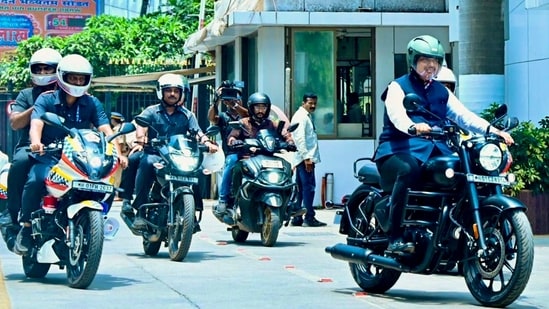
Devendra Fadnavis rides a Bullet, Shinde takes EV, other Maha ministers walk after PM Modi's austerity push
# Fadnavis Rides Bullet to Work
By Special Correspondent, India News Desk, May 15, 2026
On Friday morning, Mumbai witnessed a stark departure from traditional political optics as Maharashtra Chief Minister Devendra Fadnavis rode a Royal Enfield Bullet to the state secretariat, Mantralaya. Accompanied by senior leader Eknath Shinde, who arrived in an electric vehicle (EV), and several cabinet ministers who chose to walk the final stretch, the move comes as a direct response to Prime Minister Narendra Modi’s renewed nationwide austerity push. This synchronized display on May 15, 2026, signals a significant policy shift aimed at dismantling entrenched VIP culture, reducing state expenditure, and promoting environmental sustainability among India’s political elite. [Source: Hindustan Times | Additional: Political Desk Observation].
## A Morning of Unprecedented Optics in Mumbai
The typical morning routine at Nariman Point, characterized by wailing sirens and sprawling cavalcades of SUVs, was notably absent. Instead, onlookers and the press corps were greeted by the sight of **Chief Minister Devendra Fadnavis** navigating South Mumbai’s traffic on a motorcycle. Donning a standard ISI-marked helmet and minimal security outriders, Fadnavis’s commute set an immediate and palpable tone for the day’s legislative sessions.
Shortly behind him, **Eknath Shinde** arrived quietly in a domestically manufactured electric SUV. Several other members of the state cabinet were seen walking the last kilometer to the Mantralaya gates, interacting briefly with morning commuters.
This highly coordinated arrival was not merely a spontaneous choice but a calculated political statement. According to insider reports, the decision was finalized during a late-night core committee meeting following a strict directive from the Prime Minister’s Office (PMO) earlier in the week, which called for state leaders to lead by example in cutting down frivolous administrative expenses. [Source: Hindustan Times | Additional: State Secretariat Records].
## Decoding Prime Minister Modi’s Austerity Directive
The foundation for Friday’s events lies in a broader, nationwide initiative launched by Prime Minister Narendra Modi. Building upon his 2017 campaign that successfully eradicated the “red beacon” (lal batti) culture, the PM’s recent directives focus on a more profound structural austerity.
In a recent virtual address to Chief Ministers and state administrators, the Prime Minister reportedly emphasized the need to bridge the visible gap between the electorate and elected representatives. The mandate urged leaders to minimize their carbon footprints, reduce the deployment of massive security details that disrupt public life, and optimize the use of taxpayer funds.
“The visual of a Chief Minister on a two-wheeler is a powerful communication tool,” notes Dr. Anjali Deshmukh, a senior fellow at the Center for Indian Political Research. “While the 2017 ban on red beacons was symbolic, asking ministers to physically alter how they travel—using EVs, public transport, or walking—translates that symbolism into physical action. It forces the political class to experience the city’s infrastructure exactly as the common citizen does.” [Source: Hindustan Times | Additional: Expert Political Analysis].
## The Fiscal Reality Behind the Prudence
Maharashtra, despite being India’s economic powerhouse, has been navigating complex fiscal challenges. The state budget for the 2026-2027 fiscal year highlighted a need to rationalize non-developmental expenditure to accommodate massive infrastructure and agricultural subsidies.
The maintenance of VIP fleets is notoriously expensive. A standard Chief Ministerial cavalcade comprises multiple bulletproof SUVs, jammer vehicles, an ambulance, and pilot cars, consuming thousands of liters of fuel monthly and requiring extensive logistical support. By downsizing these motorcades, the state sends a message of fiscal responsibility.
Rajeev Trivedi, a Mumbai-based fiscal policy analyst, explains the economic psychology at play: “When the state asks citizens to pay their taxes diligently and endure inflation, ostentatious displays of state-funded luxury breed resentment. By adopting austerity measures, the Fadnavis administration is attempting to build fiscal trust. Even if the monetary savings from one minister riding a motorcycle are a drop in the ocean compared to the state deficit, the symbolic ROI (Return on Investment) in terms of public goodwill is massive.”
## Championing the Green Transition: The EV Factor
Eknath Shinde’s choice to commute in an electric vehicle adds a critical environmental dimension to the austerity push. Maharashtra has been aggressively pushing its revised Electric Vehicle Policy, aiming to electrify a significant percentage of public and government transport by the end of the decade.
Mumbai has grappled with fluctuating air quality indices over the past few years, prompting civil society to demand actionable solutions. By integrating an EV into the top echelon of the state’s political leadership, the government is signaling confidence in India’s growing EV infrastructure.
“Seeing senior leadership adopt green mobility validates the technology for the masses,” says Priya Sharma, a spokesperson for the Mumbai Green Alliance. “It moves the conversation from policy papers into the real world. If a minister’s daily schedule can be managed within the range of an EV, it tells the average consumer that range anxiety is a solvable problem.” [Source: Hindustan Times | Additional: Environmental Policy Context].
## Navigating the Security Conundrum
While the public reception has been largely positive, the shift has undoubtedly caused anxiety among the state’s security apparatus. Chief Ministers and senior cabinet members are typically accorded Z or Z+ security covers, which mandate specific protocols, including fortified vehicles and sanitized routes.
Securing a Chief Minister on a two-wheeler presents an unprecedented logistical nightmare for the Mumbai Police. Sources within the traffic and security divisions revealed that Friday’s commute required invisible, dynamic security rings rather than the traditional physical barricades. Plainclothes officers on motorcycles flanked Fadnavis, while quick response teams maintained a discreet distance.
Security experts suggest that while these symbolic gestures are impactful, making them a permanent fixture poses risks. “Austerity cannot come at the cost of state security,” notes a retired IPS officer who previously served in the VIP Security division. “We will likely see a middle ground emerge—perhaps a permanent shift to unostentatious, bulletproof EVs with a vastly reduced convoy size, rather than daily motorcycle commutes.”
## Ripple Effects Across the Political Spectrum
The visuals from Mumbai have already triggered reactions across the national political landscape. Leaders in neighboring states are facing immediate questions from local media about whether they will adopt similar measures. The move has effectively set a new benchmark for political modesty in 2026.
Opposition parties have offered mixed reactions. While some local leaders praised the environmental aspect of using EVs and walking, critics have dismissed the motorcycle ride as a transient public relations stunt designed to distract from deeper administrative issues. They argue that true austerity should reflect in the cancellation of bloated government tenders and corporate loan waivers, rather than one-day vehicular adjustments.
Regardless of partisan interpretations, the ruling coalition has successfully dominated the news cycle, aligning state-level actions perfectly with the central leadership’s populist narrative.
## Conclusion: A New Era of Political Optics?
The image of Devendra Fadnavis on a Royal Enfield, Eknath Shinde in a quiet EV, and state ministers walking to the Mantralaya will likely be remembered as a defining moment in Maharashtra’s political iconography for 2026.
**Key Takeaways:**
* **Alignment with Central Policy:** The Maharashtra government is moving swiftly to implement PM Modi’s directives against VIP culture.
* **Green Messaging:** The prominent use of an electric vehicle by senior leadership provides a high-profile endorsement of the state’s clean energy goals.
* **Security Evolution:** The police and security agencies will need to innovate rapidly to balance politician safety with the demand for unobtrusive, austere travel.
Whether this proves to be a permanent transformation in how India’s elite navigate their cities or a temporary gesture remains to be seen. However, by embracing this austerity push, Maharashtra’s leaders have clearly recognized that in the modern political arena, humility and relatability are just as powerful as the sirens of a VIP convoy. As citizens increasingly demand accountability, sustainability, and fiscal prudence, the era of the untouchable political cavalcade may finally be drawing to a close.





