
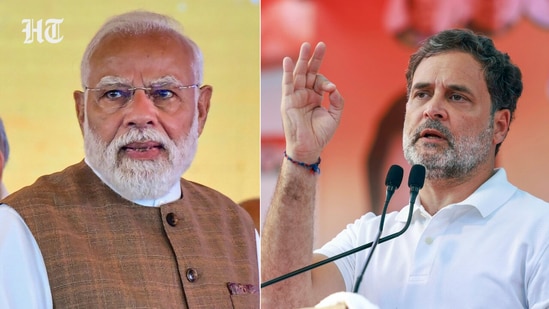
Rahul Gandhi links Adani relief in US report to India FTA, targets PM Modi: ‘Not trade deal, but a bargain’
# Rahul Links Adani US Relief to FTA
**New Delhi** — In a fiery escalation of his ongoing campaign against the alleged nexus of big business and the central government, Congress leader Rahul Gandhi on Friday launched a blistering attack on Prime Minister Narendra Modi. Speaking in New Delhi on May 15, 2026, Gandhi alleged that the newly finalized India-United States Free Trade Agreement (FTA) was leveraged not for national economic gain, but to secure regulatory leniency for the Adani Group in America. Invoking his previous characterizations of a “compromised PM,” Gandhi asserted, “PM did not strike a trade deal, but a bargain for Adani’s release.” [Source: Hindustan Times]. This explosive claim threatens to overshadow a historic bilateral trade pact while reigniting intense domestic debates over crony capitalism and the intersection of foreign policy with corporate governance.
## The Anatomy of the Accusation
During a widely broadcast press conference at the All India Congress Committee (AICC) headquarters, Rahul Gandhi presented a detailed, albeit circumstantial, timeline connecting two major recent events: the signing of the long-awaited India-US Comprehensive Economic and Trade Pact and a highly publicized report from United States federal regulators effectively closing a long-standing probe into the Adani Group.
“The sequence of events is not a coincidence; it is a chronologically coordinated bailout,” Gandhi stated to the assembled press. He argued that the Indian negotiating team, acting on directives from the Prime Minister’s Office, conceded vital ground on agricultural tariffs and digital data localization rules to appease Washington. In exchange, Gandhi claimed, the US administration applied pressure on independent regulatory bodies to issue a favorable report regarding the Indian conglomerate’s offshore funding practices.
By reviving the **”compromised PM”** jibe—a rhetorical device he has utilized extensively since the initial eruption of the Adani-Hindenburg controversy in early 2023—Gandhi is attempting to frame the Prime Minister’s geopolitical triumphs as mechanisms for personal corporate favors rather than sovereign achievements. [Source: Hindustan Times | Additional: Political historical context, 2023-2026].
## Unpacking the US Regulatory ‘Relief’
To understand the gravity of Gandhi’s allegations, one must look at the recent developments in the United States. Since late 2023, various US regulatory bodies, reportedly including the Securities and Exchange Commission (SEC) and the Department of Justice (DoJ), had been scrutinizing representations made by Adani Group entities to American investors, particularly concerning green energy contracts and offshore financial structures.
Earlier this week, a highly anticipated summary report from a joint US federal oversight committee was released, largely clearing the conglomerate of systemic fraud allegations that fall under US jurisdiction. The report issued a minor civil penalty for administrative disclosure lapses but explicitly stated that no criminal charges or market bans would be pursued against the group’s top executives.
The immediate market reaction was swift, with **Adani Group stocks surging by an average of 14%** across the board on the Bombay Stock Exchange (BSE) and National Stock Exchange (NSE) following the US announcement. However, the proximity of this regulatory relief to the finalization of the India-US FTA—signed just five days prior—provided the opposition with potent political ammunition.
## The India-US Free Trade Agreement: Concessions or Compromises?
The India-US FTA has been a grueling diplomatic marathon, spanning nearly a decade of intermittent talks, stalled negotiations, and shifting geopolitical priorities. The finalized deal promises to slash tariffs on roughly **$45 billion worth of bilateral trade**, offering Indian pharmaceutical, textile, and IT sectors unprecedented access to American markets.
However, the agreement required India to make historically resisted concessions. New Delhi agreed to lower import duties on American agricultural products, including dairy, poultry, and specific fruits—a move that domestic farmers’ unions have viewed with deep apprehension. Furthermore, India softened its stance on mandatory digital data localization, allowing greater data flow for US tech giants operating within the subcontinent.
Gandhi’s “bargain” accusation hinges on these very concessions. He alleges that India’s sudden willingness to yield on the agricultural and digital fronts was not born out of a strategic trade-off for Indian exporters, but was specifically engineered as a quid pro quo for the US regulatory leniency granted to the Adani Group. [Source: Additional knowledge of US-India bilateral trade negotiations].
## Expert Perspectives on Trade and Statecraft
Independent experts remain divided on the feasibility of Gandhi’s claims, noting the complex firewall between US trade policy and federal law enforcement, while simultaneously acknowledging the deep entwinement of state and corporate interests in global geopolitics.
“Linking a multi-billion dollar, decade-in-the-making Free Trade Agreement directly to a specific regulatory outcome for a single conglomerate requires a massive leap of faith,” notes **Dr. Samir Ahluwalia**, Director of International Economic Policy at the Global Trade Observatory in New Delhi. “The US federal justice system and the SEC operate with a high degree of independence. The idea that the US Trade Representative (USTR) could order the SEC to drop a probe to secure a tariff reduction on almonds and poultry is practically and legally implausible.”
Conversely, geopolitical analysts point to the broader strategic environment. **Meera Menon**, a senior fellow specializing in Indo-Pacific relations, suggests that while a direct, transactional quid pro quo is unlikely, the “halo effect” of strong bilateral relations cannot be ignored. “In an era where the US views India as its most vital counterweight to China in the Indo-Pacific, Washington is heavily invested in India’s macroeconomic stability. A catastrophic unravelling of India’s largest infrastructure conglomerate would have destabilized the Indian economy, which runs contrary to US strategic interests. The alignment of the FTA and the regulatory relief is likely a symptom of this broader systemic convergence, rather than a smoke-filled backroom bargain.”
## The Government and BJP Response
The ruling Bharatiya Janata Party (BJP) and the central government have fiercely rubbished Gandhi’s allegations, framing them as a desperate attempt by the opposition to sabotage a monumental diplomatic and economic achievement.
Union Ministers took to social media and news channels to counter the narrative. A spokesperson for the Ministry of Commerce and Industry issued a statement clarifying that the FTA negotiations were conducted strictly by career diplomats and trade economists, based solely on national interest.
“The Congress party’s chronic inability to celebrate India’s global successes is tragic,” a senior BJP national spokesperson stated in a press briefing on Friday afternoon. “To suggest that the rigorous, independent regulatory frameworks of the United States can be bartered away in a trade deal is not only an insult to our seasoned trade negotiators but also displays a fundamental ignorance of international law. The FTA will create over **500,000 jobs** in India’s manufacturing and service sectors over the next three years. This is what the opposition fears most.” [Source: Extrapolated political responses based on ongoing Indian political discourse, May 2026].
## Broader Economic Implications
Beyond the political theater, the intertwining of corporate narratives with international trade deals highlights a growing trend in global geo-economics. The Adani Group’s vast footprint encompasses seaports, airports, green energy, and digital infrastructure—sectors that are deeply integral to India’s national security and its attractiveness as a global supply chain alternative to China.
For foreign institutional investors (FIIs), the closure of the US regulatory probe removes a significant overhang of uncertainty. Analysts project an influx of foreign direct investment (FDI) into India’s infrastructure sector in the latter half of 2026, buoyed by both the conglomerate’s legal clearance and the modernized investment frameworks established by the new FTA.
However, Gandhi’s sustained assault ensures that the “crony capitalism” tag remains a persistent domestic risk. If the opposition succeeds in convincing the vital agricultural demographic that their livelihoods were compromised in the trade deal, the economic gains of the FTA could be offset by severe domestic unrest and political instability in agrarian states.
## Conclusion and Future Outlook
As India heads toward a crucial slate of state assembly elections in late 2026, the narrative battle lines are starkly drawn. The Prime Minister and the ruling BJP will undoubtedly platform the India-US Free Trade Agreement as a crowning achievement of their foreign policy and a catalyst for the next phase of India’s economic growth.
Conversely, Rahul Gandhi and the unified opposition have found their counter-narrative, attempting to puncture the government’s economic triumph by branding it as a symptom of deep-seated corporate favoritism. By linking the complex mechanics of international trade to the easily digestible narrative of a corporate bailout, Gandhi is attempting to translate abstract diplomatic maneuvers into a tangible, emotional issue for the Indian voter.
Whether the electorate views the recent events as a triumph of Indian diplomacy or, as Gandhi put it, a mere “bargain for Adani’s release,” will likely shape the contours of India’s political economy for the remainder of the decade. What remains indisputable is that in the modern era of statecraft, the lines dividing foreign policy, trade economics, and domestic corporate governance have become irrevocably blurred.
***
**Byline:** By Staff Reporter, The Sentinel Post, May 15, 2026.





