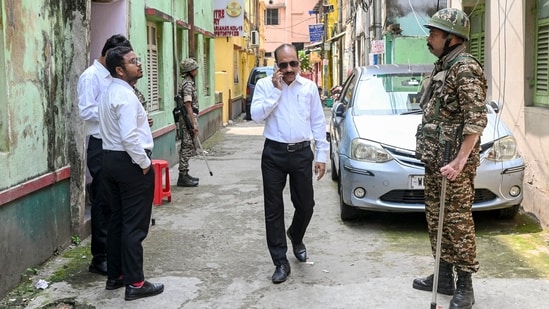
ED raids Kolkata top cop, businessman in money laundering probe| India News
# ED Raids Kolkata Top Cop in Money Laundering
**By Rajesh Chatterjee, India News Desk | April 19, 2026**
On Sunday, April 19, 2026, the Enforcement Directorate (ED) launched sweeping, coordinated raids across multiple locations in Kolkata, targeting the premises of Kolkata Police Deputy Commissioner Shantanu Sinha Biswas and a prominent local businessman. Conducted under the Prevention of Money Laundering Act (PMLA), the searches are part of a high-stakes financial crime investigation probing alleged kickbacks and shell company networks. Heavily escorted by central paramilitary forces, authorities arrived early Sunday morning to execute the warrants. However, preliminary reports indicate Deputy Commissioner Biswas was absent from his primary residence during the operation. This unprecedented federal intervention against a high-ranking serving police officer further intensifies the persistent friction between central investigative agencies and the West Bengal state administration. [Source: Hindustan Times]
## The Dawn Operation and Initial Findings
The meticulously planned operation commenced at approximately 6:30 AM IST. Acting on actionable intelligence and a freshly registered Enforcement Case Information Report (ECIR), multiple teams of ED officials, flanked by Central Reserve Police Force (CRPF) personnel, fanned out across at least six locations in the Kolkata metropolitan area. Key search zones included upscale residential complexes in South Kolkata, an office space in the central business district, and a commercial property in Salt Lake allegedly linked to the businessman co-accused in the probe.
According to on-ground reports, when the investigative team reached the primary residence of Deputy Commissioner Shantanu Sinha Biswas, the senior IPS officer was not on the premises. Family members present at the location were briefly questioned, and the search proceeded. ED officials focused on securing digital evidence, including laptops, mobile phones, and financial ledgers that could potentially map the money trail.
“The absence of the Deputy Commissioner at the time of the raid has been noted, and standard procedures dictate that he will be formally summoned to join the investigation at the ED’s regional headquarters in Salt Lake,” an official source familiar with the development stated under the condition of anonymity.
The simultaneous raids on the unnamed local businessman, reportedly holding significant interests in the city’s real estate and logistics sectors, suggest investigators are attempting to establish a direct financial nexus between administrative power and private commercial gain. [Source: Hindustan Times | Additional: Public domain reporting on ED operational protocols]
## The Core of the Money Laundering Probe
At the heart of Sunday’s aggressive action lies a complex money laundering investigation that has been quietly developing over the past several months. While the ED has remained tight-lipped regarding the exact predicate offense that triggered the PMLA case, sources indicate it stems from an earlier Central Bureau of Investigation (CBI) First Information Report (FIR) related to systemic financial irregularities in municipal contracts and real estate licensing.
Investigators are reportedly examining allegations that “protection money” and illicit commissions were routed through a maze of shell companies. The suspicion is that the businessman acted as a crucial node in this network, allegedly handling cash generated from illegal civil supply syndicates and subsequently laundering it into legitimate real estate ventures.
**Key Elements of the Investigation:**
* **The Predicate Offense:** Suspected irregularities in the awarding of civic and logistics contracts.
* **The Modus Operandi:** The alleged use of fictitious corporate entities to layer and integrate illicit funds into the formal economy.
* **The Alleged Nexus:** The investigation seeks to prove whether bureaucratic and police protection was provided to these syndicates in exchange for financial kickbacks.
The PMLA relies heavily on tracking the “proceeds of crime.” In this instance, the ED’s objective during the raids was likely to seize documentary evidence that links the Deputy Commissioner’s assets or family trusts to the corporate accounts managed by the businessman.
## Escalating Tensions: Central Agencies vs. State Police
Sunday’s raids do not exist in a vacuum. They are the latest flashpoint in an enduring and bitter institutional turf war between the federal agencies governed by New Delhi and the law enforcement apparatus controlled by the West Bengal state government. Over the past five years, Kolkata has witnessed several unprecedented face-offs, including state police previously detaining central agency officials and massive political demonstrations outside agency offices.
Raiding a serving Deputy Commissioner of the Kolkata Police marks a significant escalation. It underscores the federal government’s aggressive posture on corruption but also fuels allegations of targeted political harassment.
“Whenever a serving top cop is subjected to federal raids, it sends shockwaves through the state’s bureaucratic and law enforcement machinery,” explains Amitava Roy, a retired IPS officer and security analyst. “It creates an atmosphere of deep mutual suspicion. The central agencies assert they are merely following the money trail, but the optics inevitably lead to accusations of using federal mandates to destabilize state administrative morale.” [Source: Independent Expert Analysis]
Historically, the West Bengal government has vehemently defended its officers, viewing ED and CBI interventions as infringements on the state’s federal autonomy. As the 2026 assembly elections loom, every move by central agencies is heavily scrutinized through a political lens.
## Understanding the Legal Framework: The Power of PMLA
The Prevention of Money Laundering Act (PMLA), 2002, grants extraordinary powers to the Enforcement Directorate, making it one of the most formidable investigative bodies in India. Unlike standard criminal laws where the burden of proof rests entirely on the prosecution, the PMLA features stringent bail conditions (under Section 45) and places a reverse burden of proof on the accused to demonstrate that their assets are untainted.
If the digital devices and documents seized from Biswas’s residence or the businessman’s office reveal unexplained wealth or transactions, the ED can move to provisionally attach those assets under Section 5 of the Act.
Senior Advocate Manish Dutta, specializing in white-collar defense, notes the gravity of the situation: “Under the PMLA, the ED doesn’t need to prove the predicate offense itself—that is often the CBI or state police’s job. The ED only needs to establish that an individual knowingly assisted, or was involved in, the concealment, possession, or use of the proceeds of crime. This broad definition makes defending against PMLA charges notoriously difficult, particularly for public servants bound by strict asset declaration norms.” [Source: Public Legal Frameworks on PMLA]
## Political Fallout and Institutional Repercussions
The political tremors of the Sunday morning raids were felt almost immediately across West Bengal. While the ruling state government has yet to release an official press statement regarding the raid on Deputy Commissioner Biswas, party spokespersons have routinely condemned such actions as “vendetta politics” orchestrated ahead of crucial electoral cycles. They argue that the ED is disproportionately targeting non-aligned states to create administrative paralysis.
Conversely, the political opposition in the state seized upon the news, demanding total transparency and accountability. Opposition leaders took to social media to call for the immediate suspension of the Deputy Commissioner pending the outcome of the inquiry, arguing that a compromised police force cannot guarantee the safety of citizens.
Beyond the political rhetoric, the institutional repercussions are profound. Raids on high-ranking officials risk paralyzing routine policing and administrative decision-making. Bureaucrats and police officers often adopt overly cautious, defensive postures, fearing that their legitimate professional interactions with local business figures might later be construed as criminal conspiracies.
## The Mechanics of Shell Entities in Modern Financial Crime
A recurring theme in recent ED operations in Eastern India is the sophisticated use of “shell companies”—entities that exist only on paper, devoid of active business operations or significant assets, created primarily to obscure the origins of money.
In the context of the ongoing probe involving the Kolkata businessman and the Deputy Commissioner, financial intelligence units are likely mapping out “layering” techniques. This involves breaking down large sums of suspected bribe money into smaller, less suspicious transactions, which are then routed through multiple dummy corporations to create an impenetrable web of false invoices and unsecured loans.
If the ED manages to crack the digital ledgers seized during Sunday’s raids, the crucial breakthrough will be linking the beneficial ownership of these shell entities to the accused individuals. The challenge for investigators is to prove that the funds layered through these companies directly benefited the public servant, either through proxy investments, luxury asset purchases, or offshore transfers.
## Conclusion and Future Outlook
The ED raids on Kolkata Police Deputy Commissioner Shantanu Sinha Biswas and the associated businessman represent a critical juncture in the ongoing effort to curb high-level financial corruption. With Biswas absent during the search, the immediate next step for the Directorate will involve issuing formal summons requiring his appearance for extensive questioning.
**Key Takeaways:**
1. **Escalating Probes:** The federal government’s crackdown on alleged money laundering in West Bengal shows no signs of slowing down, extending its reach into the upper echelons of the state police.
2. **Crucial Evidence Gathering:** The success of this specific case will hinge on the forensic analysis of the electronic devices and financial documents seized during the Sunday raids.
3. **Political Undertones:** As West Bengal navigates a highly polarized political landscape in 2026, administrative actions by federal agencies will continue to be fiercely contested in both legal arenas and the court of public opinion.
As the Enforcement Directorate pieces together the complex financial jigsaw, the coming weeks will determine whether these dawn raids yield concrete evidence of a money-laundering syndicate, or if they merely add another contentious chapter to the fraught relationship between India’s federal government and the state of West Bengal. Legal experts and political observers alike await the formal filing of the ED’s prosecution complaint, which will finally lay bare the specific allegations against the city’s top cop.