
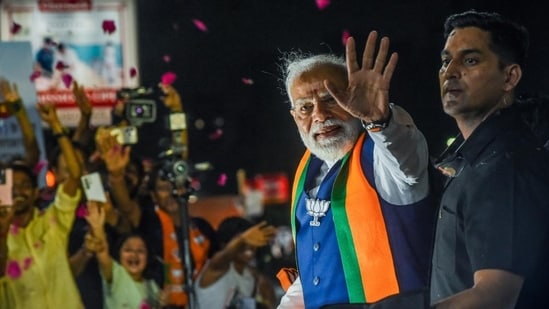
Election 2026 LIVE: Trinamool leader's ‘outsider’ dig at PM Modi, Amit Shah in Bengal ahead of second phase| India News
# TMC Fires ‘Outsider’ Jibe at Modi in Bengal Polls
As West Bengal braces for the crucial second phase of the 2026 Assembly elections, political rhetoric has reached a fever pitch. On Sunday, Trinamool Congress (TMC) State General Secretary Tanmay Ghosh launched a sharp rhetorical attack against the Bharatiya Janata Party (BJP), declaring that “no outsider,” explicitly naming Prime Minister Narendra Modi and Union Home Minister Amit Shah, will be seen in the state after May 4. This escalating war of words highlights the fierce ongoing battle for regional supremacy versus national expansion, setting the stage for a high-stakes electoral showdown in one of India’s most politically explosive states. [Source: Hindustan Times].
## The Resurgence of the ‘Insider vs. Outsider’ Narrative
The invocation of the “outsider” label is not a new phenomenon in West Bengal’s political landscape. During the heavily contested 2021 Assembly elections, the TMC successfully utilized the *Bohiragoto* (outsider) narrative to galvanize Bengali sub-nationalism against the BJP’s centralized campaign machinery. Tanmay Ghosh’s recent comments indicate a strategic revival of this tested playbook for the 2026 polls.
Speaking to the press on Sunday, April 26, Ghosh emphasized that the extensive campaigning by central BJP leaders would yield no dividends, asserting that the local populace inherently trusts regional leadership over national figures who visit only during election seasons. His specific mention of May 4 likely coincides with the cessation of major campaign rallies by central leaders ahead of the subsequent voting phases.
“The ‘outsider’ narrative acts as a potent emotional shield for the Trinamool Congress,” explains Dr. Aditi Sen, a senior political sociologist at the New Delhi-based Centre for Electoral Studies. “By framing the election as a defense of Bengali culture against Northern Indian political dominance, the TMC attempts to consolidate regional pride and deflect anti-incumbency sentiments stemming from local governance issues.” [Additional: Expert Analysis].
## High Stakes in the Second Phase
The second phase of the 2026 West Bengal Assembly elections is poised to cover pivotal constituencies across both South and North Bengal, regions that have historically demonstrated volatile voting patterns. The Election Commission of India (ECI) has mandated unprecedented security measures, deploying hundreds of companies of Central Armed Police Forces (CAPF) to ensure a violence-free democratic process.
For both the ruling TMC and the opposition BJP, this phase is critical. The constituencies going to the polls feature a diverse mix of urban voters, agricultural communities, and vital minority demographics. The BJP is looking to defend the gains it made in previous election cycles, particularly in regions dominated by the Matua and Rajbanshi communities, while the TMC aims to reclaim lost ground through its extensive grassroots welfare networks.
The ECI has tightly monitored campaign speeches, issuing numerous advisories to all political parties to maintain decorum. However, as the voting day approaches, the rhetorical clashes have only intensified, reflecting the immense pressure both sides are under to secure an early psychological advantage in the multi-phase election.
## BJP’s High-Octane Centralized Campaign
The Bharatiya Janata Party’s strategy in West Bengal heavily relies on the immense popularity of its national leadership. Prime Minister Narendra Modi and Home Minister Amit Shah have historically drawn massive crowds in the state, utilizing their rallies to emphasize themes of national integration, anti-corruption, and economic development under the “Double Engine Sarkar” (alignment of state and central governments) promise.
In the run-up to the 2026 elections, the BJP has aggressively targeted the Mamata Banerjee-led government over allegations of systemic corruption, pointing to various investigations conducted by central agencies like the Enforcement Directorate (ED) and the Central Bureau of Investigation (CBI).
“The BJP’s reliance on its central leaders is a calculated move to bridge the gap in its local organizational structure,” notes Rajat Das, a veteran political analyst covering Eastern Indian politics. “While the TMC boasts deeply entrenched local networks, the BJP counters this by leveraging the Prime Minister’s pan-India appeal and focusing on governance fatigue and anti-incumbency at the Panchayat level.” [Additional: Expert Analysis].
By bringing in a continuous roster of national heavyweights, the BJP aims to maintain a high-visibility, high-energy campaign. However, this centralized approach is exactly what opens the door for the TMC’s “outsider” critiques.
## The Trinamool Congress Counter-Offensive
Under the leadership of Chief Minister Mamata Banerjee and National General Secretary Abhishek Banerjee, the TMC has crafted a dual-pronged defense. The first prong involves aggressive political messaging, as demonstrated by Tanmay Ghosh’s remarks, painting the opposition as disconnected from the cultural and linguistic ethos of Bengal.
The second, and perhaps more formidable prong, is the TMC’s vast array of social welfare schemes. Programs such as *Lakshmir Bhandar* (direct cash transfers to women), *Kanyashree* (financial aid for girls’ education), and *Swasthya Sathi* (health insurance) have created a massive, loyal voting bloc, particularly among rural women.
The TMC campaign argues that these localized, targeted benefits are under threat from the central government, pointing to the withholding of federal funds under various national schemes—a major point of friction between the state and the center over the past few years. By framing the withholding of funds as an “anti-Bengal” policy orchestrated by “outsiders,” the TMC effectively merges its administrative grievances with its emotional, sub-nationalistic electoral pitch.
## Electoral Arithmetic and Demographic Shifts
Understanding the intensity of this political clash requires looking at the complex demographic arithmetic of West Bengal. The state is highly polarized along regional, caste, and religious lines, making every voting bloc crucial.
**Historical Vote Share Trends in West Bengal:**
| Election Year | TMC Vote Share (%) | BJP Vote Share (%) | Left+INC Vote Share (%) |
| :— | :— | :— | :— |
| 2016 (Assembly) | 44.9% | 10.2% | ~38.0% |
| 2019 (Lok Sabha)| 43.3% | 40.3% | ~13.0% |
| 2021 (Assembly) | 47.9% | 38.1% | ~8.0% |
| *2024 (Lok Sabha)* | *45.7%* | *38.7%* | *~12.0%* |
*(Note: 2024 figures are based on broad ECI estimates leading into the 2026 cycle).* [Additional: Public Electoral Data].
The data highlights a bipolar political environment. The near-collapse of the Left and the Indian National Congress (INC) over the last decade has turned Bengal into a direct battleground between the TMC and the BJP.
For the BJP, sustaining the 38-40% vote share relies heavily on consolidating the Hindu vote, particularly among marginalized castes like the Matuas in border districts, who have been central to discussions surrounding the Citizenship Amendment Act (CAA). Conversely, the TMC relies on retaining its absolute dominance over the minority vote, which comprises roughly 27-30% of the electorate, while maintaining a strong grip on the rural Bengali-speaking Hindu population through welfarism.
## Center-State Frictions Amplified
The “outsider” rhetoric espoused by leaders like Tanmay Ghosh cannot be viewed in a vacuum; it is the culmination of years of severe administrative and political friction between the state secretariat in Kolkata (Nabanna) and the central government in New Delhi.
Over the past legislative term, West Bengal has witnessed numerous flashpoints. The state government has repeatedly accused the center of weaponizing federal agencies to target TMC ministers and local leaders. Simultaneously, the central government has accused the state of rampant corruption in the distribution of federal rations and education recruitment.
This administrative deadlock frequently bleeds into the electoral narrative. When Ghosh states that central leaders will not be seen after May 4, it is an insinuation that the BJP’s interest in West Bengal is purely electoral and extractive, contrasting it with the TMC’s persistent, year-round presence in the state. The BJP vehemently denies this, pointing to its growing cadre base and the numerous local leaders who face daily political violence, positioning itself as the true champion of democratic rescue in the state.
## Conclusion: Key Takeaways and Future Outlook
As the May 4 horizon mentioned by Tanmay Ghosh approaches, the West Bengal election landscape is characterized by intense polarization and high stakes. The key takeaways from the current political climate include:
1. **Narrative Continuity:** The TMC continues to find utility in the “insider vs. outsider” binary, leveraging regional identity as a bulwark against the BJP’s Hindutva and development-oriented national pitch.
2. **Central Leadership vs. Regional Welfarism:** The election remains a fundamental test of whether Prime Minister Modi’s immense national charisma can override Chief Minister Mamata Banerjee’s deeply entrenched, welfare-driven regional machinery.
3. **Institutional Tensions:** The ongoing campaigns are heavily colored by center-state administrative disputes, including the freezing of funds and central agency investigations.
The remaining phases of the 2026 Assembly elections will determine not just the governance of West Bengal for the next five years, but also the broader limits of the BJP’s eastern expansion and the resilience of regional political fortresses in modern India. Regardless of whether national leaders scale back their physical presence after May 4, the ideological battlelines drawn during this campaign will shape the state’s political discourse long after the final ballot is cast.
***
By Staff Reporter, Election Desk, April 27, 2026.





