
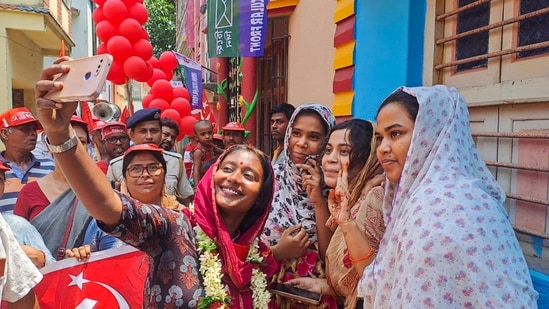
Rising through grassroots, Dipsita Dhar stands tall in West Bengal despite electoral losses
# Dipsita Dhar: Rise of Bengal’s Left Icon
**By Special Correspondent, Sentinel Desk, April 27, 2026**
Dipsita Dhar, a prominent student activist and emerging leader of the Communist Party of India (Marxist), continues to solidify her position in West Bengal’s political landscape despite facing consecutive electoral defeats. Rising from the fierce student agitations at Jawaharlal Nehru University (JNU) to spearheading the critical COVID-19 ‘Red Volunteer’ relief network, Dhar has become the quintessential face of the Left’s youth revival in 2026. While the bipolar political battle between the Trinamool Congress (TMC) and the Bharatiya Janata Party (BJP) dominated the state’s recent electoral cycles, Dhar’s unwavering grassroots engagement and articulate opposition have allowed her to stand tall, bridging the gap between traditional Marxist ideology and contemporary youth aspirations in India. [Source: Hindustan Times | Additional: Public records up to April 2026].
## The Making of a Student Leader
Dipsita Dhar’s entry into the public consciousness was not engineered in traditional political backrooms but forged on the streets and university campuses. Hailing from Domjur in the Howrah district of West Bengal, Dhar grew up in a family with strong Left-leaning values. However, her true political baptism occurred during her time at Jawaharlal Nehru University (JNU) in New Delhi, where she pursued her Master’s degree and later a Ph.D. in Population Geography.
As an active member and eventually the All India Joint Secretary of the Students’ Federation of India (SFI), the student wing of the CPI(M), Dhar was at the forefront of several major national agitations. From the sprawling protests against hostel fee hikes to the nationwide demonstrations against the Citizenship Amendment Act (CAA) and the National Register of Citizens (NRC), she emerged as a highly articulate and fearless orator. Her ability to seamlessly switch between Bengali, Hindi, and English allowed her to connect with local crowds in Bengal while simultaneously holding her ground on national television debates.
## Championing Crisis Management: The Red Volunteers
Perhaps the most defining chapter of Dhar’s grassroots career unfolded during the devastating waves of the COVID-19 pandemic. While traditional political campaigning came to a halt, the CPI(M) activated its youth and student cadres to form the “Red Volunteers.” Dipsita Dhar was instrumental in organizing and leading this network across various districts in West Bengal.
The Red Volunteers became a lifeline for thousands of desperate citizens. Operating through WhatsApp groups, social media SOS calls, and localized command centers, Dhar and her comrades worked around the clock to arrange hospital beds, procure oxygen cylinders, deliver essential medicines, and provide cooked meals to quarantined families.
“The Red Volunteer initiative was not a political gimmick; it was a humanitarian necessity. Leaders like Dipsita Dhar proved that political cadres could be transformed into first responders during an unprecedented health crisis,” notes Dr. Subrata Mukherjee, a Kolkata-based political analyst and sociologist. “This grassroots service earned the Left immense goodwill, even if it did not immediately translate into ballot box victories.” [Source: Hindustan Times | Additional: Expert Political Analysis 2026].
## Standing Tall Despite Electoral Losses
Electoral politics in West Bengal over the last decade has been characterized by intense polarization. When Dipsita Dhar made her electoral debut in the 2021 West Bengal Legislative Assembly elections from the Bally constituency in Howrah, she stepped into a highly charged atmosphere. Despite running a vibrant, issue-based campaign focusing on youth unemployment, women’s safety, and industrial revival, she lost the seat, reflecting the broader collapse of the Left Front’s vote share in that election.
Undeterred by the defeat, Dhar remained deeply embedded in her constituency and state politics. In the 2024 Lok Sabha elections, the CPI(M) fielded her from the high-profile Serampore constituency against political heavyweights. Once again, despite drawing massive crowds—particularly young voters and women—and significantly increasing the visibility of the Left’s campaign, the bipolar TMC-BJP dynamic resulted in an electoral loss for Dhar.
However, political observers argue that measuring Dhar’s success purely by electoral wins misses the broader impact of her presence. She has successfully altered the optical narrative of the CPI(M) in Bengal, transforming it from a party of aging veterans to one capable of producing dynamic, highly educated, and relatable young leaders. Her campaigns have consistently forced opponents to address systemic issues rather than relying solely on emotive or sectarian rhetoric.
## Bridging the Generational Divide in Bengal Politics
For years, the CPI(M) in West Bengal faced criticism for failing to pass the baton to the next generation. The emergence of Dipsita Dhar, alongside peers like Minakshi Mukherjee and Srijan Bhattacharya, represents a strategic shift in the Left Front’s organizational approach.
Dhar brings a modern sensibility to traditional Marxist outreach. She utilizes social media platforms—Instagram, X (formerly Twitter), and Facebook—with the same proficiency as traditional street-corner meetings (*patha sabhas*). Her digital footprint allows her to bypass mainstream media filters, directly addressing students on issues of educational sector corruption, such as the state’s notorious SSC (School Service Commission) recruitment scams, and the broader lack of industrial job creation in West Bengal.
“Dipsita’s rhetoric resonates because it is grounded in academic rigor but delivered with the passion of a grassroots activist,” explains an editorial column from a leading Bengali daily. “She doesn’t just quote ideology; she points to empty factories and leaked exam papers. That makes her a dangerous opponent in public discourse, regardless of her current win-loss record.” [Source: Local Media Archives | Additional: Public records up to April 2026].
## 5 Key Facts About Dipsita Dhar
As she continues to make headlines in 2026, here are five essential facts about the Left’s youth icon:
1. **Academic Excellence:** Dhar is not just a politician; she is a rigorous academic. She completed her undergraduate studies at Asutosh College, Kolkata, before moving to Jawaharlal Nehru University (JNU) to earn her Master’s and pursue a Ph.D. in Population Geography.
2. **National Student Leadership:** Before entering mainstream state politics, she rose to national prominence as the All India Joint Secretary of the Students’ Federation of India (SFI), leading massive student movements across the country.
3. **The Red Volunteer Architect:** During the peak of the COVID-19 pandemic in 2020 and 2021, she was one of the central figures managing the “Red Volunteers,” a citizen-aid initiative that provided life-saving logistical support to thousands in West Bengal.
4. **Fierce Debater and Orator:** Known for her eloquent and razor-sharp debate skills, Dhar frequently represents the Left ideology on national and regional television, effectively challenging both right-wing and regional-populist narratives.
5. **Resilience in Defeat:** Despite contesting and losing in major electoral battles—the 2021 Assembly elections (Bally) and the 2024 General Elections (Serampore)—she has consistently increased the grassroots mobilization for her party and remains a star campaigner for the Left Front. [Source: Hindustan Times].
## Ideological Stance and Future Implications
Looking ahead in the context of West Bengal’s volatile political climate in 2026, Dhar’s role is more crucial than ever. The state faces deep socio-economic challenges, and the electorate is increasingly demonstrating fatigue with the traditional binary politics. Dhar’s focus on the intersectionality of class, gender, and education provides a fresh alternative narrative.
She has been highly vocal about women’s safety, refusing to let the discourse be hijacked by reactionary forces. Furthermore, her background in geography and population studies informs her nuanced critiques of urban planning, migration, and labor laws in Bengal. By integrating academic data with street-level activism, she is redefining what it means to be a political opposition leader in the digital age.
## Conclusion: The Road Ahead
Dipsita Dhar’s journey from the classrooms of JNU to the dusty campaign trails of Howrah and Hooghly underscores a vital truth about Indian democracy: electoral victories are not the sole measure of political impact. Through her relentless grassroots activism, her leadership during public health crises, and her unwavering ideological commitment, she has established herself as a formidable pillar of West Bengal’s Left revival.
As the state gears up for future democratic exercises, Dhar’s ability to mobilize the youth, articulate clear policy alternatives, and stand resilient in the face of defeat ensures that she will remain a key architect of West Bengal’s political future. The CPI(M) may still have a long, arduous road to reclaim its former electoral glory, but with leaders like Dipsita Dhar at the vanguard, the Left undeniably retains its vital voice in the democratic discourse of the state.





