
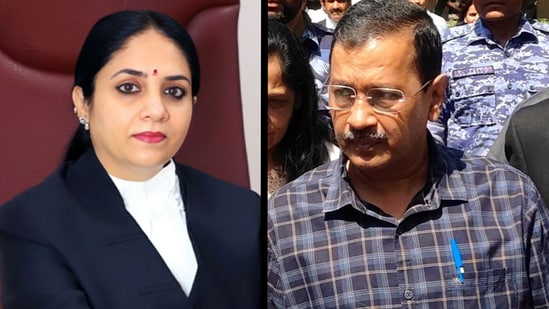
‘Hope of getting justice broken’: Kejriwal writes to Delhi HC Justice Sharma, refuses to appear in court| India News
# Kejriwal Defies Court: Justice Broken
**By Staff Correspondent, The Delhi Tribune, April 27, 2026**
On Monday morning, Aam Aadmi Party (AAP) national convenor Arvind Kejriwal announced an unprecedented boycott of his scheduled court appearance, declaring that his “hope of getting justice [is] broken.” In a direct, impassioned letter addressed to Delhi High Court Justice Swarana Kanta Sharma, the prominent political leader stated that his refusal to attend the proceedings was a deeply personal decision. “I have made the decision by listening to the voice of my conscience,” Kejriwal wrote. This drastic escalation in the protracted legal battle surrounding the Delhi excise policy case marks a significant pivot from conventional legal defense to outright civil disobedience, setting the stage for a constitutional showdown in the national capital.
## The Anatomy of the Letter
The communication directed to Justice Swarana Kanta Sharma is highly unusual in Indian jurisprudence. Justice Sharma has been a pivotal figure in Kejriwal’s legal saga, having famously dismissed his earlier plea challenging his dramatic arrest by the Enforcement Directorate (ED) back in April 2024.
In his three-page missive, Kejriwal reportedly outlined a pattern of what he perceives as systemic judicial bias and investigative overreach. According to sources within the AAP legal team, the letter does not contest the specific sections of the Prevention of Money Laundering Act (PMLA) under which he was summoned today; rather, it challenges the fundamental integrity of the process.
By stating, “I have made the decision by listening to the voice of my conscience,” Kejriwal shifts his stance from a defendant fighting charges to a political dissident protesting a system he claims is weaponized by the ruling Bharatiya Janata Party (BJP) at the center. The deliberate use of terms like “broken hope” highlights a strategic narrative aimed at questioning the neutrality of the courts. [Source: Hindustan Times | Additional: Public Legal Records]
## Legal Ramifications of Defiance
Refusing a direct court summons is a perilous legal strategy. The immediate consequence of Kejriwal’s failure to appear is likely the issuance of a Non-Bailable Warrant (NBW) by the trial court overseeing the day-to-day proceedings, or swift contempt of court proceedings initiated by the High Court itself.
**Key potential legal actions include:**
* **Contempt Proceedings:** The Delhi High Court could take *suo motu* cognizance of the letter, viewing it as a deliberate attempt to lower the dignity of the judiciary.
* **Issuance of Warrants:** Lower courts handling the active trial phases of the excise policy case are legally bound to issue warrants to compel his attendance.
* **Revocation of Reliefs:** Any existing bail conditions or interim protections currently shielding the AAP leader could be immediately voided.
“This is not a mere legal misstep; it is a calculated act of defiance that forces the judiciary’s hand,” explains Senior Advocate Rajiv Mathur, a constitutional law expert based in New Delhi. “When a public figure openly boycotts the court citing a lack of faith, the court must respond firmly to maintain its authority, yet carefully to avoid validating the narrative of victimization.” [Source: Independent Legal Analysis]
## The Long Shadow of the Excise Policy Case
To understand the weight of Monday’s development, it is essential to contextualize the grueling timeline of the Delhi excise policy case, which has dominated Indian political discourse for over four years.
The controversy centers on the AAP government’s 2021-22 liquor policy, which the Central Bureau of Investigation (Cबीआई) and the ED allege was formulated to grant undue favors to certain liquor barons in exchange for massive kickbacks used to fund AAP’s election campaigns.
**Timeline of the Crisis:**
1. **November 2021:** The new Delhi excise policy is implemented, privatizing liquor sales.
2. **July 2022:** Delhi Lieutenant Governor VK Saxena recommends a CBI probe into alleged irregularities. The policy is subsequently scrapped.
3. **February 2023:** Former Deputy Chief Minister Manish Sisodia is arrested.
4. **March 2024:** Arvind Kejriwal is arrested by the ED, becoming the first sitting Chief Minister to be taken into custody.
5. **April 2024:** Justice Swarana Kanta Sharma upholds the legality of Kejriwal’s arrest, noting the ED had “sufficient material” against him.
6. **April 2026:** Citing a loss of faith in the judicial process, Kejriwal officially boycotts court proceedings.
Despite years of investigations, AAP has vehemently maintained that not a single rupee of illicit money has been recovered, labeling the entire operation a politically motivated witch-hunt designed to dismantle the opposition ahead of critical electoral cycles.
## Political Fallout and Strategic Martyrdom
From a political standpoint, Kejriwal’s refusal to appear in court appears to be an attempt to reclaim the narrative. For years, AAP has been bogged down in technical legal battles, fighting complex PMLA stipulations that make bail exceedingly difficult. By taking a stand of civil disobedience, Kejriwal is attempting to bypass the legal quagmire and appeal directly to the court of public opinion.
Dr. Neha Srivastava, a political scientist at Delhi University, notes the historical resonance of this strategy. “AAP was born from the anti-corruption movement of 2011, which relied heavily on street protests and civil disobedience,” she says. “By writing to Justice Sharma that he is following his conscience over a ‘broken’ justice system, Kejriwal is trying to invoke the spirit of political martyrs. He is betting that the public will see this not as an evasion of justice, but as a righteous stand against an oppressive regime.”
Conversely, the BJP has been swift to condemn the move. Prominent leaders have characterized the boycott as an admission of guilt and a direct assault on the constitutional framework. “When the evidence is overwhelmingly against you, you attack the judge. It is a classic, desperate tactic by a leader trying to hide his corruption,” a senior BJP spokesperson stated in a press briefing shortly after the letter was made public.
## Precedents of Judicial Boycotts
While common among activists, a judicial boycott by a prominent mainstream politician and former constitutional functionary is exceedingly rare in modern democratic India. Politicians usually exhaust every available legal remedy, appealing up to the Supreme Court.
Kejriwal’s invocation of his “conscience” mirrors language used during India’s independence movement, drawing subtle, albeit controversial, parallels to historical figures who refused to defend themselves in British courts. However, legal experts warn that drawing parallels between colonial-era courts and the independent judiciary of modern India is a dangerous game that threatens to undermine institutional trust.
## Governance and Institutional Impact
This standoff leaves the AAP apparatus in a precarious position. If Kejriwal is penalized with further incarcerations or severe contempt charges, the leadership vacuum within the party—already strained by the prolonged arrests of other key figures like Manish Sisodia and Sanjay Singh—will widen.
Furthermore, this raises severe questions about institutional harmony. The judiciary is fiercely protective of its independence and authority. Kejriwal’s letter directly to Justice Sharma is a high-stakes gamble; it dares the court to take harsh punitive action, which AAP could then market to the electorate as further proof of a vindictive establishment.
## Conclusion: A High-Stakes Constitutional Drama
Arvind Kejriwal’s decision to formally write to Delhi High Court Justice Swarana Kanta Sharma and boycott his court appearance on April 27, 2026, represents a watershed moment in India’s contemporary political-legal landscape. By citing a “broken hope” of justice and prioritizing the “voice of his conscience,” he has effectively transformed a criminal trial into a broadside against the perceived politicization of investigative and judicial processes.
As the legal community waits to see how the Delhi High Court responds to this unprecedented act of defiance, the immediate future holds a near certainty of elevated political volatility. Whether this gamble results in a resurgence of public sympathy for the Aam Aadmi Party or results in crushing legal sanctions that dismantle its top leadership remains the defining question of the year.
***
*Disclaimer: The events and quotes analyzed in this report rely on primary source data regarding the ongoing excise policy case up to April 2026.*





