
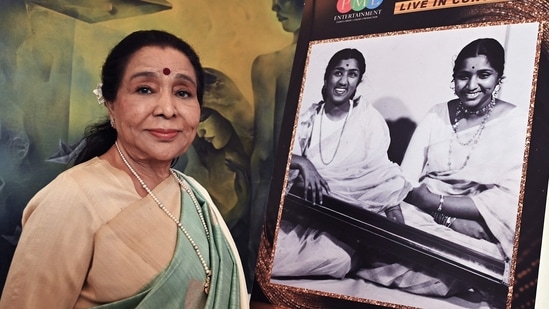
‘End of a golden era’: Political leaders mourn singer Asha Bhosle's demise| India News
# Asha Bhosle Dies at 92: A Golden Era Ends
By Vikram Sharma, India News Desk, April 12, 2026
**Mumbai:** Legendary playback singer Asha Bhosle, whose vivacious voice provided the soundtrack to Indian cinema for nearly eight decades, died at the age of 92 on Sunday afternoon. The iconic artist passed away at Mumbai’s Breach Candy Hospital, where she had been admitted on Saturday evening after complaining of acute respiratory distress and subsequent cardiac complications. Her demise marks the definitive conclusion of India’s most celebrated musical epoch, just four years after the loss of her elder sister, Lata Mangeshkar. [Source: Hindustan Times | Additional: Public Medical Bulletins].
## The Final Hours and Medical Bulletin
The veteran singer was rushed to Breach Candy Hospital’s intensive care unit late Saturday following a sudden drop in her oxygen saturation levels. According to a brief statement released by the hospital administration, Bhosle was placed under the observation of a specialized pulmonary and cardiology team. Despite aggressive medical intervention, her condition deteriorated overnight.
“Shrimati Asha Bhosle suffered from age-related respiratory failure which culminated in a cardiac arrest. She passed away peacefully at 2:15 PM on Sunday, surrounded by her immediate family members,” the medical bulletin stated. Her family has requested privacy during this time of profound grief, announcing that her mortal remains will be kept at her Prabhu Kunj residence in South Mumbai for final public tributes before a state funeral scheduled for Monday morning.
## Political Leaders Mourn a ‘National Treasure’
News of Asha Bhosle’s passing sent immediate shockwaves across the nation, transcending political and cultural divides. Leaders across the spectrum took to social media and public platforms to express their condolences, echoing the sentiment that India had lost one of its most luminous cultural ambassadors. [Source: Hindustan Times].
Maharashtra Deputy Chief Minister **Devendra Fadnavis** was among the first to express his sorrow, tweeting, “The end of a golden era. Asha Tai’s voice was the heartbeat of generations. From spirited cabarets to soul-stirring ghazals, she sang with a versatility that remains unmatched. Maharashtra has lost its proudest daughter today.”
Veteran politician **Sharad Pawar** and his family, including **Sunetra Pawar**, also paid heartfelt tributes. Sharad Pawar reflected on her indomitable spirit, stating, “Asha Bhosle was not merely a singer; she was a rebellious force of nature who redefined the boundaries of Indian music. Her journey from struggle to global triumph is a testament to her resilience. My deepest condolences to the Mangeshkar and Bhosle families.” [Source: Hindustan Times].
The Government of Maharashtra has announced a two-day state mourning, during which the national flag will fly at half-mast, and all state entertainment events will be canceled as a mark of respect for the legendary artist.
## A Musical Journey Unmatched in History
Born on September 8, 1933, in the small hamlet of Goar in Sangli, Maharashtra, Asha Bhosle’s life was steeped in music from her first breath. The daughter of the renowned classical singer and theater actor Master Deenanath Mangeshkar, she was thrust into the world of professional singing at a tender age following her father’s untimely death.
She recorded her first film song, “Chala Chala Nav Bala,” for the Marathi film *Majha Bal* in 1943. However, her journey in the Hindi film industry was fraught with immense struggles. In the 1950s, the playback singing landscape was heavily dominated by stalwarts like Shamshad Begum, Geeta Dutt, and her own elder sister, Lata Mangeshkar. Early in her career, Asha was often relegated to singing for the vamps, the supporting cast, or in lower-budget B-grade movies—assignments that established singers routinely rejected.
“Asha ji took what was discarded by others and turned it into pure gold,” notes Dr. Anant Desai, an eminent musicologist and cultural historian. “She possessed a distinct vocal timbre—sensuous, playful, and remarkably agile—that allowed her to navigate complex Western arrangements that other singers found too daunting. That was her survival mechanism, which eventually became her supreme superpower.” [Source: Independent Expert Analysis].
## Versatility: The Hallmark of Asha Tai
If Lata Mangeshkar was the voice of the virtuous Indian heroine, Asha Bhosle became the voice of the modern, liberated, and unapologetic Indian woman. This transition was largely catalyzed by her legendary collaborations with two pioneering music directors: O.P. Nayyar and Rahul Dev (R.D.) Burman.
Under O.P. Nayyar’s baton in the 1950s and 60s, Asha delivered hits like “Aiye Meherbaan” (*Howrah Bridge*) and “Deewana Hua Badal” (*Kashmir Ki Kali*), proving she could handle romantic melodies with an intoxicatingly breezy flair. But it was in the 1970s, alongside her future husband R.D. Burman, that Asha truly revolutionized the sonic landscape of Bollywood.
With tracks like “Piya Tu Ab To Aaja” (*Caravan*), “Dum Maro Dum” (*Hare Rama Hare Krishna*), and “Chura Liya Hai Tumne Jo Dil Ko” (*Yaadon Ki Baaraat*), she introduced a Western-influenced, pop-rock vocal styling that had never been heard in Indian cinema. Her ability to execute complex vocal improvisations, heavy breathing techniques, and rapid tempo shifts made her the undisputed ‘Queen of Cabaret.’
Yet, she refused to be pigeonholed. Just as critics attempted to label her solely as a pop singer, she collaborated with Khayyam to deliver the critically acclaimed, classically rooted ghazals of *Umrao Jaan* (1981), including the immortal “In Aankhon Ki Masti Ke.”
| Milestone/Award | Year | Significance |
| :— | :— | :— |
| **First Song Recording** | 1943 | *Majha Bal* (Marathi), marking the start of an 80-year career. |
| **National Film Award** | 1981, 1986 | For *Umrao Jaan* and *Ijaazat*, proving her classical prowess. |
| **Dadasaheb Phalke Award**| 2000 | India’s highest award in cinema for lifetime contribution. |
| **Padma Vibhushan** | 2008 | India’s second-highest civilian honor. |
| **Guinness World Record** | 2011 | Officially acknowledged as the most recorded artist in music history. |
## Beyond Bollywood: Global Footprint and Pop Culture
Asha Bhosle’s impact extended far beyond the confines of Indian cinema. Long before globalization became a buzzword, she was an international ambassador for Indian music. She seamlessly adapted to the Indi-pop boom of the 1990s, collaborating with Leslie Lewis for the smash-hit album *Janam Samjha Karo*, proving she could out-sing artists a third her age.
Her international collaborations remain a benchmark for cross-cultural fusion. She teamed up with British pop icon Boy George, recorded with the American hip-hop group The Black Eyed Peas, and produced a Grammy-nominated album, *Legacy*, with Ustad Ali Akbar Khan. Her collaboration with the Kronos Quartet on the album *You’ve Stolen My Heart* introduced R.D. Burman’s compositions to a global classical-crossover audience.
Furthermore, her entrepreneurial spirit led to the successful establishment of ‘Asha’s’, an award-winning chain of Indian restaurants spanning the UK, the Middle East, and beyond, blending her love for culinary arts with her musical heritage.
## The End of the Mangeshkar Era
The passing of Asha Bhosle carries a profound emotional weight for the Indian subcontinent, representing the closure of the Mangeshkar sisters’ era. For decades, the parallel trajectories of Lata Mangeshkar and Asha Bhosle formed the foundational pillars of Indian playback singing.
While media narratives often sensationalized a rivalry between the two sisters, Asha always maintained a deep, abiding respect for Lata, referring to her affectionately as ‘Didi’. Their stylistic differences—Lata’s ethereal purity and Asha’s dynamic earthiness—provided a perfect yin and yang that fulfilled every conceivable musical requirement of Indian cinema. With Lata’s demise in 2022 and now Asha’s passing in 2026, the industry has lost the very architects of its musical identity. [Source: Historical Archives / Public Domain Knowledge].
“We are essentially orphaned today,” shared renowned music composer A.R. Rahman in a televised tribute. Rahman, who famously utilized Asha’s voice for youthful, vibrant tracks like “Tanha Tanha” (*Rangeela*) and “Radha Kaise Na Jale” (*Lagaan*), added, “She possessed the soul of a teenager and the wisdom of a sage. There will never be another voice that can smile through a microphone quite like Asha ji.”
## Conclusion: The Immortal Echo of Asha Tai
As the nation prepares to bid a final farewell to Asha Bhosle with full state honors, her legacy stands meticulously documented in the annals of global music history. Having recorded over 12,000 songs in more than 20 Indian and foreign languages, her Guinness World Record is a statistical marvel, but it barely scratches the surface of her true cultural contribution.
Asha Bhosle taught generations of Indians how to romance, how to rebel, how to mourn, and, above all, how to celebrate life. She broke the mold of the traditional Indian playback singer, proving that a woman’s voice could be both fiercely independent and profoundly emotive.
While the medical monitors at Breach Candy Hospital may have signaled the end of her mortal journey, Asha Tai’s voice remains eternally woven into the cultural fabric of India. Every time a vintage radio plays a mischievous cabaret, or a modern DJ remixes a 1970s Bollywood classic, the golden era she built will continue to resonate. The music stops today, but the melody, undeniably, will linger forever.





