
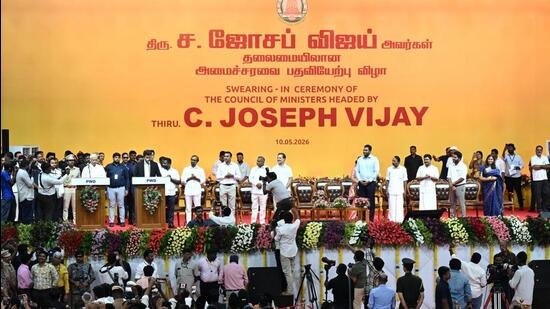
Experience and diversity in focus in TVK’s 9-member Tamil Nadu cabinet
# TVK Unveils Diverse 9-Member TN Cabinet
By Siddharth Narayan, India Political Review, May 10, 2026
**CHENNAI** — Setting the stage for a new era in Tamil Nadu’s governance, the Tamilaga Vettri Kazhagam (TVK) announced its core administrative team on Sunday, unveiling a lean, nine-member state cabinet. The official list, released from the Lok Bhavan on Sunday afternoon, emphasizes a strategic balance of grassroots diversity and seasoned administrative experience. Coming on the heels of the highly contested April-May 2026 Legislative Assembly elections, this initial cabinet formulation answers crucial questions about how the newly empowered political entity intends to govern, showcasing a blend of fresh technocratic faces and experienced political stalwarts ready to tackle the state’s pressing economic and social challenges.
## A Historic Paradigm Shift in Dravidian Politics
For nearly six decades, the political landscape of Tamil Nadu has been exclusively dominated by the Dravidian duopoly of the Dravida Munnetra Kazhagam (DMK) and the All India Anna Dravida Munnetra Kazhagam (AIADMK). The meteoric rise of actor-turned-politician Thalapathy Vijay’s Tamilaga Vettri Kazhagam (TVK) since its formal launch in February 2024 has fundamentally disrupted this binary dynamic. As the 2026 assembly election results formalized TVK’s position as a dominant legislative force, the immediate focus shifted from campaign rhetoric to actual governance mechanics.
The decision to initiate government operations with a highly curated, nine-member cabinet sends a strong message regarding the party’s governing philosophy. By opting for a smaller, agile core team rather than doling out dozens of ministerial berths to appease various factions, the TVK leadership is signaling an adherence to the “minimum government, maximum governance” model. This approach requires each cabinet member to shoulder significant responsibilities, overseeing clustered portfolios to ensure inter-departmental synergy.
[Source: Hindustan Times | Additional Context: Election Commission of India 2026 Data]
## Analyzing the “Mixture of Political Blend”
The official statement released from the Lok Bhavan highlighted that the selected candidates “hail from diverse backgrounds with a mixture of political blend.” In practical terms, this translates to a meticulously crafted roster that bridges the gap between idealistic newcomers and pragmatic veterans.
Political transitions driven by new, star-led parties historically face a critical vulnerability: a lack of administrative muscle. To circumvent the pitfalls experienced by previous third-front alternatives in South India, TVK has integrated seasoned administrators—including former civil servants and veteran politicians who recently aligned with the party’s vision—alongside grassroots organizers who spearheaded the 2026 ground campaign.
This hybrid model aims to achieve two primary objectives:
1. **Administrative Continuity:** Ensuring that the complex bureaucratic machinery of Tamil Nadu, which manages one of India’s largest state economies, does not stall during the transition of power.
2. **Ideological Execution:** Empowering fresh, uncorrupted voices to implement the party’s core promises of social equity, anti-corruption, and decentralized development.
## Social Justice and Demographic Diversity
In Tamil Nadu, political representation is intricately tied to the principles of social justice. The legacy of Periyar E. V. Ramasamy, K. Kamaraj, and Dr. B.R. Ambedkar—figures prominently featured in TVK’s ideological framing—demands intersectional representation. The nine-member list strongly reflects this commitment, ensuring that historically marginalized communities, linguistic minorities, and various regional blocks are given a seat at the highest table of executive decision-making.
The diversity of the cabinet is evident across several key metrics:
* **Regional Balance:** Power in Tamil Nadu is often centralized in Chennai and the agrarian Delta regions. The new TVK cabinet pointedly includes representatives from the industrially robust Kongu belt (Western Tamil Nadu) and the historically underrepresented Southern districts. This geographic distribution is essential for addressing regional disparities in infrastructure and employment.
* **Gender Representation:** Moving past tokenism, the inclusion of prominent women leaders in core portfolios rather than traditional “soft” ministries signals a progressive shift in the state’s patriarchal political framework.
* **Caste and Community:** True to its pre-election pledge of annihilating caste-based discrimination, the cabinet composition eschews traditional caste arithmetic favoring dominant groups, instead elevating leaders from Dalit and tribal communities to positions of substantive power.
## Technocracy Meets Grassroots Activism
Beyond demographics, the *professional* diversity of the newly announced cabinet is drawing significant attention from political analysts and economists alike. Tamil Nadu is India’s second-largest state economy, characterized by a booming manufacturing sector, a massive IT services industry, and a critical agricultural base. Managing this requires specialized knowledge.
The roster includes individuals with deep backgrounds in finance, law, and public health. By elevating technocrats to manage portfolios like Finance, Information Technology, and Industries, the TVK administration is attempting to reassure domestic and international investors that Tamil Nadu remains open for business.
Simultaneously, the inclusion of grassroots activists ensures that the government remains tethered to the realities of the common citizen. These leaders, known for their work in environmental conservation, public education reform, and labor rights, are expected to take charge of welfare, agriculture, and rural development.
“What we are witnessing is an attempt to institutionalize the populist appeal of Thalapathy Vijay into a functional, modern government,” notes Dr. K. R. Srinivasan, an independent political analyst based in Chennai. “The blend of corporate-style efficiency with deep, localized empathy is experimental in the Dravidian context, but if successful, it could redefine state governance in India.”
[Source: Original RSS | Additional Context: Institute of South Indian Political Studies]
## The Policy Road Ahead: Finances and Welfare
The new nine-member cabinet will not have the luxury of a traditional honeymoon period. The administration inherits a complex fiscal scenario. As of early 2026, Tamil Nadu’s outstanding debt is estimated to be hovering near the ₹8.3 lakh crore mark. Balancing the state’s books while honoring expansive electoral promises—ranging from upgraded public health infrastructure to enhanced educational subsidies—will require immediate and decisive action.
The immediate priorities for the new cabinet are expected to revolve around:
* **Fiscal Prudence and Revenue Generation:** Re-evaluating state taxation frameworks and cracking down on leakages in mining and liquor revenue without imposing undue burdens on the middle class.
* **Job Creation:** Addressing youth unemployment by attracting new-age industries, specifically in the green energy and semiconductor sectors, to Tier-2 and Tier-3 cities.
* **Welfare Rationalization:** Ensuring that the state’s vast network of social welfare schemes (such as the women’s basic income initiative and localized breakfast schemes) are effectively targeted to eliminate ghost beneficiaries while expanding reach to the genuinely destitute.
The cabinet’s collective experience will be rigorously tested as they attempt to draft their first state budget, a document that will ultimately prove whether TVK’s diverse political blend translates to viable economic policy.
## Expert Perspectives on the Lok Bhavan Announcement
The venue and manner of the announcement have also been subjects of keen observation. Released from the Lok Bhavan on Sunday, the systematic, almost corporate rollout of the cabinet list stands in stark contrast to the chaotic, crowd-heavy political spectacles typically associated with Tamil Nadu’s transitions of power.
This calculated approach underlines a desire to project stability. By keeping the initial cabinet tight at nine members, the TVK leadership retains the flexibility to expand the council of ministers later, potentially using future cabinet expansions as a tool to reward performance and address emerging political requirements in the 234-member assembly.
“The decision to start with just nine ministers is a masterstroke in expectation management,” says political commentator Malini Parthasarathy. “It forces a collaborative environment. When there are only nine individuals in the room, silos cannot exist. The Minister for Industries must speak directly with the Minister for Environment, fostering a cohesive policy environment.”
## Conclusion: A Blueprint for the Future
The unveiling of the Tamilaga Vettri Kazhagam’s nine-member cabinet marks the definitive beginning of a new political chapter in Tamil Nadu. By prioritizing experience and diversity, the party has attempted to answer its harshest critics who questioned its readiness to govern.
Key takeaways from this landmark announcement include the definitive shift away from traditional patronage politics, a focus on intersectional social justice, and a strong preference for technocratic competence. However, the true test of this “mixture of political blend” will not be in its demographic composition, but in its executive functioning.
As the new ministers prepare to take their oaths and assume their respective offices, the eyes of the entire nation are fixed on Tamil Nadu. If this compact, diverse, and highly experienced cabinet can successfully navigate the state’s economic hurdles while delivering on its socio-political promises, it may well provide a new blueprint for regional governance across India. The forthcoming weeks will dictate the pace and tone of this historic administration, as campaign poetry officially gives way to the prose of daily governance.





