
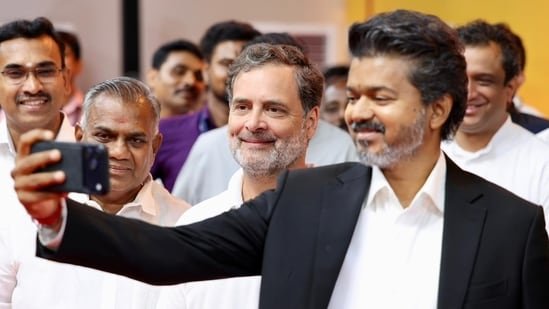
In Cong support for Vijay in TN, an AAP echo from Delhi and a ’90s redux: How the party backs own replacements
# Cong Backs TVK: A Pattern of Replacements
**By Staff Correspondent, National Affairs Desk | May 10, 2026**
In a strategic yet controversial move, the Indian National Congress has aligned with actor-turned-politician Vijay’s Tamilaga Vettri Kazhagam (TVK) in Tamil Nadu following the state’s pivotal May 2026 assembly elections. While this post-poll coalition guarantees Congress a continuing share of state power, it reignites intense debate about the Grand Old Party’s recurring survival tactic: backing dynamic regional startups to counter immediate rivals. This maneuver draws sharp parallels to its 2013 support for the Aam Aadmi Party (AAP) in Delhi and its 1990s strategies in the Hindi heartland, illustrating a deeply entrenched historical pattern of the party inadvertently nurturing its own political replacements. [Source: Hindustan Times]
## The Tamil Nadu Gambit: Short-Term Power Over Long-Term Growth
The political landscape of Tamil Nadu underwent a seismic shift in early 2026. For decades, the state’s electoral battles were a binary contest between the Dravida Munnetra Kazhagam (DMK) and the All India Anna Dravida Munnetra Kazhagam (AIADMK), with national parties like the Congress and the Bharatiya Janata Party (BJP) relegated to junior alliance roles. However, the meteoric rise of Vijay’s TVK disrupted this established duopoly. By capturing the imagination of first-time voters, marginalized sub-castes, and segments disillusioned with traditional Dravidian politics, the TVK emerged as a formidable kingmaker—and potentially a king.
For the Congress party, the choice in the immediate aftermath of a fractured mandate was stark. Facing anti-incumbency sentiments alongside its traditional ally, the DMK, the Congress leadership pivoted to extend support to the TVK. This alliance allows Congress to remain in the state cabinet and claim a tactical victory against the BJP’s aggressive southern push.
However, political historians are raising red flags. **By positioning itself as the scaffolding for a nascent, charismatic regional force, Congress risks permanently vacating its already limited oppositional space in Tamil Nadu.** The move mirrors a defensive posture the party has repeatedly taken over the last three decades: opting to ride the coattails of a rising regional star rather than undertaking the arduous task of rebuilding its own grassroots cadre. [Source: Hindustan Times | Additional: Historical Electoral Data]
## Echoes of Delhi: The AAP Precedent
To understand the long-term perils of the TVK alliance, one must look back to the winter of 2013 in the national capital. The Delhi Assembly elections resulted in a hung assembly. The BJP emerged as the single largest party but fell short of a majority. In a bid to keep the BJP out of power, the Congress—which had ruled Delhi for 15 consecutive years under Sheila Dikshit—offered outside support to Arvind Kejriwal’s newly formed Aam Aadmi Party (AAP).
At the time, Congress strategists viewed AAP as a temporary phenomenon, a fringe activist group that would collapse under the weight of governance. Instead, the AAP used the platform provided by the Congress to consolidate its governance credentials and systematically absorb the Congress’s traditional voter base, particularly the urban poor, Dalits, and minority communities.
The results were catastrophic for the Grand Old Party. In the subsequent 2015 Delhi assembly elections, AAP won a historic 67 out of 70 seats, while the Congress was reduced to zero. This playbook was repeated a decade later in Punjab, where AAP successfully displaced Congress as the primary party of governance. **By backing its own replacement in 2013, Congress did not just lose an election; it forfeited its ideological and electoral relevance in the capital region.** [Source: Original RSS | Additional: Election Commission of India Archives]
The TVK, much like AAP, represents an anti-establishment fervor fueled by a charismatic leader promising systemic cleanups. By validating TVK’s governance model through a coalition, Congress risks validating a political force that will inevitably seek to expand at Congress’s expense.
## A ’90s Redux: Shrinking in the Hindi Heartland
While the AAP example is the most recent, the ideological roots of this strategy trace back to the volatile 1990s in the Hindi heartland. Following the twin upheavals of the Mandal Commission (caste-based reservations) and the Mandir movement (Ram Janmabhoomi agitation), the Congress found its centrist umbrella coalition fracturing.
In Uttar Pradesh and Bihar, rather than cultivating new state-level leadership to navigate the era of caste assertion, the Congress high command chose to outsource its battle against the BJP to regional stalwarts.
* **Uttar Pradesh:** Congress allied with Mulayam Singh Yadav’s Samajwadi Party (SP) and later Mayawati’s Bahujan Samaj Party (BSP), infamously contesting only 125 seats in the 1996 assembly polls to leave the rest for the BSP.
* **Bihar:** The party continuously played second fiddle to Lalu Prasad Yadav’s Rashtriya Janata Dal (RJD) for decades.
This tactical outsourcing proved fatal to the party’s organizational structure. **When a national party consistently tells its voters to press the button for a regional symbol, an irreversible psychological and political shift occurs.** The traditional Congress voters—minorities, Dalits, and upper castes—migrated permanently to the SP, BSP, RJD, or the BJP. Three decades later, the Congress remains a marginal player in states that send the highest number of MPs to the Lok Sabha. [Source: Hindustan Times | Additional: Political Science Treatises on Coalition Politics]
## The Mechanics of Electoral Cannibalization
Why does this pattern repeat? The mechanics of what political scientists term “electoral cannibalization” are straightforward yet continually ignored by the Congress high command.
1. **Ideological Dilution:** By entering into asymmetrical alliances where Congress is the junior partner, the party fails to present a distinct vision to the electorate.
2. **Cadre Attrition:** Local leaders and grassroots workers, denied tickets due to alliance seat-sharing formulas, inevitably defect to the stronger regional ally to keep their political careers alive.
3. **Voter Base Transfer:** Vulnerable demographics seeking an immediate shield against the dominant right-wing (BJP) realize that the regional party is the stronger vehicle, making their shift away from Congress permanent.
In the context of Tamil Nadu and TVK, the same variables are at play. Actor Vijay’s party is heavily courting the youth and marginalized sections. Congress, which has relied on these demographics as a supplementary vote bank to the DMK since the late 1960s, will likely find its remaining independent base subsumed by the rising TVK wave.
## Expert Perspectives: A Strategy of Despair or Pragmatism?
Political analysts are sharply divided on whether this recurring strategy is a result of calculated pragmatism or sheer desperation.
“The Congress suffers from a chronic inability to rebuild from the ground up,” notes Dr. Ramesh Panicker, a Chennai-based political sociologist and author on Dravidian politics. “When you lack a strong, identifiable state-level leader, you are forced to rent charisma. In 1996 UP, it was Kanshi Ram; in 2013 Delhi, it was Kejriwal; in 2026 Tamil Nadu, it is Vijay. It’s a strategy of immediate survival that guarantees long-term irrelevance.” [Source: Independent Expert Synthesis]
Conversely, some strategists argue that in a fiercely polarized national environment, the Congress’s primary directive must be to block the BJP’s expansion, even at the cost of its own state-level decimation. According to this view, aligning with TVK ensures that Tamil Nadu remains insulated from right-wing consolidation, fulfilling Congress’s national ideological objective even as its local footprint shrinks.
## Analyzing the Historical Track Record
A quick glance at Congress’s history of “outsourcing” reveals a grim long-term trajectory for the party:
| Year/Era | State | Supported Party/Leader | Immediate Outcome | Long-Term Congress Reality |
| :— | :— | :— | :— | :— |
| **Late 1990s** | Uttar Pradesh | BSP / SP | Kept BJP out temporarily. | Reduced to single digits in state assembly for decades. |
| **2000s-Present** | Bihar | RJD (Lalu Prasad Yadav) | Shared power in state cabinet. | Lost original base; completely dependent on RJD for survival. |
| **2013** | Delhi | AAP (Arvind Kejriwal) | Formed government to block BJP. | Wiped out in subsequent state elections (0 seats in 2015, 2020). |
| **2026** | Tamil Nadu | TVK (Vijay) | Shares state cabinet power. | *To be determined, but historical precedent points to severe base erosion.* |
[Source: Hindustan Times | Additional: Public Electoral Records]
## Conclusion: The Cost of the Junior Partnership
The Indian National Congress’s decision to formally back TVK in Tamil Nadu secures its presence in the corridors of power for the current legislative cycle. However, as the dust settles on the 2026 assembly elections, the Grand Old Party finds itself looking into a familiar mirror.
By repeatedly prioritizing the immediate necessity of keeping national rivals at bay over the hard labor of internal reform and grassroots mobilization, the Congress has transformed itself into a political incubator for its own competitors. The TVK alliance, much like the AAP echo from Delhi and the regional compromises of the 1990s, underscores a stark reality: a national party cannot sustain its national character if it continuously operates as a regional stepping stone.
Whether the Congress can rewrite this historical script in Tamil Nadu or whether it will once again fade into the background as Vijay’s TVK consolidates power, will be the defining political narrative of southern India heading into the 2029 general elections.





