
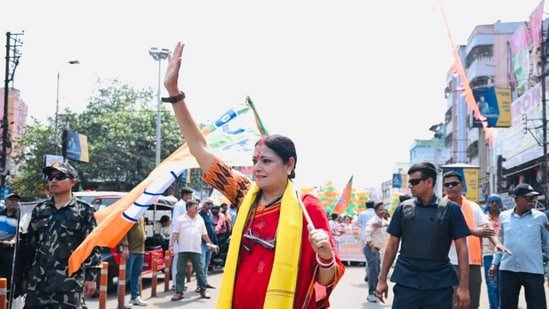
Fashion designer, 23 criminal cases: Who is Agnimitra Paul? BJP's frontrunner to be next Bengal CM
# Who is Agnimitra Paul? BJP’s Bengal CM Hopeful
By Siddharth Verma, National Politics Desk, May 6, 2026
On May 6, 2026, speculation intensified in West Bengal’s volatile political arena as Bharatiya Janata Party (BJP) functionaries began positioning Asansol South MLA Agnimitra Paul as a potential Chief Ministerial candidate against incumbent Mamata Banerjee. A former prominent fashion designer who transitioned into a formidable political figure, Paul’s trajectory has been marked by rapid ascendance and intense partisan conflict, reflected in her **23 pending criminal cases** [Source: Hindustan Times]. As the state gears up for a highly anticipated electoral showdown, Paul has emerged as a strategic counter-figure. Her potential elevation signifies the BJP’s tactical shift toward projecting a strong, regional female leader to challenge the Trinamool Congress’s (TMC) long-standing dominance and its powerful female electorate base.
## From Runway to Grassroots Politics
Before entering the grueling theater of West Bengal politics, Agnimitra Paul was a household name in India’s fashion and entertainment industries. She designed costumes for acclaimed Bollywood and Tollywood films, carving out a niche as an elite creative professional. However, her pivot to public life in March 2019 surprised many political observers.
Joining the BJP ahead of the 2019 Lok Sabha elections, Paul quickly shed her glamorous persona to embrace grassroots activism. Her communication skills, fluency in Bengali and Hindi, and recognizable public profile accelerated her rise within the party ranks. By 2020, she was appointed the President of the BJP Mahila Morcha (Women’s Wing) in West Bengal. In this capacity, she spearheaded numerous campaigns against the ruling TMC, organizing rallies and leading protests on issues ranging from women’s safety to post-poll violence.
Her electoral baptism came during the high-stakes **2021 West Bengal Legislative Assembly elections**. Contesting from the Asansol South constituency—a region known for its complex mix of industrial workers, Hindi-speaking migrants, and traditional Bengali voters—Paul secured a decisive victory. She defeated the TMC candidate by a significant margin, establishing herself not just as a celebrity face, but as a viable vote-catcher [Source: Hindustan Times | Additional: Election Commission of India public records].
## The Strategic ‘Woman vs. Woman’ Narrative
The foundational logic behind positioning Agnimitra Paul as the BJP’s face for the 2026 assembly elections lies in the demographic realities of West Bengal. Chief Minister Mamata Banerjee has cultivated a massive, intensely loyal following among female voters, heavily supported by direct-benefit transfer schemes like *Lakshmir Bhandar*. In past elections, this female voter base has acted as a bulwark for the TMC, effectively neutralizing anti-incumbency sentiments.
BJP strategists reportedly acknowledge that countering a charismatic female mass leader with a male-dominated state leadership has historically yielded limited returns. By projecting a “woman vs. woman” contest, the BJP aims to fragment the TMC’s female vote bank.
* **Relatability and Aggression:** Paul combines urban appeal with a combative street-level political style, making her an effective foil to Banerjee’s populist image.
* **Symbolism of Nari Shakti:** Elevating Paul aligns with the BJP’s broader national narrative of *Nari Shakti* (women’s empowerment), allowing the party to argue that they offer modern, progressive female leadership as an alternative to the TMC administration.
## Understanding the 23 Criminal Cases
A striking detail in Paul’s political dossier is the accumulation of 23 criminal cases against her [Source: Hindustan Times]. To understand this figure, one must look at the context of opposition politics in West Bengal.
In India’s fiercely competitive political landscape, particularly in states with high incidences of political violence, criminal cases against opposition leaders are commonplace. The charges against Paul primarily stem from her involvement in political agitations. These typically include:
1. **Unlawful Assembly:** Leading unauthorized protests or marches.
2. **Violation of Disaster Management Acts:** Organizing political gatherings during the COVID-19 pandemic.
3. **Public Disturbance:** Clashes with state police during political bandhs (strikes) or demonstrations.
From a neutral standpoint, these cases serve a dual purpose in public perception. TMC supporters and critics point to these charges as evidence of disruptive and unlawful behavior. Conversely, within the BJP and among her supporters, these cases are worn as badges of honor—proof of her willingness to fight on the front lines and endure state machinery pressure. Political analysts note that in Bengal, a high number of agitation-related cases often enhances an opposition leader’s credibility as a genuine anti-establishment warrior rather than diminishing their electoral viability.
## Internal Dynamics: Why Agnimitra over Others?
The Bengal BJP is not without established heavyweights. Leader of the Opposition Suvendu Adhikari and State President Sukanta Majumdar have been the primary faces of the party’s fight against the TMC. However, the potential elevation of Paul suggests complex internal dynamics and electoral calculus.
### Table: Comparing Key BJP Bengal Faces
| Leader | Political Base | Strengths | Potential Drawbacks |
| :— | :— | :— | :— |
| **Suvendu Adhikari** | Midnapore region | Mass base, organizational control, defeated Mamata Banerjee in Nandigram (2021). | Highly polarizing, former TMC background. |
| **Sukanta Majumdar** | North Bengal | RSS backing, intellectual appeal, unifying figure within the cadre. | Lacks mass appeal in South Bengal and urban centers. |
| **Agnimitra Paul** | Asansol / Urban | Female representation, articulate, unburdened by past political baggage. | Less organizational experience compared to veteran politicians. |
“Choosing Agnimitra Paul as a CM face would be an unorthodox but highly calculated risk for the BJP,” notes Dr. Arindam Sen, an independent political scientist based in Kolkata. “While she lacks the decades of organizational maneuvering that leaders like Adhikari possess, she provides a clean slate. She can appeal to the urban middle class that has recently drifted, while her combative nature satisfies the rural cadres looking for an aggressive leader.”
## Implications for the 2026 Assembly Polls
The 2026 West Bengal Assembly elections are poised to be a watershed moment. The TMC is seeking a historic fourth consecutive term, a feat that would cement Mamata Banerjee’s legacy as one of India’s most formidable regional leaders. The BJP, having won 77 seats in 2021 to become the principal opposition, is desperate to cross the majority mark.
If the BJP formally anoints Agnimitra Paul as the Chief Ministerial candidate, the electoral discourse will inevitably shift. The campaign would likely center on issues of women’s safety, administrative transparency, and industrial revitalization—areas where the BJP has heavily criticized the incumbent government. Furthermore, Paul’s constituency of Asansol sits in the Paschim Bardhaman district, a vital industrial and coal-mining belt. Strong leadership emerging from this region could help the BJP consolidate votes in the crucial western districts of the state, complementing their traditional stronghold in North Bengal.
However, political transitions are fraught with challenges. The TMC possesses a deeply entrenched organizational network down to the booth level. Furthermore, the ruling party will likely emphasize Banerjee’s extensive administrative experience against Paul’s relatively short political tenure.
## Key Takeaways and Future Outlook
The speculation surrounding Agnimitra Paul’s potential candidacy highlights several critical aspects of contemporary Indian politics:
* **The Premium on Female Leadership:** Political parties are increasingly recognizing that superficial outreach to female voters is insufficient; promoting women to the highest executive roles is becoming a strategic necessity.
* **The Normalization of Political Litigation:** The 23 criminal cases against Paul underscore the combative, often legally fraught nature of opposition politics in West Bengal, where legal battles and political campaigns are inextricably linked.
* **BJP’s Evolving State Strategies:** The potential move away from traditional mass leaders to a newer, specialized face indicates a willingness by the BJP central leadership to experiment with state-level dynamics to break electoral deadlocks.
As of May 2026, while BJP functionaries have strongly hinted at Agnimitra Paul’s viability as an “ideal CM candidate” [Source: Hindustan Times], the central parliamentary board of the party has yet to make an official declaration. Whether this speculation transforms into an official mandate remains to be seen. What is certain, however, is that Agnimitra Paul has successfully navigated the arduous journey from the fashion runways of Mumbai to the gritty, high-stakes battlegrounds of Bengal politics, cementing her status as a central figure in the state’s future.





