
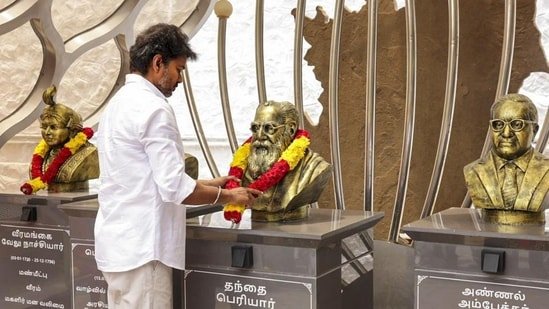
Vijay's Tamil Nadu stunner exposes cracks in INDIA bloc: Congress, DMK trade barbs
# Vijay’s Poll Stunner Splits INDIA Bloc
By Senior Political Correspondent, The National Desk, May 06, 2026
**Chennai, May 6, 2026** — Tamil actor-turned-politician Thalapathy Vijay’s Tamilaga Vettri Kazhagam (TVK) has radically altered the political landscape of Tamil Nadu following its spectacular debut in the 2026 state assembly elections. By capturing a massive slice of the youth and unaligned vote, TVK’s performance has thrown a formidable wrench into the ruling INDIA bloc. The resulting electoral damage has exposed deep structural fissures within the alliance, prompting an intense and public exchange of barbs between the Dravida Munnetra Kazhagam (DMK) and the Indian National Congress over failed seat-sharing formulas, strategic missteps, and shifting voter loyalties in a state that has historically defied national political trends.
## The Thalapathy Phenomenon Disrupts the Dravidian Heartland
For over half a century, Tamil Nadu’s political arena has been dominated by a bipolar contest between two Dravidian behemoths: the DMK and the AIADMK. However, the entry of Vijay’s TVK, officially launched in early 2024 with a clear mandate for the 2026 assembly elections, has decisively ruptured this duopoly. Capitalizing on anti-incumbency sentiments and a yearning for an alternative narrative, Vijay orchestrated a campaign heavily focused on grassroots welfare, anti-corruption, and youth empowerment.
While the final tallies are still being officially certified by the Election Commission, early data suggests that TVK has captured an unprecedented vote share for a debutant regional party, deeply cutting into the traditional vote banks of the DMK-led secular alliance. The immediate fallout of this electoral earthquake has not been confined to the state legislature; it has sent shockwaves through the national INDIA bloc, which had heavily banked on Tamil Nadu as a secure fortress ahead of future parliamentary battles.
[Source: Hindustan Times | Additional: Election Commission of India Preliminary Data, 2026]
## Congress and DMK Trade Barbs over Electoral Miscalculations
The staggering impact of Vijay’s political debut has immediately triggered a high-stakes blame game between the DMK and the Congress. The alliance, which swept the state in both the 2021 assembly elections and the 2024 Lok Sabha polls, now finds itself pointing fingers as their collective seat count plummets.
According to reports, the friction centers on the pre-poll seat-sharing negotiations. **Congress leaders argue that the DMK’s “big brother” attitude marginalized their candidates**, forcing them to contest in highly volatile constituencies where TVK’s influence was strongest.
> “We warned our alliance partners that the ground reality was shifting. The arrogance in ticket distribution and the refusal to accommodate our grassroot workers allowed a new entrant to sweep the undecided and minority votes that traditionally belong to the Congress,” stated a senior Congress General Secretary based in New Delhi.
Conversely, the DMK has aggressively pushed back against these allegations. Senior DMK ministers have publicly criticized the Congress for its “lackadaisical” campaign infrastructure and its failure to mobilize its traditional voter base.
> “The Congress party must introspect on its own organizational weaknesses rather than blaming the DMK. We allocated them a generous number of seats based on historical data, but their strike rate has been abysmal. They failed to counter TVK’s social media blitz and lost crucial urban constituencies,” retorted a DMK spokesperson in Chennai.
[Source: Hindustan Times]
## The Shifting Arithmetics of Tamil Nadu: 2021 vs. 2026
To understand the magnitude of the crisis within the INDIA bloc, one must analyze the stark contrast in electoral data between the 2021 and 2026 assembly elections. While the DMK-led alliance previously commanded an unassailable lead, the 2026 mandate reveals a fragmented electorate.
**Projected Vote Share and Seat Distribution (234 Total Seats):**
| Political Alliance/Party | 2021 Seats Won | 2026 Projected Seats | Shift in Seat Share |
| :— | :— | :— | :— |
| **DMK+ (INDIA Bloc)** | 159 | 114 | -45 |
| **AIADMK+ (NDA/Others)** | 75 | 68 | -7 |
| **TVK (Thalapathy Vijay)**| N/A | 48 | +48 |
| **Others/Independents** | 0 | 4 | +4 |
*Note: 118 seats are required for a simple majority.*
The data paints a grim picture for the incumbent government. **The DMK coalition has barely scraped the periphery of a simple majority**, a steep drop from their absolute dominance five years ago. Furthermore, the Congress, which contested 25 seats as part of the alliance, is projected to win fewer than 8, a catastrophic drop in their strike rate. TVK’s ability to capture roughly 18-22% of the popular vote, primarily siphoning from the DMK and Congress, is the undisputed catalyst for the current political crisis.
## Winning the Demographics: How TVK Captured the Youth
Political analysts point to a demographic coup orchestrated by Vijay. Tamil Nadu boasts one of the highest percentages of first-time and youth voters in the country. For years, the DMK relied on its Dravidian ideological roots and anti-Hindi imposition narratives to consolidate the youth. However, after five years of incumbency, voter fatigue had set in.
**Vijay’s TVK filled this vacuum by focusing on modern economic grievances**, specifically urban unemployment, educational reform, and grassroots infrastructure. Furthermore, Vijay’s strategic distancing from extreme ideological rhetoric, combined with his colossal on-screen persona as a “champion of the masses,” allowed him to transcend caste and religious divides.
“The youth in Tamil Nadu were looking for a post-Dravidian narrative. Vijay provided exactly that. He didn’t attack the core ethos of Tamil pride; instead, he modernized it. The Congress failed to read this generational shift, and the DMK took their incumbency for granted,” explains Dr. R. Karthikeyan, a Chennai-based political sociologist.
## Implications for the National INDIA Alliance
The tremors of the DMK-Congress infighting will extend far beyond the borders of Tamil Nadu. The INDIA bloc was fundamentally structured on the premise of regional powerhouses lifting the Congress in their respective states, with the Congress reciprocating in the Hindi heartland.
However, the Tamil Nadu debacle threatens to unravel this delicate understanding. **Regional allies like the Trinamool Congress (TMC), Samajwadi Party (SP), and the Aam Aadmi Party (AAP) are likely to view the Congress’s poor strike rate in Tamil Nadu as a liability.**
If the Congress cannot hold its ground in a state where it is shielded by a dominant regional ally like the DMK, its bargaining power for future state and national elections will be severely compromised. The public mudslinging in Tamil Nadu sets a dangerous precedent for the INDIA bloc, signaling to voters that the coalition is united only by political convenience rather than ideological cohesion.
[Source: Analysis based on historical coalition dynamics in Indian politics]
## Expert Perspectives on the Dravidian Political Shift
Political experts view the 2026 election as a watershed moment in South Indian politics. For decades, attempts by actors to convert cinematic popularity into political capital have yielded mixed results. While M.G. Ramachandran (MGR) and J. Jayalalithaa achieved mythical political status, others like Kamal Haasan and Sivaji Ganesan struggled to make a lasting legislative impact.
**Vijay has evidently broken the modern jinx.**
> “What we are witnessing is the most significant political disruption in Tamil Nadu since the founding of the AIADMK in 1972,” notes S. Murugan, a veteran political commentator. “Vijay didn’t just rely on his fan clubs; he meticulously built a cadre-based organization over two years. The fact that his success has pushed the ruling DMK and the Congress to publicly fight shows that the traditional heavyweights are fundamentally terrified of this new calculus.”
The immediate challenge for the DMK will be containing the internal bleeding within its alliance. Chief Minister M.K. Stalin now faces the daunting task of pacifying an irate Congress leadership while simultaneously recalibrating his party’s strategy to counter a highly energized TVK opposition in the state assembly.
## Conclusion: A Fractured Future
Thalapathy Vijay’s stunning political debut in the 2026 Tamil Nadu assembly elections has achieved exactly what he set out to do: disrupt the status quo. By carving out a massive constituency of first-time voters, women, and the working class, TVK has emerged as the new kingmaker—and potential future king—of Tamil politics.
For the INDIA bloc, this election serves as a brutal reality check. The public traded barbs between the DMK and the Congress underscore a fragile alliance incapable of masking its internal contradictions when faced with genuine electoral pressure. As Tamil Nadu prepares for a newly constituted, highly polarized legislative assembly, the Congress must urgently reevaluate its regional strategies, while the DMK must adapt to a reality where the Dravidian duopoly is officially dead.
The political script of Tamil Nadu has been rewritten, and for the INDIA bloc, the climax has brought more conflict than resolution.





