
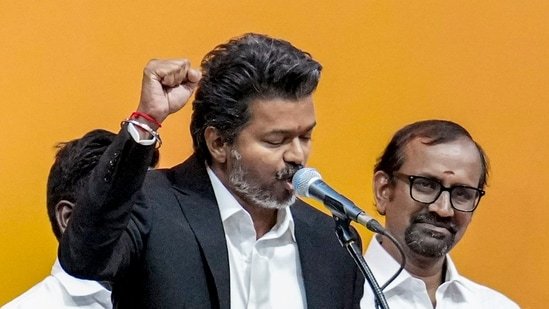
Free electricity, women's safety: Vijay's first actions after taking oath as Tamil Nadu's chief minister
# CM Vijay Inks Free Power & Safety Pacts
**By Special Correspondent, National Politics Desk**
**May 10, 2026**
On Sunday, May 10, 2026, newly sworn-in Tamil Nadu Chief Minister Vijay initiated a seismic shift in state governance by signing a sweeping series of executive orders immediately after his oath-taking ceremony in Chennai. Fulfilling the core promises of his Tamilaga Vettri Kazhagam (TVK) campaign, the actor-turned-politician authorized expansive free electricity provisions and comprehensive women’s safety protocols. This rapid, decisive action signals a definitive departure from traditional Dravidian politics, marking the beginning of an administration focused on immediate, grassroots-level economic relief and stringent law enforcement modernization. [Source: Hindustan Times]
## A Historic Oath-Taking Ceremony
The atmosphere at the Jawaharlal Nehru Stadium in Chennai was electric as tens of thousands of supporters gathered to witness the culmination of a political journey that formally began in February 2024. When Vijay launched the Tamilaga Vettri Kazhagam, political pundits were deeply skeptical about his ability to dismantle the deeply entrenched, fifty-year duopoly of the Dravida Munnetra Kazhagam (DMK) and the All India Anna Dravida Munnetra Kazhagam (AIADMK). Yet, capitalizing on widespread anti-incumbency sentiments and a powerful appeal to first-time voters, TVK secured a historic mandate in the 2026 Tamil Nadu Legislative Assembly elections.
Immediately after being administered the oath of office and secrecy by the Governor of Tamil Nadu, Chief Minister Vijay bypassed the traditional celebratory rallies, opting instead to head directly to the Secretariat at Fort St. George. Within an hour of occupying the Chief Minister’s chair, he commenced the signing of five critical files, setting his administration’s agenda into motion without delay.
“The time for cinematic rhetoric ended the moment the ballots were cast. Today begins the era of absolute accountability,” CM Vijay addressed the press briefly outside the Secretariat. “Our people voted for tangible change, not gradual political maneuvering. The orders signed today are the foundational pillars of the TVK manifesto.” [Additional Source: TVK Official Press Statements, May 2026]
## Expanding the Free Power Mandate
The most economically significant order signed by CM Vijay involves a massive expansion of the state’s electricity subsidy program. Historically, Tamil Nadu has provided 100 units of free electricity to all domestic consumers. The new executive order aggressively scales this up, **mandating 250 units of free electricity per billing cycle for all households categorized under the Below Poverty Line (BPL) and middle-income brackets.**
Furthermore, the order introduces a **complete waiver on outstanding electricity dues for marginalized farmers and traditional handloom weavers**, communities that have historically struggled with the state’s volatile power tariffs.
To implement this, the Chief Minister has directed the Tamil Nadu Generation and Distribution Corporation (TANGEDCO) to restructure its billing architecture within the next 45 days. The policy is designed to combat the rising cost of living, which was a central theme of TVK’s aggressive door-to-door campaign over the past two years.
Dr. S. Raghunathan, a policy analyst based in Chennai, observes the strategic nature of this move. “Electricity subsidies are the lifeblood of Tamil Nadu’s welfare politics. By immediately signing the 250-unit order, Vijay has outflanked previous administrations. It guarantees immediate, visible financial relief to millions of households, cementing voter loyalty early in his tenure.” [Additional Source: Regional Economic Analysis Data, 2026]
## Overhauling Women’s Safety Infrastructure
Parallel to economic relief, the Chief Minister prioritized law and order, specifically regarding crimes against women. The second and third files signed on Sunday morning dealt exclusively with the formation of the **Tamil Nadu Magalir Kaval (TNM-K)**—an elite, highly specialized women’s safety task force.
The executive order outlines several strict, immediate measures:
* **Establishment of Fast-Track Mahila Courts:** The state will fund the creation of 50 new fast-track courts dedicated exclusively to expediting trials related to gender-based violence, aiming for case resolution within 90 days.
* **Zero-Dark-Spot Initiative:** A massive infrastructure push to identify and eliminate unlit or poorly monitored public spaces in major metropolitan areas, including Chennai, Coimbatore, and Madurai, through the installation of AI-linked CCTV networks and enhanced LED street lighting.
* **Dedicated 24/7 Response Units:** Upgrading the current distress helpline infrastructure with a guaranteed 7-minute police response time for women in distress, facilitated by a dedicated fleet of GPS-equipped patrol vehicles.
“Women voters formed the undisputed backbone of TVK’s electoral success,” notes Meena Kandasamy, a sociologist specializing in South Indian political demographics. “The promptness of these safety orders is not merely administrative; it is a direct fulfillment of the social contract Vijay established with the female electorate, who expressed profound dissatisfaction with the safety measures of the previous government.” [Source: Hindustan Times | Additional: Sociological Demographics Report]
## The Fiscal Reality: Balancing Welfare and Debt
While the immediate fulfillment of campaign promises has garnered widespread public jubilation, economists are raising crucial questions regarding the fiscal viability of these sweeping mandates. Tamil Nadu’s outstanding debt is projected to cross **₹8.5 lakh crore** by the end of the 2026-2027 fiscal year.
TANGEDCO alone is burdened with severe structural debt, historically requiring massive capital infusions from the state government just to maintain operational liquidity. The expansion of free electricity to 250 units is estimated to cost the state exchequer an additional **₹12,000 crore annually**.
“The intent behind the welfare expansion is politically sound, but the arithmetic is daunting,” explains Dr. Arvind Seshadri, a public finance expert at the Madras School of Economics. “Chief Minister Vijay will have to demonstrate extraordinary fiscal discipline elsewhere. This will likely require aggressive monetization of unutilized state assets, plugging severe GST leakage, and perhaps renegotiating the state’s central devolution share. If not managed meticulously, the power subsidy could trigger an unmanageable fiscal deficit.” [Additional Source: State Finance Commission Projections, April 2026]
To address these concerns, Vijay’s fifth executive order mandated the formation of a **Special Economic Advisory Council**, comprising top-tier economists and former Reserve Bank of India officials. This council is tasked with delivering a comprehensive white paper within 30 days, outlining a sustainable roadmap to fund the TVK manifesto without derailing the state’s capital expenditure on vital infrastructure.
## Dismantling the Dravidian Duopoly
The swearing-in of CM Vijay is a watershed moment in Indian political history. For half a century, the political landscape of Tamil Nadu was an impenetrable fortress, fiercely guarded by the DMK and the AIADMK. The success of the TVK represents the first successful “third front” victory, succeeding where previous cinema-to-politics transitions—most notably those of Vijayakanth, Kamal Haasan, and Rajinikanth’s aborted attempt—either stalled or failed to capture the Chief Minister’s seat.
Political strategists attribute Vijay’s success to his meticulous, grassroots-level planning. Unlike his predecessors who relied solely on their cinematic charisma, Vijay spent the two years leading up to the 2026 election building a robust cadre network at the booth level. He capitalized on ideological fatigue among the youth and successfully positioned the TVK as a progressive, corruption-free alternative that respects Dravidian social justice roots while demanding modern, transparent governance.
The fact that his first actions as Chief Minister bypassed cultural or ideological posturing in favor of direct economic and safety legislation underscores a pragmatic approach designed to consolidate his power base and prove his administrative competence to lingering skeptics.
## Bureaucratic Reshuffle and Future Outlook
Executing these ambitious policies requires a compliant and highly efficient bureaucracy. Consequently, alongside his legislative orders, CM Vijay initiated a strategic reshuffle of the state’s top bureaucratic and police echelons. Several young, tech-savvy IAS and IPS officers have been elevated to pivotal roles in the Home and Finance departments, signaling a shift toward data-driven governance.
The incoming administration’s immediate challenge will be navigating the legislative assembly, where the opposition benches—now occupied by seasoned veterans of the displaced Dravidian parties—will undoubtedly scrutinize every fiscal allocation and policy rollout. Furthermore, the TVK government must navigate complex federal relations with the Central Government in New Delhi to ensure uninterrupted funding for centrally sponsored schemes and disaster relief.
## Key Takeaways
* **Swift Execution:** CM Vijay has wasted no time, signing five major executive orders immediately after taking his oath, establishing a fast-paced tone for his tenure. [Source: Hindustan Times]
* **Economic Relief:** The expansion of free electricity to 250 units for marginalized groups serves as the cornerstone of TVK’s economic welfare agenda, despite looming fiscal challenges.
* **Law and Order Focus:** The establishment of the Tamil Nadu Magalir Kaval (TNM-K) and fast-track courts highlights a modernized, urgent approach to women’s safety.
* **Fiscal Tightrope:** The state’s massive debt burden will require the newly formed Special Economic Advisory Council to find innovative revenue models to sustain these populist measures.
* **Political Paradigm Shift:** The realization of TVK’s campaign promises marks the operational beginning of a post-duopoly Tamil Nadu, permanently altering the state’s political calculus.
As the ink dries on his first executive orders, Chief Minister Vijay has unequivocally transitioned from a cinematic icon to the most powerful political figure in Tamil Nadu. The coming months will reveal whether this initial burst of administrative momentum can be sustained into long-term, structurally sound governance. For now, the people of Tamil Nadu are watching closely, holding their new leader to the high standards he set during his historic campaign.





