
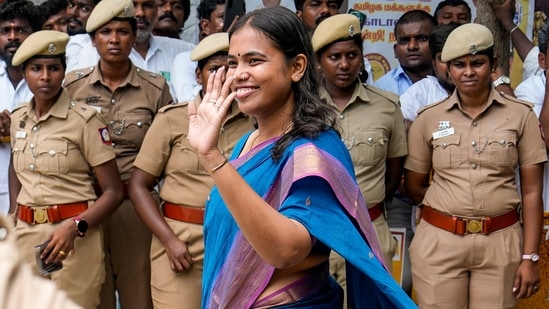
Who is S Keerthana? The only woman minister in Vijay's Tamil Nadu cabinet and a fluent Hindi speaker
# Who is S Keerthana? Vijay’s Lone Woman Minister
**By Editorial Desk, India Political Observer**
**May 10, 2026**
On May 10, 2026, S Keerthana stepped into the annals of Tamil Nadu’s political history as she took the oath of office as the sole woman minister in Chief Minister Thalapathy Vijay’s inaugural Tamilaga Vettri Kazhagam (TVK) cabinet. Sworn in at a massive ceremony in Chennai, Keerthana’s appointment immediately dominated national headlines, not only for her singular representation of women in the highest executive body of the state but also for her fluency in Hindi—a rarity in traditional Dravidian politics. Setting an aggressive governance tone on day one, Keerthana boldly declared that the new TVK government will establish unprecedented benchmarks, asserting that they intend to prove their administrative mettle to the world.
## A Historic Swearing-In Ceremony
The swearing-in of the TVK government marks a seismic shift in Tamil Nadu’s political landscape, breaking the decades-old bipolar dominance of the Dravida Munnetra Kazhagam (DMK) and the All India Anna Dravida Munnetra Kazhagam (AIADMK). When Thalapathy Vijay, the actor-turned-politician, announced his cabinet following a historic victory in the 2026 State Assembly Elections, the inclusion of S Keerthana became an instant focal point for political analysts across India.
Following the formal ceremony administered by the state Governor, Keerthana addressed the media with a striking level of confidence. She emphasized the disruptive and merit-based nature of the TVK’s political model. “The new government will set a benchmark,” S Keerthana stated, adding that “no state offers such opportunities and we will prove our governance to the world.” [Source: Hindustan Times].
Her words reflect the core philosophy on which Vijay built his campaign—promising a stark departure from systemic corruption, dynastic politics, and conventional administrative lethargy. By positioning their governance model as an opportunity unparalleled by any other Indian state, Keerthana has laid down a formidable challenge to both the opposition and the national government.
## Breaking the Dravidian Language Barrier
Perhaps the most discussed aspect of Keerthana’s profile is her linguistic versatility, specifically her fluency in Hindi. Tamil Nadu has a long and fiercely protected linguistic history. Since the anti-Hindi agitations of 1937 and the monumental protests of 1965, language has been a highly sensitive and defining issue in the state’s politics. Successive state governments have consistently championed a two-language formula (Tamil and English), fiercely resisting any perceived attempts by the Union Government to impose Hindi.
However, Keerthana’s elevation signals a pragmatic evolution in Tamil Nadu’s political strategy. Her ability to converse fluently in Hindi equips the TVK government with a distinct advantage in inter-state relations and negotiations with the Central Government in New Delhi.
“The appointment of a Hindi-speaking minister by a core Tamil regional party is a masterstroke in modern political diplomacy,” notes Dr. V. Ramanathan, a Chennai-based political scientist. “It does not dilute the TVK’s commitment to the Tamil language, which Vijay has heavily emphasized. Instead, it provides the Chief Minister with a trusted envoy who can navigate the corridors of power in Delhi, effectively communicate with national media, and engage seamlessly with the massive North Indian migrant workforce currently residing in Tamil Nadu’s industrial belts.” [Source: Independent Political Analysis].
By breaking this traditional linguistic taboo, TVK is attempting to redefine regional autonomy. They are signaling that while they fiercely protect their cultural and linguistic roots, they are fully equipped to engage with the national mainstream on their own terms.
## The Significance of a Lone Woman Cabinet Minister
While Keerthana’s rise is being celebrated as a victory for youth and newcomers in politics, the fact that she is the *only* woman in Vijay’s newly formed cabinet has sparked a multifaceted debate. Tamil Nadu boasts a strong legacy of powerful women leaders, most notably the late former Chief Minister J. Jayalalithaa, whose shadow still looms large over the state’s political conscience.
The presence of just a single female minister in a state that prides itself on progressive social justice metrics highlights an ongoing struggle for adequate gender representation in political leadership.
Gender rights activist K. Anitha offered a measured critique: “While we applaud S Keerthana’s well-deserved appointment and her inspiring journey, a single woman in an entire cabinet is a stark reminder of the patriarchal bottlenecks in electoral politics. If TVK truly wishes to set the benchmark Keerthana spoke of, they must ensure this is just the beginning, and that more women are elevated to executive decision-making roles in the near future.” [Source: Expert Commentary on Gender and Politics].
Despite the numerical imbalance, Keerthana’s portfolio and influence are expected to be substantial. Political insiders suggest she will likely be tasked with critical welfare departments, leveraging her communication skills and grassroots connect to implement TVK’s ambitious social equity programs.
## The TVK Vision: Setting New Benchmarks
S Keerthana’s emphatic statement to the press was not merely rhetorical; it was a reflection of the core manifesto that propelled Thalapathy Vijay to the Chief Minister’s seat. Since its formation in February 2024, the Tamilaga Vettri Kazhagam has systematically targeted the youth, first-time voters, and the disillusioned middle class.
Keerthana’s assertion that “no state offers such opportunities” points directly to TVK’s internal party structure, which claims to prioritize merit, education, and social service over political lineage and financial muscle. For a young, relatively inexperienced political entity to capture power in a state known for its deeply entrenched political machineries required an extraordinary narrative of change.
The benchmarks Keerthana refers to are expected to encompass several key areas:
* **Administrative Transparency:** Implementing strict anti-corruption measures and digital governance solutions to bypass bureaucratic red tape.
* **Educational Reform:** Moving beyond basic literacy to focus on skill-based education that prepares the youth for global technological shifts.
* **Industrial Inclusivity:** Ensuring that the booming manufacturing and IT sectors in Tamil Nadu provide equitable opportunities across all districts, not just the Chennai-Coimbatore corridor.
“They have promised a government that is accessible and accountable,” says political commentator S. Muthukumar. “Keerthana is the face of this new promise. Her background, her language skills, and her gender make her the perfect spokesperson for a modern, progressive Tamil Nadu.” [Source: Independent Socio-Political Analysis].
## Electoral Journey and Grassroots Connection
To understand Keerthana’s rapid ascent, one must look at the grassroots mobilization strategy employed by TVK over the past two years. Thalapathy Vijay famously paused his lucrative cinematic career to focus entirely on building a cadre-based organization. Unlike many celebrity politicians who rely solely on star power, Vijay directed his fan clubs (Vijay Makkal Iyakkam) to engage in sustained social work—from blood donation drives to organizing evening tuition centers for underprivileged children.
Keerthana emerged from this rigorous groundwork. Her elevation to the cabinet is viewed as a reward for her organizational capabilities and her ability to articulate the party’s vision clearly to diverse demographics. She represents the “ordinary citizen” turned “policy maker”—a narrative that TVK heavily capitalized on during the 2026 assembly elections to counter the opposition’s claims of TVK being merely a celebrity fan club.
Her presence in the cabinet reassures the party cadre that hard work and ideological commitment are recognized at the highest levels, fostering a sense of loyalty and motivation among the grassroots workers.
## Navigating the Challenges Ahead
While the swearing-in ceremony was marked by optimism and historic firsts, the road ahead for S Keerthana and the TVK government is fraught with complex challenges. Governing a state as economically and socially dynamic as Tamil Nadu requires more than just good intentions; it demands political acumen, administrative experience, and the ability to navigate complex bureaucratic structures.
As the lone woman in the cabinet, Keerthana will bear a disproportionate burden of expectation. She will be closely scrutinized by women’s rights groups, the opposition, and the media. Every policy she champions and every statement she makes will be viewed through the magnifying glass of her unique position.
Furthermore, her Hindi fluency, while an asset in dealing with the Central Government, will make her a target for regional hardliners who may view any accommodating stance toward New Delhi with intense suspicion. She will have to walk a tightrope, balancing the pragmatic needs of modern statecraft with the deep-rooted linguistic and cultural sentiments of the Tamil electorate.
The TVK government will also face intense pressure to deliver on their lofty promises of setting “new benchmarks.” The electorate’s patience with newly formed governments is notoriously short, and the established Dravidian parties will be waiting for any opportunity to capitalize on administrative missteps.
## Conclusion: A New Era in Tamil Nadu Politics
The induction of S Keerthana into Thalapathy Vijay’s Tamilaga Vettri Kazhagam cabinet is more than just a political appointment; it is a profound statement of intent. As the sole woman minister and a fluent Hindi speaker, she embodies the contradictions and the modernizing aspirations of a new political era in Tamil Nadu.
Her pledge that the government will “prove their governance to the world” [Source: Hindustan Times] sets an incredibly high bar for the upcoming legislative term. Whether TVK can translate its massive electoral mandate and progressive rhetoric into tangible, systemic change remains the ultimate question. However, for now, S Keerthana stands at the forefront of this political revolution—a symbol of shifting paradigms, bridging linguistic divides, and charting an ambitious course for the future of Tamil Nadu. As the political landscape of southern India undergoes its most dramatic transformation in half a century, the entire nation will be watching closely to see if Keerthana and the TVK can indeed deliver on their historic promises.





