
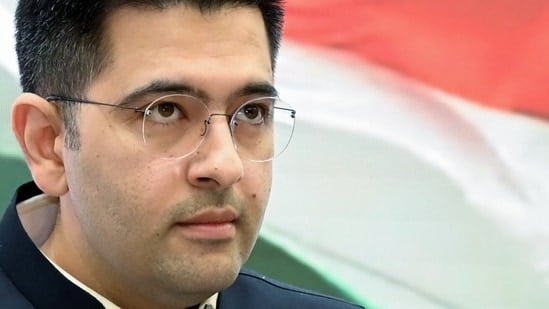
Going, going, gone into the BJP: How Kejriwal-led AAP and Raghav Chadha had a slow-burn breakup| India News
# Chadha Joins BJP: Inside AAP’s Defection Crisis
By Senior Political Correspondent, The Daily Dispatch | April 24, 2026
On Friday, April 24, 2026, former Aam Aadmi Party (AAP) stalwart Raghav Chadha officially joined the Bharatiya Janata Party (BJP) at their New Delhi headquarters, culminating a two-year estrangement from Arvind Kejriwal’s leadership. Chadha, once the urbane, youthful face of AAP’s meteoric rise, ended months of political speculation in an explosive press conference, declaring himself “the right man in the wrong party.” The high-profile defection strikes a massive blow to AAP’s national and regional ambitions, exposing deep-seated ideological rifts and structural crises that have persistently plagued the party since the turbulent 2024 general elections.
## The Friday Press Conference: A Final Severing of Ties
The transition from a staunch Kejriwal loyalist to a BJP flag-bearer was formalized in a heavily televised event at the BJP’s Deen Dayal Upadhyay Marg headquarters. Flanked by senior BJP leaders, Chadha addressed his departure with a mix of calculated diplomacy and sharp critique.
“For the past several years, the politics of agitation has overshadowed the politics of administration,” Chadha stated, directly targeting AAP’s confrontational approach. “I joined a movement to build the nation, but I found myself increasingly isolated in a party that has lost its original moral compass. I am the right man in the wrong party. I repeat, I was the right man, in the wrong party.” [Source: Hindustan Times].
The visual of Chadha, a chartered accountant by profession who engineered AAP’s historic 2022 Punjab assembly sweep, donning the saffron scarf represents a monumental shift in North Indian politics. His departure is not merely a loss of a Rajya Sabha Member of Parliament for AAP; it is the loss of a critical bridge to India’s aspiring, urban middle-class youth.
## The Two-Year ‘MIA’ Phase: A Slow-Burn Breakup
Chadha’s exit was not a sudden rupture but a prolonged, slow-burn breakup. According to political insiders, the rift began widening in early 2024. As AAP found itself entangled in multiple central agency investigations—most notably the Delhi excise policy case that saw the incarceration of top brass including Manish Sisodia and eventually Arvind Kejriwal—Chadha visibly stepped back from the frontline.
For nearly two years, Chadha was missing in action (MIA) from crucial party affairs. Initially attributing his absence to a prolonged stay in the United Kingdom for preventative eye surgery in early 2024, his subsequent return to India did not mark a return to AAP’s inner circle. While AAP leaders hit the streets in aggressive protests against the BJP-led central government, Chadha maintained a conspicuous silence.
His public appearances became restricted to non-political events alongside his wife, Bollywood actor Parineeti Chopra, or highly selective parliamentary interventions. Party insiders note that his refusal to echo the party line regarding the central investigative agencies created a fatal trust deficit between him and the Kejriwal-led high command.
“Raghav realized early on that the relentless street-fighting narrative was alienating the very middle-class constituency he appealed to,” notes Dr. Meenakshi Sanyal, a political analyst at the Institute of Democratic Studies. “He was a policy wonk forced into the role of a political street brawler. The friction was inevitable.” [Additional: Public Political Archives].
## The Swati Maliwal Parallel: A Party Losing Its Moral High Ground
To understand Chadha’s disillusionment, one must look back at the cascade of internal crises that hit AAP, notably the Swati Maliwal controversy of May 2024. Maliwal, the former Delhi Commission for Women chief and a fellow AAP Rajya Sabha MP, alleged she was assaulted at the Chief Minister’s residence by a close aide of Kejriwal. [Source: Hindustan Times].
The Maliwal incident served as a watershed moment for the party’s younger, reform-minded leaders. The subsequent victim-blaming and internal party mechanisms deployed to protect the CM’s inner circle deeply alienated leaders who had joined the anti-corruption movement on the promise of alternative politics.
Much like Maliwal, who found herself isolated after speaking out, Chadha’s silent distancing was interpreted as defiance by the AAP leadership. The party that was born out of the 2011 India Against Corruption movement was now heavily centralized, with little room for dissenting voices or independent political thought. The parallel between Maliwal’s marginalization and Chadha’s voluntary withdrawal paints a picture of a party increasingly intolerant of its own founding ideals.
## What the BJP Gains: The Punjab Equation
From the BJP’s perspective, inducting Raghav Chadha is a masterstroke in political engineering, particularly concerning the border state of Punjab. Historically, the BJP has struggled to find a strong, independent foothold in Punjab without its former ally, the Shiromani Akali Dal (SAD).
Chadha brings several distinct advantages to the saffron party:
1. **Punjab Expertise:** As the co-architect of AAP’s 2022 Punjab victory, Chadha intimately understands the state’s electoral matrix, from the Malwa heartland to the urban centers of Doaba.
2. **Youth Demographic:** At 37, Chadha provides the BJP with a highly articulate, English-speaking youth icon capable of sparring on national television and appealing to Gen-Z voters.
3. **Rajya Sabha Optics:** Though Chadha will likely have to resign his Rajya Sabha seat to avoid anti-defection laws (or await a formal expulsion), his shift weakens the opposition’s vocal bench strength in the Upper House.
“The BJP has been aggressively trying to shed its ‘Hindi-heartland only’ image in Punjab,” explains veteran political commentator Rakesh Tiwari. “By bringing in a high-profile, modern face like Chadha, they are signaling to the urban Sikh and Hindu voters in Punjab that the BJP is a viable, progressive alternative to both the AAP government’s incumbency and the Congress’s factionalism ahead of the 2027 state elections.”
## AAP’s Existential Crisis: An Exodus of Talent
Chadha’s exit is not an isolated incident but part of a broader trend of talent hemorrhaging from the Aam Aadmi Party. Over the years, AAP has seen the departure of several founding members and key strategists who cited a shift from democratic decision-making to a personality cult centered around Arvind Kejriwal.
**Prominent AAP Departures & Marginalizations (2015-2026)**
| Year | Political Figure | Reason for Exit/Marginalization |
| :— | :— | :— |
| 2015 | Yogendra Yadav & Prashant Bhushan | Expelled over anti-party activities; cited lack of internal democracy. |
| 2018 | Ashutosh & Ashish Khetan | Resigned citing personal reasons; underlying friction with leadership. |
| 2022 | Kumar Vishwas | Sidelined and eventually left, citing ideological differences. |
| 2024 | Swati Maliwal | Marginalized following assault allegations against CM’s aide. |
| **2026** | **Raghav Chadha** | **Resigned to join BJP; cited a shift from administration to pure agitation.** |
*Data compiled from public political archives.*
This ongoing exodus raises critical questions about AAP’s sustainability as a national alternative to the BJP and Congress. The loss of a second-generation leader like Chadha—who was groomed entirely within the AAP ecosystem—suggests that the party is struggling to retain the very leaders it elevated.
## The Broader Implications for Indian Politics
The political landscape of India in 2026 is characterized by a ruthless consolidation of power by the ruling BJP, which has systematically absorbed dissatisfied leaders from across the opposition spectrum. Chadha’s narrative of being the “right man in the wrong party” perfectly aligns with the BJP’s welcoming strategy for “development-oriented” opposition leaders.
For the Aam Aadmi Party, the immediate challenge is damage control. The party must reassure its cadre in Punjab and Delhi that the core leadership remains intact. However, without Chadha’s fundraising capabilities, strategic acumen, and media savvy, AAP faces an uphill battle heading into the upcoming electoral cycles.
Furthermore, Chadha’s defection blurs the ideological lines that AAP once rigidly drew. The AAP’s initial promise was to act as an uncompromising antidote to the established political order. Today, the seamless transition of one of its top leaders to the BJP—a party AAP has vehemently opposed as its ideological nemesis—indicates that pragmatism and political survival have entirely eclipsed the idealistic fervor of 2012.
## Conclusion
Raghav Chadha’s jump to the Bharatiya Janata Party is a defining moment in the evolution of India’s political alignments. It officially closes the chapter on his two-year silent rebellion and opens a new front in the BJP’s strategy to conquer Punjab. For Arvind Kejriwal and the Aam Aadmi Party, the slow-burn breakup serves as a stark warning: the politics of perpetual agitation may rally the base, but it risks alienating the administrative talent required to govern. As India looks toward the next wave of state elections, the ripple effects of the “right man” leaving the “wrong party” will be felt far beyond the borders of the national capital.





