
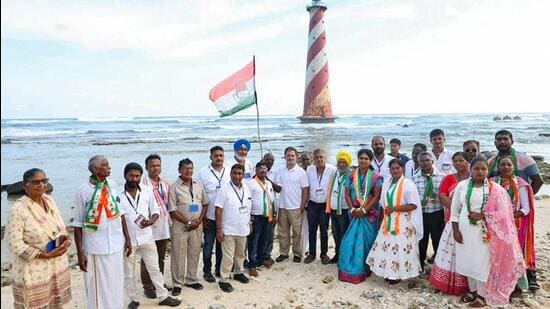
Gravest crime against nature, tribal heritage: Rahul Gandhi on Great Nicobar project
# Gandhi Slams Great Nicobar Project as Eco Crime
By Special Correspondent, April 29, 2026
On Wednesday, April 29, 2026, senior Congress leader Rahul Gandhi forcefully condemned the ₹72,000 crore Great Nicobar mega-infrastructure project, labeling it the “gravest crime against nature and tribal heritage.” Speaking to the media in New Delhi, Gandhi announced his intention to escalate the issue in the upcoming parliamentary session, demanding immediate governmental transparency and accountability. The ambitious development initiative, which envisions a transshipment port and an international airport, has sparked a fierce national backlash over the projected felling of nearly 8.5 lakh trees and the severe threats posed to the indigenous Shompen and Nicobarese tribes. This high-profile political intervention effectively mainstreams the ongoing debate, pitting India’s strategic economic ambitions against the critical need for ecological and anthropological preservation. [Source: Hindustan Times | Additional: Public Parliamentary Records].
## The Core Allegations and Parliamentary Vow
The controversy surrounding the holistic development of Great Nicobar Island has simmered for years, but Rahul Gandhi’s recent remarks have elevated it to the forefront of national political discourse. Gandhi alleged that the massive ecological damage inherent in the project is being glossed over by federal authorities. By categorizing the initiative as a “crime against nature,” the opposition leader is actively courting environmental activists, civil society organizations, and tribal rights advocates who have long opposed the development.
Gandhi explicitly vowed to utilize the parliamentary floor to interrogate the environmental clearances granted to the project. The opposition’s strategy appears twofold: to challenge the economic viability of the project in light of its environmental costs, and to highlight the alleged bypassing of constitutional safeguards meant to protect indigenous communities.
“The destruction of one of India’s most pristine ecosystems cannot be justified under the guise of development. The erasure of tribal heritage is an irreversible tragedy,” Gandhi noted in his critique, signaling a tumultuous upcoming monsoon session where the opposition bloc is expected to demand a comprehensive review of the Environmental Impact Assessment (EIA). [Source: Hindustan Times].
## Scope and Scale of the Mega Project
To understand the magnitude of the political and environmental conflict, it is essential to examine the project’s vast scale. Spearheaded by the NITI Aayog (India’s apex public policy think tank), the **₹72,000 crore (approximately $9 billion) mega-project** aims to transform the southern-most tip of the Andaman and Nicobar archipelago into a maritime and commercial hub.
The development plan covers an estimated **166 square kilometers** of the island and comprises four primary components:
1. **International Container Transshipment Terminal (ICTT):** Located at Galathea Bay, designed to handle up to 16 million TEUs (twenty-foot equivalent units) of cargo annually.
2. **Greenfield International Airport:** Intended to support both civilian and strategic military operations with a peak capacity of 4,000 passengers per hour.
3. **Gas and Solar Power Plant:** A 450 MVA power facility to sustain the new infrastructure.
4. **Coastal Township:** A massive urban development projected to house over **300,000 new residents** over the next three decades.
The government asserts that the project will generate over 100,000 direct and indirect jobs, drastically boosting the regional economy and positioning India as a dominant player in global maritime trade. [Source: NITI Aayog Project Blueprint].
## Ecological Costs: Biodiversity and Deforestation
Despite the economic promises, the ecological toll of the Great Nicobar project is the primary catalyst for the current political storm. The island is designated as a UNESCO World Biosphere Reserve, characterized by ancient, untouched tropical rainforests and unique endemic species.
According to the Ministry of Environment, Forest and Climate Change (MoEFCC), the project necessitates the **felling of an estimated 8.5 lakh (850,000) trees**. Environmentalists argue this will drastically alter the island’s microclimate and hydrology.
Furthermore, the construction of the transshipment port at Galathea Bay directly impacts a globally significant nesting site for the endangered **Giant Leatherback Turtle**. Other vulnerable species threatened by the habitat destruction include the Nicobar Megapode, the Nicobar Macaque, and extensive offshore coral reef systems.
“The Great Nicobar ecosystem is an evolutionary marvel, essentially an isolated biological laboratory,” explains Dr. Meera Sanyal, an independent conservation biologist based in Chennai. “Mitigation strategies like ‘compensatory afforestation’ planned thousands of miles away in the arid landscapes of Haryana cannot scientifically replace a highly complex, millennia-old tropical rainforest canopy.” [Source: Independent Scientific Analysis].
## The Threat to Indigenous Heritage
Perhaps the most sensitive aspect of Gandhi’s critique pertains to the existential threat posed to the island’s indigenous populations. Great Nicobar is home to two primary tribes: the Nicobarese, and the highly secluded **Shompen**, a Particularly Vulnerable Tribal Group (PVTG).
The Shompen tribe consists of roughly 200 to 300 individuals who live deep within the island’s forests, maintaining minimal contact with the outside world. They rely entirely on the forest for foraging, hunting, and fresh water. Anthropologists have repeatedly warned that the influx of 300,000 construction workers and eventual settlers—an astronomical increase compared to the island’s current total population of around 8,000—could introduce foreign pathogens. For an isolated community with no immunological defense against common mainland diseases, this exposure could be fatal.
Rights groups have pointed out that the project severely encroaches upon the Tribal Reserve areas protected under the Andaman and Nicobar Protection of Aboriginal Tribes Regulation (ANPATR), 1956. Gandhi’s assertion that the project is a “crime against tribal heritage” directly channels the fears of human rights organizations that the Shompen face a high risk of demographic collapse. [Source: Hindustan Times | Additional: Anthropological Survey of India reports].
## The Government’s Defense and Strategic Imperatives
To maintain a balanced perspective, the geopolitical and economic imperatives driving the central government’s unwavering support for the project must be acknowledged. New Delhi views the Great Nicobar Island not merely as a piece of ecological real estate, but as a critical geostrategic asset.
Located just 90 nautical miles from the western entrance of the **Strait of Malacca**—one of the world’s most vital maritime chokepoints through which nearly 30% of global sea-borne trade passes—the island offers India an unparalleled vantage point.
Arvind Sharma, a New Delhi-based maritime security analyst, outlines the government’s rationale: “In the context of the Indo-Pacific, establishing a robust civilian and strategic footprint in Great Nicobar is essential to counter an increasingly assertive Chinese naval presence in the Indian Ocean Region. The transshipment port will not only secure supply chains but also prevent Indian cargo from being highly dependent on foreign ports like Colombo or Singapore.”
The government has also continuously reiterated that strict environmental safeguards are in place. Authorities have committed to creating specific biological corridors to ensure wildlife movement and have stated that strict “no-go” zones will be enforced to prevent outsiders from interacting with the Shompen tribe. Furthermore, the administration has pledged significant funds towards coral translocation and advanced conservation research. [Source: Ministry of Ports, Shipping and Waterways].
## Project Overview: Strategic Goals vs. Ecological Concerns
The polarizing nature of the Great Nicobar project can be summarized through the conflicting priorities of its proponents and critics:
| Aspect | Government / Strategic Stance | Ecological / Opposition Concerns |
| :— | :— | :— |
| **Geopolitics** | Secures the Indian Ocean Region; monitors the critical Strait of Malacca. | Militarization and massive footprint disrupt a fragile, historically isolated zone. |
| **Economy** | Recaptures transshipment cargo lost to foreign ports; creates 100,000+ jobs. | Economic gains do not justify the permanent loss of unique natural capital. |
| **Environment** | Claims robust mitigation plans, coral translocation, and remote afforestation. | Loss of 8.5 lakh ancient trees; grave threat to Leatherback nesting sites. |
| **Tribal Rights** | Promises strict exclusion zones to protect the Shompen from outsiders. | Demographic inundation (300k settlers) poses severe disease and cultural risks. |
## Parliamentary Outlook and Political Implications
Rahul Gandhi’s vow to raise the Great Nicobar issue in Parliament signifies a shift in how environmental policies are being leveraged in Indian politics. Historically, large-scale infrastructure projects justified by national security have faced minimal coordinated political opposition. However, the sheer scale of the deforestation and the human rights concerns regarding the Shompen have provided the opposition with a potent narrative.
During the upcoming parliamentary sessions, political analysts expect the opposition to demand the formation of a Joint Parliamentary Committee (JPC) or a specialized ecological review board to reassess the project’s clearances. They are likely to scrutinize the rapid pace at which Stage-I forest clearances were granted, questioning whether empirical environmental science was sidelined in favor of rapid industrialization.
The ruling government will likely defend the initiative by underscoring the long-term national security benefits and accusing the opposition of stalling crucial national development. This clash will force lawmakers to publicly debate where India must draw the line between aggressive economic expansion and the preservation of its rapidly diminishing natural heritage.
## Conclusion
Rahul Gandhi’s harsh condemnation of the Great Nicobar project as the “gravest crime against nature and tribal heritage” has successfully drawn intense national focus to an issue that was previously confined to environmental and academic circles. By bringing the debate to the Parliament floor, the tension between executing strategic mega-infrastructure and preserving vulnerable ecosystems is set to become a defining political talking point of 2026.
As India seeks to establish itself as a formidable global economic and maritime power, the fate of Great Nicobar will serve as a historic litmus test. The nation watches closely to see if a middle path can be forged—one that secures India’s geopolitical interests without irreparably sacrificing the pristine biodiversity and the ancient indigenous cultures that call the archipelago home. The outcome of this parliamentary debate will likely set a lasting precedent for how future mega-projects in ecologically sensitive zones are evaluated, executed, or ultimately abandoned.





