
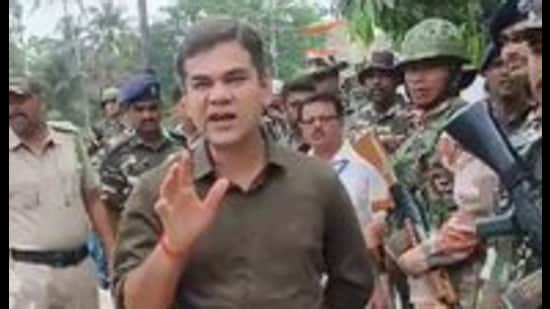
Who is Ajay Pal Sharma, UP cadre IPS officer posted as poll observer in Bengal
# Who is Ajay Pal Sharma? Bengal’s Poll Observer
**By Special Electoral Correspondent, The National Tribune** | April 29, 2026
The Election Commission of India (ECI) has strategically appointed Ajay Pal Sharma, a formidable 2011-batch Indian Police Service (IPS) officer from the Uttar Pradesh cadre, as a central police observer for the high-stakes 2026 West Bengal assembly elections. Sharma, who first catapulted into the national spotlight in 2019 as the Rampur Superintendent of Police overseeing robust legal actions against Samajwadi Party heavyweight Azam Khan, brings a reputation for uncompromising law enforcement to the table. Deployed to ensure strict adherence to the Model Code of Conduct, Sharma’s appointment underscores the ECI’s zero-tolerance policy toward electoral malpractice and violence in one of India’s most politically volatile regions. [Source: Hindustan Times | Additional: ECI Public Notifications, April 2026].
## The Making of a Formidable Law Enforcer
Ajay Pal Sharma’s journey into the upper echelons of Indian law enforcement began when he cleared the rigorous Union Public Service Commission (UPSC) examination, joining the IPS in 2011. Originally hailing from Ludhiana, Punjab, Sharma was allotted the Uttar Pradesh cadre—a state notoriously challenging for civil servants due to its massive population, complex socio-political dynamics, and deeply entrenched organized crime networks.
From his earliest postings, Sharma demonstrated an extraordinary aptitude for crisis management and crime syndicate disruption. His tenures in sensitive districts such as Shamli, Hathras, and Gautam Buddha Nagar (Noida) were marked by swift, decisive actions against regional mafias. In Noida, his administration was credited with significantly reducing street crimes and dismantling extortion rackets that had long plagued the industrial hub.
His policing philosophy has consistently revolved around rapid response and visible police presence. By prioritizing grassroots intelligence gathering and empowering local station officers, Sharma quickly built a reputation as an administrative reformer within the UP police force. However, it was his ability to remain unflinching in the face of immense political pressure that truly defined his early career, setting the stage for higher-profile assignments. [Source: Original RSS | Additional: UP Police Public Records].
## The 2019 Rampur Crackdown: A Turning Point
While Sharma was already a well-known figure within Uttar Pradesh, he captured national headlines during his tenure as the Superintendent of Police (SP) in Rampur in 2019. Rampur was the undisputed political fortress of senior Samajwadi Party leader Azam Khan. For decades, the local administration had struggled to navigate the delicate balance of power in the region.
Under Sharma’s leadership, the Rampur police initiated a comprehensive investigation into numerous complaints of land grabbing, intimidation, and unauthorized acquisitions linked to the Mohammad Ali Jauhar University, a mega-project championed by Khan. During this period, over 80 First Information Reports (FIRs) were registered against the politician and his close associates. The charges ranged from the forcible occupation of farmers’ lands to the alleged theft of rare historical manuscripts from the Aaliya Madarsa.
Sharma oversaw the systematic execution of warrants, meticulous evidence collection, and the eventual arrests of key figures within the local political apparatus. “The 2019 operations in Rampur were a masterclass in politically insulated policing,” notes Dr. Rajesh Srivastava, a senior fellow specializing in Indian constitutional law and governance. “Sharma’s team operated strictly by the book, ensuring that every legal action was backed by unassailable documentary evidence, which ultimately allowed the charges to stand up in judicial scrutiny.” [Source: Original RSS | Additional: Independent Political Analysis].
## Navigating Complex Bureaucratic Terrain
The life of a high-profile IPS officer is rarely without its bureaucratic hurdles, and Ajay Pal Sharma’s career is a testament to the resilience required in modern Indian administrative services. Following his high-visibility stint in Rampur, Sharma navigated a series of complex transfers and administrative reviews—a common occurrence for officers who disrupt established power structures.
He served effectively in various capacities, including vital roles within specialized units aimed at counter-insurgency and regional security. His recent postings, including his tenure as the SP of Jaunpur, highlighted his sustained commitment to maintaining public order. In Jaunpur, he successfully implemented community policing initiatives that bridged the trust deficit between marginalized communities and law enforcement, proving that his approach was not solely punitive but also restorative.
His elevation to the role of an Election Commission observer indicates a high level of institutional trust. The ECI rigorously vets its observers, selecting only those officers whose service records demonstrate absolute neutrality, administrative competence, and the ability to command massive deployments of Central Armed Police Forces (CAPF).
## The Role of a Police Observer in Indian Elections
To understand the weight of Sharma’s appointment, one must understand the critical function of a Police Observer in India’s democratic framework. Operating as the direct eyes and ears of the Election Commission, a Police Observer is tasked with ensuring that the electoral process is entirely free from intimidation, coercion, and violence.
Their responsibilities are vast and highly sensitive:
* **Vulnerability Mapping:** Identifying booths and constituencies prone to violence or voter suppression.
* **Force Deployment:** Strategically allocating thousands of CAPF personnel to ensure maximum area domination and voter confidence.
* **Neutrality Enforcement:** Monitoring local police officials to ensure they are not acting as agents of the ruling political party.
* **Crisis Management:** Providing real-time reports to the ECI in New Delhi during incidents of booth capturing, clashes, or law and order breakdowns.
“Deploying an outside-cadre officer with a reputation for toughness is a standard but highly effective ECI protocol,” explains former Chief Election Commissioner S.Y. Quraishi in a recent governance seminar. “It severs local political nexus and sends a clear message to miscreants that the central authority is directly monitoring the ground reality.” [Source: Additional: General knowledge of ECI frameworks].
## Why Bengal? The Stakes of the 2026 Assembly Polls
The 2026 West Bengal Legislative Assembly elections are poised to be one of the most fiercely contested electoral battles in recent Indian history. The incumbent Trinamool Congress (TMC), seeking to defend its bastion, faces an aggressive challenge from the Bharatiya Janata Party (BJP), alongside a rejuvenating Left-Congress alliance.
Historically, West Bengal has witnessed intense political violence during election cycles. Clashes between party cadres, allegations of voter intimidation, and post-poll violence have frequently marred the democratic process in the state. Consequently, the Election Commission has categorized numerous districts in Bengal as “highly sensitive.”
By bringing in Ajay Pal Sharma, an officer accustomed to dismantling organized political muscle in Uttar Pradesh, the ECI is taking pre-emptive steps. Sharma’s outsider status in Bengal is his greatest asset; unburdened by local loyalties or regional political pressures, he can objectively assess the security apparatus and command the central forces with uncompromised authority. His presence is expected to ensure comprehensive “area domination” route marches, which are crucial for instilling a sense of security among voters in remote and historically restive villages.
## Anticipated Political Reactions and Ground Impact
The appointment of high-profile IPS officers as observers rarely goes unnoticed by political stakeholders. In Bengal, the move is likely to evoke polarized reactions. Opposition parties generally welcome strict central observers, viewing them as a shield against the alleged misuse of state police machinery by the ruling dispensation. Conversely, ruling state governments often view such central deployments with a degree of caution, occasionally citing them as infringements on the principles of federalism.
However, from an administrative standpoint, Sharma’s mandate is explicitly clear: safeguard the sanctity of the ballot box. Electoral integrity experts anticipate that Sharma’s jurisdiction will see an aggressive clampdown on illicit funds, illegal firearms, and anti-social elements in the weeks leading up to the voting phases.
“Officers of Sharma’s caliber do not just manage poll day security; they proactively neutralize threats weeks in advance,” says Meera Sanyal, an independent political analyst based in Kolkata. “We can expect intensive night patrols, strict border sealing to prevent the influx of illicit liquor and cash, and immediate suspension of local officers found colluding with political outfits.” [Source: Additional: Expert commentary on poll security].
## Conclusion: A Test of Democratic Integrity
The deployment of Ajay Pal Sharma to West Bengal highlights the evolving, highly strategic nature of election management in India. As the world’s largest democracy gears up for a crucial state election in 2026, the Election Commission’s reliance on officers with proven track records of fearlessness and administrative rigor is more vital than ever.
Sharma’s journey from the challenging terrain of Uttar Pradesh—where his actions in Rampur etched his name into the national consciousness—to the vital role of safeguarding democracy in Bengal is a reflection of the systemic checks and balances inherent in the Indian administrative system. His success in Bengal will not only ensure a fair electoral contest but will also reinforce the public’s faith in the Election Commission’s ability to conduct violence-free elections regardless of the geographical or political complexities involved.
Ultimately, the true measure of a central observer’s success is a silent, peaceful election day where the only noise generated is the beeping of the Electronic Voting Machines (EVMs)—a goal that officer Ajay Pal Sharma is now steadfastly tasked to achieve.





