
Haryana wage hike triggered unrest in Noida. But why were protests also held in Faridabad?| India News
# Haryana Wage Hike Ignites NCR Unrest
**By Siddharth Rao, National Labor Desk** | **April 14, 2026**
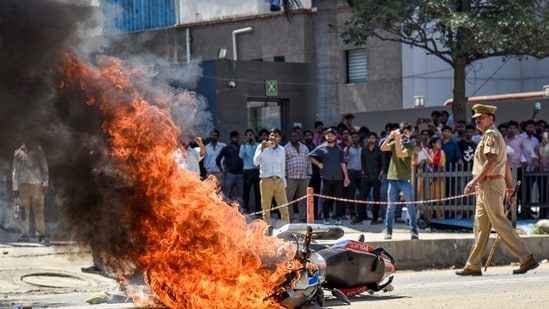
On Tuesday, April 14, 2026, the National Capital Region (NCR) was paralyzed by sweeping industrial unrest as thousands of factory workers launched massive demonstrations in Uttar Pradesh’s Noida and Haryana’s Faridabad and Palwal districts. The catalyst for these coordinated strikes was the Haryana state government’s recent decision to substantially raise minimum wages across all employment categories. While protests in neighboring Noida were driven by demands for regional wage parity, the demonstrations within Haryana highlighted a glaring paradox: workers protesting against a policy designed to benefit them. Factory floors emptied as laborers cited aggressive employer retaliation, rampant job insecurity, and severe implementation loopholes that have effectively neutralized the promised financial gains. [Source: Hindustan Times | Additional: Regional Labor Reports].
## The Ripple Effect: Why Noida Workers Walked Out
The NCR functions as a highly integrated economic ecosystem, where state borders are largely invisible to the millions of migrant laborers who power the region’s manufacturing and service sectors. When Haryana announced its sweeping wage revisions, the ripple effects were immediately felt across the border in Uttar Pradesh. In Noida and Greater Noida—massive industrial hubs housing electronics, garment, and auto-ancillary factories—thousands of workers abandoned their assembly lines to block major arterial roads.
Their demand was straightforward: absolute wage parity with their counterparts in Haryana. Because Uttar Pradesh has traditionally maintained lower minimum wage floors to attract industrial investment, the sudden hike in Haryana created a stark disparity. A semi-skilled worker in Noida now finds themselves earning significantly less than someone doing the exact same job just thirty kilometers away in Faridabad.
“Labor is highly mobile in the NCR,” explains Dr. Meenakshi Iyer, a labor economist at the Institute for Economic Growth. “When one state unilaterally alters the wage equilibrium, it inevitably sparks unrest in neighboring jurisdictions. Noida workers are acutely aware of the policy shifts in Haryana, and in an era of high inflation, they are demanding that the Uttar Pradesh government step in to close this widening compensation gap.” [Source: Independent Economic Analysis].
## The Haryana Paradox: Protesting a Pay Raise
While the Noida protests align with traditional labor demands, the demonstrations in Palwal and Faridabad present a deeply complex narrative. Thousands of workers organized sit-ins at the prominent industrial sectors of Haryana, burning effigies and halting supply chain logistics. But why were protests also held in Faridabad, the very district supposed to benefit from the wage hike? [Source: Hindustan Times].
The answer lies in the harsh realities of on-the-ground implementation and immediate employer pushback. Following the government notification, labor unions report that a vast majority of factory owners in Faridabad and Palwal refused to absorb the increased operational costs. Instead, employers resorted to a variety of retaliatory tactics that left workers worse off than before the wage hike.
Key grievances driving the protests in Haryana include:
* **Mass Terminations:** Several medium-scale manufacturing units abruptly fired long-standing permanent employees, replacing them with informal daily-wage laborers to bypass the new wage mandates.
* **Slashing of Benefits:** To offset the mandated increase in basic pay, employers have stripped workers of transport allowances, subsidized canteen meals, and critical overtime pay.
* **Unrealistic Quotas:** Workers report that factory floor managers have drastically increased production targets. Those unable to meet these new, grueling quotas face immediate wage deductions, nullifying the state-mandated hike.
“The government announced a higher wage on paper, but on the factory floor, it is a completely different reality,” stated Ramkishan Gujjar, a regional representative for the All India Trade Union Congress (AITUC). “Factory owners are cutting our overtime hours and threatening to shut down operations entirely. A wage hike is meaningless if it costs you your livelihood.” [Source: Additional Labor Union Statements].
## Dissecting the New Wage Policy
To fully grasp the magnitude of the unrest, one must examine the specifics of Haryana’s revised wage policy. The state government, citing inflationary pressures, rising housing costs in urban centers, and the post-pandemic cost of living, implemented a staggered increase across all major skill classifications.
While exact district-by-district figures vary slightly based on specific industrial zones, the baseline revisions reflect a nearly 18% to 22% jump in mandatory compensation:
* **Unskilled Labor:** Increased to adequately cover basic nutritional and housing needs, aimed primarily at the construction and basic manufacturing sectors.
* **Semi-Skilled Labor:** Saw a moderate bump, heavily impacting the garment manufacturing and basic machine operation sectors in Palwal.
* **Skilled/Highly Skilled Labor:** Received the highest nominal increase, affecting specialized auto-component technicians and electronics assembly workers prevalent in Faridabad.
The government championed this revision as a progressive step toward ensuring a “living wage” rather than just a minimum wage. However, the abrupt nature of the notification—giving industries very little time to adjust their annual budgets—set the stage for the current clash between labor and capital. [Source: Haryana State Labour Department Notifications].
## Employer Backlash and the Threat of Capital Flight
The Micro, Small, and Medium Enterprises (MSME) sector forms the industrial backbone of Faridabad and Palwal. These businesses operate on razor-thin profit margins, supplying components to larger automobile and consumer durable conglomerates. For MSME owners, the state’s wage hike is viewed not as a progressive reform, but as an existential threat.
“We simply cannot absorb a sudden 20% increase in our wage bill,” argued a spokesperson for the Faridabad Industries Association (FIA) who wished to remain anonymous due to the ongoing tensions. “The raw material costs have already skyrocketed, and our corporate buyers refuse to increase the procurement prices for our components. If we are forced to pay these new rates, thousands of small factories will go bankrupt.”
This economic pressure has led to the looming threat of capital flight. Many industry owners in Haryana are openly threatening to relocate their manufacturing units to neighboring Rajasthan or deeper into Uttar Pradesh, where labor compliance laws are perceived to be more lenient and minimum wages remain substantially lower. This threat of relocation is precisely what triggered the panic among the workforce in Faridabad, prompting them to protest to protect their jobs.
## The Plight of Contractual Workers
A significant underlying factor fueling the unrest in both Noida and Faridabad is the rampant use of contractual labor. In the modern NCR manufacturing ecosystem, an estimated 60% to 70% of the workforce is not directly employed by the factories they work in. Instead, they are hired through third-party labor contractors.
These contractors often operate in the shadows of regulatory oversight. Even when state governments mandate minimum wage hikes, contractual workers rarely see the benefits. Contractors routinely siphon off a portion of the increased wages as “administrative fees” or simply force workers to sign falsified payroll registers acknowledging the new wage while handing them the old wage in cash.
In Palwal, thousands of protesting workers directed their anger specifically at these third-party contractors. “The government deposits the new wage into the contractor’s account, but we are still handed the same meager envelope at the end of the month,” a Palwal-based textile worker told local reporters. Until the state government implements rigorous, digital-first tracking of contractor payments, labor experts warn that wage hikes will continue to exist only on paper for the region’s most vulnerable workers. [Source: Independent Human Rights and Labor Watchdogs].
## Government Response and Mediation Efforts
Faced with paralyzed industrial belts and mounting public pressure, government authorities in both states have been forced into crisis management mode. In Haryana, the State Labour Department has announced the formation of a special task force to monitor the implementation of the new minimum wage. Officials have established toll-free helplines for workers to report illegal terminations, wage theft, and intimidation by factory management.
Furthermore, Haryana’s labor officials have scheduled emergency tripartite meetings involving government representatives, trade union leaders, and industry association heads to broker a truce. The government is reportedly exploring the possibility of providing targeted tax relief or subsidized power tariffs to MSMEs to help them offset the increased wage burdens without resorting to layoffs.
Meanwhile, in Uttar Pradesh, the state government is closely monitoring the situation in Noida. While UP authorities have not yet committed to matching Haryana’s wage hike, they have deployed heavy police presences across major industrial sectors to prevent the protests from escalating into violence. However, labor analysts suggest that the UP government will eventually have to announce an interim wage revision to prevent a mass exodus of its skilled workforce to Haryana.
## Conclusion: A Call for Regional Synchronization
The simultaneous protests in Noida, Faridabad, and Palwal underscore a critical structural flaw in India’s industrial architecture: the lack of a unified regional labor policy. When neighboring states within a tightly knit economic zone like the NCR engage in regulatory arbitrage—competing against one another through disparate wage floors and labor laws—it creates a volatile environment for both businesses and workers.
The events of April 2026 clearly demonstrate that a mandated wage hike is an incomplete victory if it is not coupled with strict enforcement mechanisms and economic protections against retaliatory job cuts. Moving forward, the only sustainable solution is the establishment of an NCR-wide labor commission to synchronize minimum wages, ensuring that workers are paid fairly to combat inflation while preventing the destructive cross-border capital flight that leaves local economies in ruins. Until such a unified framework is adopted, the factory floors of the NCR will remain a flashpoint of economic friction.





