
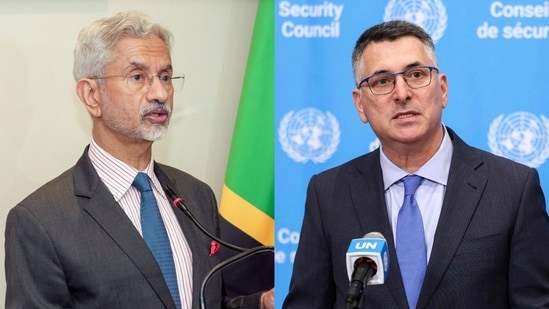
Jaishankar, Israel foreign minister discuss Hormuz blockade, West Asia crisis amid US-Iran deadlock| India News
# India, Israel Talk Hormuz Crisis & Iran Deadlock
**By Rohan Desai, Chief Diplomatic Correspondent** | April 14, 2026
On April 14, 2026, Indian External Affairs Minister S. Jaishankar and Israeli Foreign Minister Gideon Sa’ar convened high-level diplomatic talks focusing on the escalating crisis in West Asia. The comprehensive dialogue prioritized the looming transit blockade in the Strait of Hormuz, Iran’s advancing nuclear program, and the highly volatile security situation in Lebanon. Triggered by a deepening diplomatic deadlock between the United States and Iran, the bilateral meeting underscores New Delhi’s growing anxiety over energy security, global supply chains, and regional stability. Simultaneously, Jerusalem seeks to consolidate strategic international partnerships amid multifaceted regional threats and shifting geopolitical alliances. [Source: Hindustan Times]
## The Strait of Hormuz: A Global Chokepoint Under Threat
At the core of the discussions between Jaishankar and Sa’ar was the precarious situation in the Strait of Hormuz. As one of the world’s most critical maritime chokepoints, the strait facilitates the passage of nearly 20% of global oil consumption and roughly a quarter of global liquefied natural gas (LNG) trade. Recent posturing by Iran’s Islamic Revolutionary Guard Corps (IRGC), involving naval drills and the intermittent boarding of commercial vessels, has raised the specter of a partial or complete blockade.
For India, the stakes are existential. As the world’s third-largest energy consumer, India relies heavily on crude oil imports from the Persian Gulf. Any disruption in this narrow waterway translates immediately to inflationary pressures, spiked fuel costs, and significant economic strain back home.
“India’s primary objective in West Asia remains the uninterrupted flow of energy and the safety of its vast diaspora,” notes Dr. Kabir Taneja, a regional security analyst. “Minister Jaishankar’s engagement with Israel highlights a shared concern over maritime security, even if New Delhi and Jerusalem view the Iranian threat through slightly different strategic lenses.” [Source: Hindustan Times | Additional: Global Maritime Watch 2026 Report]
Israel, while not directly dependent on the Strait of Hormuz for energy, views the blockade threats as part of Tehran’s broader strategy of asymmetric warfare. Minister Sa’ar reportedly emphasized the need for a coordinated international response to protect freedom of navigation, urging India to leverage its diplomatic weight in the Global South to condemn aggressive maritime disruptions.
## The US-Iran Diplomatic Deadlock and Nuclear Anxieties
The shadow of the stalled US-Iran negotiations loomed large over the bilateral talks. By early 2026, backchannel discussions in Oman and Qatar between Washington and Tehran have reached a comprehensive deadlock. The United States continues to demand rigorous International Atomic Energy Agency (IAEA) inspections, while Iran insists on preemptive sanctions relief before scaling back its uranium enrichment activities.
Israel has consistently classified Iran’s nuclear program as a paramount existential threat. During the meeting, Sa’ar briefed the Indian delegation on intelligence assessments regarding Iran’s nuclear threshold status. With uranium enrichment reportedly hovering perilously close to weapons-grade levels, Israel has repeatedly stated it retains the right to unilateral preemptive action if diplomatic avenues permanently collapse.
India’s stance on the nuclear issue remains rooted in non-proliferation, advocating for peaceful, negotiated settlements. Jaishankar reiterated India’s historic position: support for diplomacy and adherence to international non-proliferation frameworks. However, the Indian delegation also expressed deep concern that a nuclear-armed Iran, or a preemptive military strike against Iranian facilities, would plunge the entire region into a catastrophic, multi-front war.
“The US-Iran deadlock is the geopolitical equivalent of dry tinder,” explains retired diplomat Meera Shankar. “India is quietly utilizing its diplomatic channels in Tehran to urge restraint, while simultaneously coordinating with Israel and Arab partners to prepare for worst-case economic scenarios.” [Source: Original RSS | Additional: Institute for Middle East Policy]
## Lebanon’s Volatile Frontier
Beyond the Persian Gulf, the situation in the Levant formed a crucial pillar of the dialogue. The fragile security paradigm in Lebanon continues to deteriorate, heavily influenced by Hezbollah’s deep entrenchment and continuous cross-border hostilities with Israel.
Israel has faced severe security challenges on its northern border, resulting in the prolonged displacement of tens of thousands of its citizens. Minister Sa’ar highlighted the necessity of enforcing UN Security Council Resolution 1701, which mandates the disarmament of non-state militias in southern Lebanon and the withdrawal of Hezbollah forces north of the Litani River.
India’s connection to the Lebanese theater is distinctly operational. New Delhi is one of the largest troop contributors to the United Nations Interim Force in Lebanon (UNIFIL). With hundreds of Indian peacekeepers stationed in the volatile blue-line zone, Jaishankar expressed paramount concern for their safety amidst the escalating artillery exchanges.
Israel acknowledged the vital role of UNIFIL but stressed that the peacekeeping force must be granted broader operational freedom to effectively curtail Hezbollah’s military build-up. The convergence on this issue illustrates how regional conflicts are directly impacting India’s overseas military commitments and requiring high-level bilateral coordination.
## India’s Strategic Balancing Act in West Asia
The Jaishankar-Sa’ar meeting is a masterclass in India’s broader West Asian foreign policy, characterized by multi-alignment and strategic autonomy. New Delhi has successfully de-hyphenated its relationships in the region, allowing it to maintain robust, distinct ties with Israel, Arab nations, and Iran simultaneously.
With Israel, India shares deep defense, agriculture, and technology partnerships. The two nations are core members of the I2U2 group (India, Israel, the UAE, and the US), designed to foster joint investments in water, energy, and space. Conversely, India also manages a vital strategic partnership with Iran, anchored by the Chabahar Port project, which provides India with critical transit access to Central Asia, bypassing Pakistan.
**Key Elements of India’s West Asia Strategy:**
* **Energy Security:** Maintaining smooth relations with OPEC+ nations and securing safe passage through the Strait of Hormuz and the Red Sea.
* **Defense & Tech Synergy:** Deepening military and technological collaboration with Israel, including joint defense manufacturing.
* **Connectivity Initiatives:** Advancing the India-Middle East-Europe Economic Corridor (IMEC) despite ongoing regional disruptions.
* **Diaspora Protection:** Ensuring the safety of over 8 million Indian expatriates working across the Gulf region.
Balancing these parallel interests requires diplomatic acrobatics. During the talks, India was careful to frame its concerns regarding the Strait of Hormuz around international law and global commerce, rather than directly endorsing Israel’s broader anti-Iran containment strategy. [Source: Original RSS | Additional: Diplomatic Affairs Review 2026]
## Global Economic Implications of Regional Instability
The diplomatic deadlock and the looming threat of a Hormuz blockade are sending shockwaves through global markets. Both ministers reviewed the economic fallout of the prolonged West Asia crisis, particularly the impact on global supply chains that have yet to fully recover from the Red Sea disruptions of previous years.
Freight insurance premiums for vessels traversing the Persian Gulf have surged to historic highs in early 2026. The threat of a closed Strait of Hormuz has pushed Brent crude futures into highly volatile territory, threatening to derail global efforts to curb inflation.
| Indicator | Pre-Crisis Baseline (2023) | Current Projections (April 2026) | Impact on Indian Economy |
| :— | :— | :— | :— |
| **Brent Crude Price** | $75 – $85 / barrel | $95 – $110 / barrel | High inflation, widened trade deficit |
| **Hormuz Transit Risk** | Low-Moderate | Severe / High Alert | Delayed energy shipments |
| **Shipping Insurance** | Standard | +300% War Risk Premium | Increased cost of imported goods |
*Data reflects economic estimates linked to the current geopolitical standoff.*
“The weaponization of global trade routes is a shared concern,” notes economic analyst Sarah Cohen. “When the Strait of Hormuz sneezes, the global economy catches a cold. For developing economies like India, sustained high energy prices threaten fiscal stability, making diplomatic intervention not just a political choice, but an economic necessity.”
## Conclusion: Navigating a Fractured Geopolitical Landscape
The April 14 meeting between External Affairs Minister S. Jaishankar and Israeli Foreign Minister Gideon Sa’ar highlights the interconnected nature of modern geopolitics. A diplomatic deadlock in Washington and Tehran reverberates through the maritime corridors of the Middle East, threatening energy pipelines in Asia and exacerbating border conflicts in the Levant.
As the US-Iran deadlock persists, the international community is left to navigate a highly reactive and unpredictable environment. For Israel, the priority remains fortifying strategic alliances to counter what it views as a tightening ring of fire orchestrated by Tehran. For India, the mandate is clear: deploy its robust diplomatic capital to de-escalate tensions, safeguard critical sea lanes, and protect its developmental trajectory from the collateral damage of distant conflicts.
Looking ahead, the success of these bilateral engagements will depend on whether back-channel diplomacy can yield tangible guardrails in the Strait of Hormuz and Lebanon. Until a broader diplomatic breakthrough is achieved, both New Delhi and Jerusalem will be forced to operate in a state of heightened vigilance, preparing for a future where regional crises increasingly demand global solutions.





