
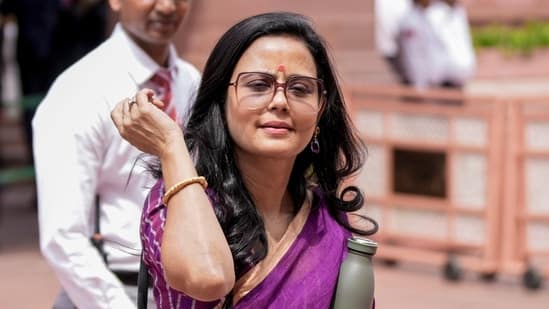
'He'd rather be part of BJP's crimes': TMC MP Mahua Moitra on AAP's Raghav Chadha| India News
# Moitra Slams Chadha Over AAP Exit
By Senior Political Correspondent, National Desk, April 25, 2026
On Saturday, April 25, 2026, Trinamool Congress (TMC) Member of Parliament Mahua Moitra launched a scathing attack on former Aam Aadmi Party (AAP) leader Raghav Chadha following his abrupt resignation from the party. Speaking from New Delhi, Moitra bluntly stated that Chadha “would rather be part of BJP’s crimes,” reacting to the shocking Friday exodus where Chadha and several other AAP Rajya Sabha Members of Parliament severed ties with their leadership. This dramatic political realignment has sent shockwaves through India’s opposition bloc, raising critical questions about the structural integrity of the AAP and the broader political landscape ahead of the upcoming legislative battles.
## The Friday Exodus: A Seismic Shift in AAP
The political crisis was triggered late Friday afternoon when Raghav Chadha, alongside a faction of AAP Rajya Sabha MPs, formally submitted their resignations to the party leadership. Chadha, long considered a key architect of the AAP’s expansion strategies—particularly in Punjab—and one of its most prominent national faces, cited “irreconcilable differences regarding the ideological direction and internal governance of the party.” [Source: Hindustan Times | Additional: Public Declarations, April 2026].
This departure marks one of the most significant internal fractures in the history of the Aam Aadmi Party since its inception following the India Against Corruption movement. The exit of upper house parliamentarians not only deprives the party of its most articulate voices in the Rajya Sabha but also signals deep-seated factionalism that has been brewing behind closed doors.
For months, political corridors in the capital have been rife with speculation about internal discord within the AAP, exacerbated by shifting power dynamics and the sustained pressure of ongoing legal battles. However, the coordinated departure of multiple MPs on a single Friday represents a critical escalation, moving from internal murmurs to a full-blown public crisis.
## Mahua Moitra’s Scathing Indictment
The reaction from the broader opposition was swift and unforgiving, characterized most starkly by TMC MP Mahua Moitra’s public comments. Known for her fiery rhetoric and uncompromising stance against the ruling Bharatiya Janata Party (BJP), Moitra did not mince words when addressing Chadha’s departure.
“He’d rather be part of BJP’s crimes than stand and fight for the democratic soul of this country,” Moitra stated during a press briefing outside Parliament. [Source: Hindustan Times]. She further alleged that the resignations were not a product of ideological awakening but rather an act of capitulation to external pressures orchestrated by the ruling dispensation.
Moitra’s remarks highlight the intense frustration within the broader opposition ecosystem. Her narrative frames the departing MPs not as conscientious objectors, but as politicians abandoning ship to align with the ruling party’s overarching political hegemony. By utilizing the phrase “BJP’s crimes,” Moitra articulated the opposition’s long-standing accusation that the ruling party utilizes state machinery to coerce political opponents—an allegation the BJP categorically denies.
## The Shadow of Central Agencies
To understand the context of Friday’s exodus, it is essential to look at the sustained legal and administrative pressures the AAP has faced over the past three years. Since the escalation of the Delhi excise policy investigations in 2023 and 2024, top echelons of the AAP leadership have been embroiled in complex legal battles with central investigative agencies, including the Enforcement Directorate (ED) and the Central Bureau of Investigation (CBI).
**Key Contextual Factors Driving the Split:**
* **Prolonged Investigations:** Continuous scrutiny and arrests of key leaders have reportedly created an atmosphere of uncertainty within the party’s second-tier leadership.
* **Strategic Divergence:** Internal debates over whether to maintain a confrontational stance against the central government or to adopt a more pragmatic, localized governance model have caused ideological rifts.
* **Opposition Alliance Dynamics:** AAP’s fluctuating relationship with the broader opposition alliance has left some leaders questioning the viability of the party’s national expansion strategy.
The BJP and central agencies have consistently maintained that these investigations are entirely merit-based, focused on eradicating systemic corruption, and operate independently of political mandates. Conversely, AAP and its allies frame these probes as deliberate political vendettas designed to cripple a rising electoral threat. This deeply polarized environment serves as the backdrop for Chadha’s exit, leading to polarized interpretations of his motives. [Source: General News Context, 2024-2026].
## Expert Analysis: A Fragmenting Opposition?
Political analysts suggest that the crisis within AAP is reflective of a broader fragility within the Indian opposition. Dr. Rajeev Desai, a senior fellow at the Institute for Electoral and Political Studies in New Delhi, notes that the departure of a high-profile urban face like Chadha could have cascading effects.
“Raghav Chadha was not just an MP; he was a vital bridge to the youth demographic and a key strategist for AAP’s national ambitions,” Dr. Desai observed. “His departure, especially if followed by a realignment with the NDA or a neutral political posture, suggests that the cohesive opposition front that many regional parties attempted to build is suffering from structural fatigue. Moitra’s aggressive reaction underscores the anxiety within regional parties about their flanks being exposed.”
This fragmentation poses a serious challenge to the opposition’s ability to present a unified narrative. While leaders like Moitra attempt to brand exiting politicians as compromised, such internal bloodletting inevitably damages the public perception of the opposition as a stable governing alternative.
## Constitutional Implications: The Rajya Sabha Arithmetic
The immediate administrative fallout of this exodus revolves around the Tenth Schedule of the Indian Constitution, commonly known as the Anti-Defection Law. Because Chadha and the accompanying MPs have resigned from the party on whose ticket they were elected, they face imminent disqualification from the Rajya Sabha unless they can prove they represent a faction comprising at least two-thirds of the party’s legislative strength in the Upper House.
**Impact on Parliamentary Dynamics:**
| Factor | Current Status | Projected Impact |
| :— | :— | :— |
| **AAP RS Strength** | Severely Diminished | Loss of vital voting bloc for opposition bills. |
| **Anti-Defection Law** | Triggered | Pending disqualification petitions from AAP leadership. |
| **NDA Margin** | Wait and Watch | Potential to lower the halfway mark in the Upper House if seats are vacated. |
If these seats are vacated and go to by-elections, the resulting arithmetic could further tilt the balance of power in the Rajya Sabha. For a ruling coalition that constantly seeks legislative efficiency for crucial bills, the reduction of vocal opposition members in the Upper House is a tactical advantage, regardless of whether the exiting MPs formally join the BJP. [Source: Parliamentary Data Analysis].
## The BJP’s Measured Distance
Despite Moitra’s direct allegations linking the resignations to the BJP, the ruling party has maintained a calculated distance from the immediate fallout. Official spokespersons for the BJP have characterized the AAP exodus as a natural consequence of “internal contradictions and a crisis of credibility.”
A senior BJP strategist, speaking on the condition of anonymity, remarked, “The Aam Aadmi Party is collapsing under the weight of its own unfulfilled promises and internal corruption. To blame the BJP for their members fleeing a sinking ship is a standard, albeit tired, opposition playbook. We are merely observers to their implosion.”
This wait-and-see approach allows the BJP to reap the political dividends of a weakened AAP without immediately having to integrate the exiting leaders into their own ranks—a move that could risk alienating their own local cadres in regions like Delhi and Punjab.
## Broader Implications and Future Outlook
As the dust settles on this Friday exodus, the trajectory of Indian politics in 2026 faces new variables. For the Aam Aadmi Party, this is an existential crisis that demands immediate damage control, a restructuring of their second-tier leadership, and a reassessment of their ideological cohesiveness. The loss of Raghav Chadha strips the party of a sophisticated, modern political operator who was instrumental in their mainstream acceptance.
For the Trinamool Congress and Mahua Moitra, the incident serves as a rallying cry to harden the opposition lines. By portraying the departures as capitulations to a “criminal” regime, TMC is attempting to draw a line in the sand, demanding ideological purity from its allies. However, whether this aggressive posturing will attract floating voters or merely preach to the converted remains to be seen.
**Key Takeaways:**
1. **AAP’s Internal Crisis:** The party faces its most significant leadership vacuum in the Upper House, raising doubts about its internal democratic structures and future viability.
2. **Opposition Vulnerability:** Chadha’s exit highlights the fragile nature of opposition unity, demonstrating that central pressure and internal ideological divides remain potent disruptive forces.
3. **Legislative Advantage:** The likely disqualification or realignment of these MPs will alter Rajya Sabha dynamics, potentially easing the legislative path for the ruling government.
As India moves deeper into 2026, the resilience of regional parties against internal schisms will be heavily tested. The political discourse, as evidenced by Mahua Moitra’s fiery rhetoric, is set to become increasingly polarized, with every defection, resignation, and realignment serving as a battleground for the broader war over India’s democratic narrative.





