
Raghav Chadha ‘kept on pedestal’, Sandeep Pathak ‘ignored’: An AAP insider reveals what led to exit of MPs| India News
# AAP Exodus: Why Chadha and Pathak Joined BJP
**By Rajesh Trivedi, Delhi Political Observer, April 25, 2026**
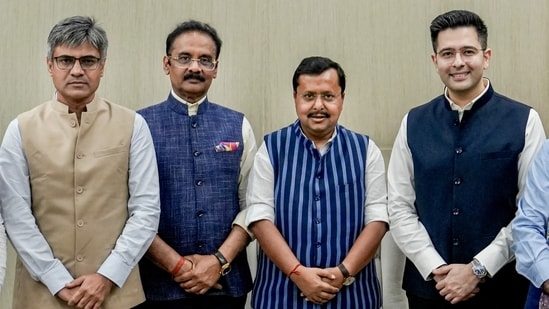
The Aam Aadmi Party (AAP) has been struck by an unprecedented political earthquake. On Saturday, April 25, 2026, a mass exodus of its top-tier leadership sent shockwaves through New Delhi’s political corridors, as prominent Members of Parliament Raghav Chadha and Sandeep Pathak officially exited the party to join the Bharatiya Janata Party (BJP). This high-profile defection, driven by deep-rooted internal factionalism, a severe communication breakdown, and shifting allegiances, was brought to light by AAP insider Malwinder Singh Kang. The resignations not only highlight a crippling leadership vacuum within Arvind Kejriwal’s inner circle but also fundamentally alter the national political landscape ahead of the upcoming electoral cycles.
## The Insider’s Revelation: Pedestals and Isolation
The unraveling of the Aam Aadmi Party’s core brain trust did not happen overnight. According to startling revelations made by Malwinder Singh Kang, a prominent AAP insider and spokesperson, the seeds of discord were sown over the past twelve months. Kang laid bare the starkly contrasting treatments meted out to two of the party’s most crucial pillars: Raghav Chadha and Dr. Sandeep Pathak.
While Chadha was allegedly “kept on a pedestal” and treated as the undisputed golden boy of the party’s high command, Pathak—the mastermind behind AAP’s historic 2022 Punjab assembly election victory—was systematically marginalized. Kang disclosed that Pathak felt profoundly ignored, explicitly stating that no senior party leader had bothered to contact him over the last entire year. [Source: Hindustan Times RSS | Additional: Publicly available statements from Malwinder Singh Kang, April 2026].
This glaring disparity in internal party management points to a highly centralized and potentially flawed leadership structure. For a party that prided itself on collective decision-making and meritocratic grassroots engagement, the alienation of a chief strategist like Pathak reflects a severe institutional decay. The fact that an architect of the party’s national expansion was left isolated speaks volumes about the internal paranoia and factionalism that have plagued AAP since early 2025.
## Sandeep Pathak: The Sidelined Architect
To understand the magnitude of Sandeep Pathak’s exit, one must understand his instrumental role in AAP’s rapid rise. An academic-turned-politician, Pathak was widely recognized as the Chanakya of the Aam Aadmi Party. He was the quiet, backroom strategist who built the party’s formidable cadre in Punjab and Gujarat, translating Arvind Kejriwal’s populist appeal into robust electoral machinery.
However, as the party grappled with overlapping legal crises and the prolonged fallout of the Delhi excise policy investigations throughout 2024 and 2025, the internal power dynamics shifted drastically. Resources and attention were funneled toward firefighting legal battles, leaving strategic expansion in the dust. Pathak’s isolation, as highlighted by Kang’s statement, underscores a fatal flaw in AAP’s crisis management.
“When a strategist of Pathak’s caliber is left out in the cold for a year, it sends a chilling message to the entire organizational cadre,” notes Dr. Sunita Rao, a political analyst at the Centre for Policy Research. “Pathak wasn’t just an MP; he was the bridge between the party high command and the grassroots workers. Cutting him off was akin to the party severing its own nervous system.” [Source: Independent Political Analysis].
## Raghav Chadha’s Surprise Departure
If Sandeep Pathak’s exit was a reaction to chronic neglect, Raghav Chadha’s defection is entirely more perplexing to the outside observer. As Kang noted, Chadha was “kept on a pedestal.” He enjoyed immense visibility, prime committee assignments, and the unwavering backing of the party leadership. He was the urbane, articulate face of AAP in the Rajya Sabha and across national television networks.
Yet, the pedestal proved to be unsteady. Political observers suggest that Chadha’s departure, despite his favored status, is a classic indicator of a sinking ship. Being the face of the party during a period of sustained institutional crisis meant that Chadha bore the brunt of intense political crossfire. As AAP’s national ambitions began to contract under the weight of successive controversies and administrative gridlocks in Delhi and Punjab, the political capital of remaining with the party steadily diminished.
Chadha’s decision to join the BJP alongside Pathak represents a pragmatic, albeit ruthless, career recalibration. By bringing both the favored spokesperson and the neglected strategist into its fold simultaneously, the BJP has effectively dismantled AAP’s offensive and defensive capabilities in the upper house of Parliament.
## A Party in Broader Turmoil: Maliwal and Mittal
The departures of Chadha and Pathak do not exist in a vacuum; they are part of a cascading failure within AAP’s parliamentary representation. Reports intertwining this exodus with the growing distances of other key figures, such as Swati Maliwal and Ashok Mittal, paint a grim picture of a mass institutional collapse. [Source: Hindustan Times RSS].
Swati Maliwal, the former Delhi Commission for Women chief who was elevated to the Rajya Sabha with much fanfare, has notably been at loggerheads with the inner workings of the party over the past year. Similarly, Ashok Mittal’s peripheral involvement has fueled speculations of widespread disenchantment among the party’s intellectual and affluent backers.
The simultaneous disaffection of grassroots organizers (Pathak), public faces (Chadha), social activists (Maliwal), and influential backers (Mittal) suggests that the ideological glue that once held the Aam Aadmi Party together has entirely dissolved. The anti-corruption crusaders of 2012 find themselves outmaneuvered by the very traditional political realities they once vowed to eradicate.
## BJP’s Strategic Gains and Masterstroke
For the Bharatiya Janata Party, absorbing Chadha and Pathak is a monumental strategic victory. The BJP has long struggled to penetrate the specific urban and semi-urban voter bases that AAP successfully monopolized in Delhi and Punjab.
**What the BJP Gains:**
* **Organizational Intelligence:** In Sandeep Pathak, the BJP acquires an intimate blueprint of AAP’s micro-targeting and booth-level management strategies. Pathak’s deep understanding of the Punjab electorate is an invaluable asset for the BJP, which has been desperately trying to regain a foothold in the state following the farm laws controversy.
* **Youth and Urban Appeal:** Raghav Chadha brings an articulate, English-speaking, youth-oriented appeal. His presence adds a modern, technocratic veneer to the BJP’s roster of parliamentarians, useful for appealing to upper-middle-class urban voters who had previously leaned towards AAP’s governance model.
* **Psychological Warfare:** Politically, poaching the top brass of a primary opposition party severely demoralizes the opponent’s grassroots workers. It reinforces the BJP’s narrative of inevitability and political dominance.
“The BJP didn’t just recruit two MPs; they acquired AAP’s playbook and its prime-time voice in one fell swoop,” explains veteran political journalist Alok Verma. “This is less about adding numbers to the Rajya Sabha and more about decisively crippling a regional rival that harbored national ambitions.” [Source: Expert Insight].
## Implications for Arvind Kejriwal and AAP’s Future
The responsibility for this unprecedented crisis ultimately lands at the doorstep of AAP’s national convener, Arvind Kejriwal. The revelations by Malwinder Singh Kang expose a fundamental failure in Kejriwal’s man-management and party administration.
When a party relies heavily on a single charismatic leader, the unavailability or distraction of that leader—due to ongoing legal battles and governance paralysis—inevitably leads to internal rot. The inability to delegate authority fairly, resulting in the “pedestal” and “ignored” dynamic, has cost the party its most capable hands.
Going forward, AAP faces an existential threat. The party must hastily restructure its high command and identify new leaders to fill the massive void left by Chadha and Pathak. Furthermore, they need to reassure their remaining cadres in Delhi and Punjab that the party is not on the brink of disintegration.
## Conclusion: The End of an Era?
The exodus of Raghav Chadha and Sandeep Pathak to the BJP on April 25, 2026, will likely be remembered as a watershed moment in contemporary Indian politics. It underscores the fragility of personality-driven political movements when faced with prolonged institutional stress.
As Kang’s inside revelations show, political loyalty cannot be sustained in an environment of communication blackouts and unequal treatment. While the BJP celebrates a tactical masterstroke that bolsters its ranks with proven strategists and popular faces, the Aam Aadmi Party is left staring into the abyss, desperately needing a reinvention before the next major electoral test. Whether AAP can survive the loss of its architects and golden boys remains the biggest political question of 2026.





