
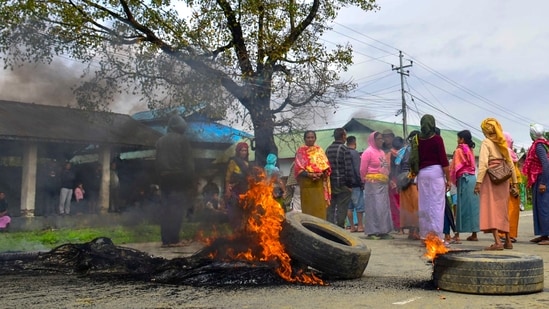
In Manipur, torch protest over blast that killed children sees clash with forces| India News
# Manipur Protest Clashes With Security Forces
**By Vikram Sethi, National Correspondent | April 17, 2026**
On Thursday evening, a massive torch-lit demonstration in Manipur escalated into volatile clashes with security forces. Starting around 7 p.m., thousands of citizens marched through the streets to demand the immediate arrest of the perpetrators behind the tragic April 7 blast that resulted in the deaths of multiple children. When the surging crowds approached heavily fortified security barricades, law enforcement responded with tear gas and crowd-control measures to disperse the rally. The unrest underscores the simmering frustration, public grief, and fragile security landscape in the northeastern state as citizens demand accountability and an end to the cycle of violence.
[Source: Hindustan Times | Additional: Regional Security Reports]
## A Cry for Justice: The Torch-Lit March
The protest began peacefully as dusk settled over the region on Thursday. By 7 p.m., what started as a localized gathering quickly swelled into a massive procession. Thousands of participants, predominantly women and youth, took to the streets carrying flaming torches. In Manipur, the imagery of torch-bearing protesters—historically associated with the *Meira Paibis* (women torchbearers)—is a powerful symbol of civil vigilance, demanding justice, and protecting the community from internal and external threats.
The primary demand of the marchers was clear and singular: swift, uncompromising justice for the victims of the April 7 explosion. Demonstrators chanted slogans demanding that the state and central governments expedite their investigations and apprehend the culprits responsible for planting the explosive device that claimed the lives of innocent children.
“We are not here to fight the police; we are here because our homes are no longer safe, and our children are paying the ultimate price for a conflict they do not understand,” said a local community leader who participated in the rally. The emotional weight of the demonstration was palpable, driven by a deep-seated communal grief that has transcended traditional ethnic and political divides in the region.
## Security Forces Intervene Amid Escalating Tensions
As the sea of torches moved toward the central administrative districts, the procession encountered multiple layers of security barricades manned by state police and central paramilitary forces. According to on-ground reports, authorities had previously denied permission for mass gatherings in sensitive zones due to the prevailing prohibitory orders under Section 144, which strictly regulates the assembly of large crowds to maintain public order.
Tensions flared when a section of the protesters attempted to breach the barricades to march toward government secretariats. In an effort to prevent a potential breach of high-security zones, law enforcement personnel initiated crowd-control protocols. Officers deployed tear gas canisters and stun grenades to disperse the surging crowd, resulting in chaotic scenes.
The resulting stampede and the effects of the tear gas led to minor injuries among several protesters, while a few security personnel sustained injuries from stones hurled from the fringes of the crowd. Despite the sudden escalation, the confrontation remained localized, and authorities were able to restore a tense calm by late Thursday night. Heavy deployment remains in place across major intersections to prevent further flare-ups.
[Source: Original RSS | Additional: Public Law Enforcement Statements]
## The April 7 Tragedy: A State in Mourning
The catalyst for Thursday’s unrest traces back to the devastating events of April 7. While comprehensive forensic details remain under classified investigation, preliminary reports indicate that an improvised explosive device (IED) was detonated in a civilian-populated area. Tragically, the blast occurred in the vicinity of a playground, resulting in the fatal injuries of several young children and leaving numerous others critically wounded.
The deaths sent shockwaves through the entire state of Manipur and drew national condemnation. Civil rights activists, political leaders across the spectrum, and international humanitarian observers have universally condemned the targeting of civilian areas.
**Key facts surrounding the April 7 incident:**
* **Target:** A primarily civilian zone with no immediate military installations nearby.
* **Victims:** Predominantly minors, escalating the emotional and humanitarian severity of the incident.
* **Weaponry:** Suspected to be an IED, highlighting the continued proliferation of illicit arms and explosives in the region.
The tragedy has amplified concerns regarding the safety of non-combatants in a state that has grappled with intermittent violence and insurgency for decades. For the local populace, the blast was not just an isolated criminal act but a tragic symptom of the broader law-and-order collapse that has plagued the state since the large-scale ethnic clashes began in 2023.
## Administrative Response and Ongoing Investigations
In the wake of both the April 7 blast and the subsequent Thursday night protests, the state administration is facing mounting pressure to deliver results. The Chief Minister’s office has assured the public that a high-level inquiry is underway. The investigation has reportedly been fast-tracked, with specialized central agencies, including the National Investigation Agency (NIA), stepping in to assist local forensic and intelligence teams.
Authorities have urged the public to remain calm and refrain from taking the law into their own hands. A senior police official stated on Friday morning, “We deeply understand the pain and anger of the citizens. The loss of children is an unforgivable crime. However, violent confrontations with security forces will only hinder the ongoing investigation. We are following credible leads and arrests will be made imminently.”
To prevent the spread of misinformation and to curb further mobilization of violent protests, the government has temporarily suspended mobile internet services in select districts. While controversial, authorities argue this measure is necessary to maintain peace in an incredibly volatile environment where rumors can rapidly incite widespread violence.
## The Broader Context: Manipur’s Lingering Security Crisis
To fully comprehend the magnitude of Thursday’s torch rally, one must look at the broader geopolitical and social tapestry of Manipur. The northeastern state has been navigating a complex web of ethnic tensions, militant insurgencies, and territorial disputes for decades. The violent clashes that erupted in May 2023 created deep societal fissures, leading to the displacement of tens of thousands of residents and the creation of heavily guarded buffer zones between communities.
Even as the state moved into 2026, the scars of previous conflicts remain unhealed. A significant issue has been the presence of unaccounted firearms and explosives within civilian populations. Despite numerous combing operations by the Indian Army and the Assam Rifles, a complete disarmament has proven elusive.
The April 7 blast is widely perceived by security analysts not merely as an act of localized terror, but as a grim reminder of the enduring militarization of public spaces in Manipur. When explosives find their way into neighborhoods where children play, it signals a systemic failure in the state’s ability to completely eradicate rogue militant factions.
## Expert Perspectives on Peacebuilding
Security experts emphasize that a strictly militaristic approach will not solve the underlying issues driving protests like Thursday’s torch rally.
“What we are witnessing in Manipur is a profound trust deficit between the civilian population and the state apparatus,” explains Dr. Ananya Sharma, a senior fellow specializing in Northeast Indian conflicts at a prominent New Delhi think tank. “When citizens feel that law enforcement cannot protect their children, they take to the streets. The torch rally is a manifestation of absolute desperation. The state must bridge this gap by not only capturing the perpetrators but by ensuring transparent justice and initiating genuine grassroots dialogue.”
Experts further warn that heavy-handed responses to civilian protests, even when unauthorized, run the risk of further alienating the public. The use of tear gas against grieving citizens, while operationally standard for crowd control, often exacerbates feelings of systemic marginalization.
## Civil Society’s Plea for Non-Violence
Amidst the chaos, a coalition of local non-governmental organizations (NGOs), religious leaders, and peace committees are working tirelessly to de-escalate the situation. These civil society groups are making public appeals across local radio and television networks, urging the youth to channel their anger into peaceful democratic demands rather than clashing with authorities.
Human rights advocates are particularly focused on the psychological toll this sustained environment of violence is having on the younger generation. Schools in several districts have seen interrupted academic calendars, and the trauma of the April 7 blast has necessitated urgent psychological counseling and trauma care interventions for surviving children and witnesses.
“Violence begets violence,” read a joint statement issued by a consortium of Manipuri student unions on Friday. “We demand justice for our lost brothers and sisters, but we must not allow our grief to burn down our own state. We appeal to the authorities to act swiftly so that the streets can be cleared of protests and filled with peace.”
## Conclusion: An Urgent Call for Peace
The torch-lit protest that illuminated the night sky of Manipur on Thursday is a stark indicator of a community pushed to its limits. The clashes between grieving citizens and security forces highlight the incredible difficulty of policing a region already traumatized by conflict.
As authorities scramble to piece together the evidence from the tragic April 7 blast, the clock is ticking. The immediate arrest of those responsible is non-negotiable for the restoration of public faith. However, the long-term future of Manipur depends on a much larger commitment from both state and national leadership: a commitment to total disarmament, the dismantling of militant infrastructure, and the fostering of a socio-political environment where children are no longer the collateral damage of ideological or ethnic disputes.
Until justice is demonstrably served, the embers of Thursday’s torches will continue to smolder, representing both a warning of potential future unrest and an undying hope for a safer tomorrow.





