
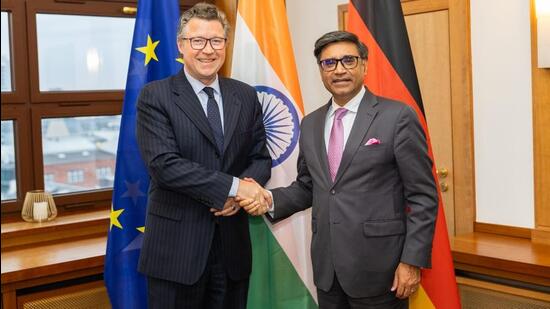
India, Germany to step up defence and tech ties amid West Asia churn| India News
# India-Germany Expand Defense Ties Amid Crisis
By Special Correspondent, Strategic Affairs Desk | April 16, 2026
**New Delhi**—Against the backdrop of escalating geopolitical instability in West Asia, India and Germany have committed to significantly expanding their bilateral defense and technology ties. During high-level consultations held on April 15, 2026, diplomats and defense officials from both nations comprehensively reviewed their strategic partnership. The talks focused heavily on joint military co-production, critical emerging technologies, and securing fragile global supply chains. Driven by ongoing disruptions in the Red Sea and broader Middle Eastern turbulence, this renewed diplomatic framework highlights a mutual imperative to safeguard Indo-Pacific maritime routes and reduce structural economic dependencies. [Source: Hindustan Times | Additional: Public Geopolitical Records].
## The Catalyst: West Asia’s Geopolitical Churn
The immediate driver for this accelerated bilateral engagement is the prolonged volatility in West Asia. Over the past three years, overlapping crises—from conflicts in the Levant to sustained asymmetric threats against commercial shipping in the Red Sea and the Gulf of Aden—have fundamentally altered the calculus of global trade.
For Germany, an export-driven powerhouse reliant on the Suez Canal for rapid access to Asian markets, the necessity to reroute shipments around the Cape of Good Hope has resulted in surging freight costs and disrupted manufacturing timelines. Similarly, India, which imports a vast majority of its energy requirements and relies heavily on European markets for its exports, has found its economic security directly challenged by the Middle Eastern churn.
“The consultations were an opportunity for the two sides to review bilateral relations and explore avenues to deepen their strategic partnership,” noted a senior official familiar with the proceedings, reflecting a growing consensus in both capitals that economic security cannot be decoupled from traditional defense preparedness [Source: Hindustan Times].
Dr. Helena Weber, a senior fellow at the Berlin-based Institute for International Security Affairs, notes the shifting mindset: “Berlin has fully internalized the lessons of the post-2022 energy crisis. Relying on volatile regions for critical transit or single authoritarian states for supply chains is no longer viable. India represents a democratic, stabilizing anchor in the Indo-Pacific, making this enhanced partnership a geopolitical necessity.”
## Elevating Defense Co-Production and Maritime Security
Historically, Germany’s strict arms export controls and bureaucratic hurdles limited its footprint in India’s lucrative defense market, which has long been dominated by Russia, France, and the United States. However, Chancellor Olaf Scholz’s *Zeitenwende* (historic turning point) in security policy has gradually materialized into tangible international strategies.
A centerpiece of the current India-Germany defense dialogue is the transition from a traditional “buyer-seller” relationship to one rooted in **co-development and co-production**.
**Key areas of defense collaboration discussed during the April 2026 consultations include:**
| Defense Sector | Scope of Collaboration | Strategic Objective |
| :— | :— | :— |
| **Naval Systems** | Advanced negotiations under India’s Project 75I for building six conventional stealth submarines. | Enhancing India’s underwater domain awareness and combat capability in the Indian Ocean Region (IOR). |
| **Propulsion Tech** | Joint development of Air Independent Propulsion (AIP) systems and advanced marine diesel engines. | Achieving higher domestic value addition (Make in India) and technological self-reliance. |
| **Aero-Engines** | Exploring maintenance, repair, and overhaul (MRO) facilities for military transport aircraft. | Reducing turnaround times for the Indian Air Force and establishing India as a regional MRO hub. |
| **Space & Cyber** | Information sharing on satellite telemetry and joint cyber-defense frameworks. | Protecting critical national infrastructure from state-sponsored cyber-attacks. |
The potential agreement between Germany’s ThyssenKrupp Marine Systems (TKMS) and India’s Mazagon Dock Shipbuilders Limited (MDL) remains the crown jewel of this defense pivot. If finalized, the multi-billion-dollar submarine deal would not only revitalize India’s aging fleet but also establish an unprecedented level of technology transfer from Berlin to New Delhi.
## Strategic Tech and Critical Supply Chains
Beyond kinetic military hardware, the consultations heavily emphasized securing critical technologies. As artificial intelligence, quantum computing, and advanced telecommunications redefine national security, both nations are actively implementing policies to “de-risk” their technological ecosystems from over-reliance on China.
India and Germany have pledged to enhance cooperation in **semiconductor supply chains**. While Germany is investing heavily in domestic fabrication facilities—backed by the European Chips Act—it requires a massive influx of skilled design engineers and testing facilities, areas where India possesses a distinct comparative advantage.
Furthermore, the two sides discussed standardizing regulations regarding the ethical deployment of Artificial Intelligence in both civilian and military spheres. By aligning their regulatory frameworks, India and the European Union (championed by Germany) aim to set a democratic gold standard for global tech governance, contrasting sharply with the techno-authoritarian models proliferating elsewhere.
## The Green Energy and Mobility Nexus
While defense and technology grab the headlines, the bedrock of the modernized Indo-German relationship relies on sustainable development and human capital exchange. The ongoing energy transition remains a critical vulnerability for both economies amidst the West Asia instability.
The **Indo-German Green and Sustainable Development Partnership**, established earlier this decade, has seen accelerated funding in 2026. Germany has committed substantial investments to India’s National Green Hydrogen Mission, viewing the subcontinent as a future hub for exporting clean energy to Europe. This strategic diversification directly mitigates the risks posed by fluctuating oil prices and chokepoints in the Strait of Hormuz.
Simultaneously, human capital mobility has become a cornerstone of bilateral ties. Germany is currently facing a severe demographic deficit, with thousands of unfilled vacancies in the STEM (Science, Technology, Engineering, and Mathematics) sectors. The reciprocal Migration and Mobility Partnership Agreement has streamlined visa processes, leading to a record number of Indian tech professionals and students integrating into the German economy by early 2026.
“The synergy is undeniable,” explains Dr. Rajiv Menon, a New Delhi-based trade economist. “Germany has the capital and the advanced manufacturing base; India has the scale, the demographic dividend, and the digital public infrastructure. Together, they form a highly complementary economic bloc capable of weathering regional supply shocks.”
## Implications for the Indo-Pacific Region
The deepening of ties between New Delhi and Berlin sends a strong strategic signal across the Indo-Pacific. For years, France was widely considered India’s primary strategic entry point into the European Union, particularly regarding defense and nuclear cooperation. Germany’s aggressive push to match, and potentially exceed, that level of engagement signifies a broader European awakening to India’s indispensable role in a multipolar world order.
Germany’s naval deployments to the Indo-Pacific—including port calls in India by its frigates and joint aerial exercises with the Indian Air Force—demonstrate a commitment to ensuring freedom of navigation. Both nations are staunch advocates of a rules-based international order, mutually wary of unilateral attempts to alter the status quo in the South China Sea and the broader Indo-Pacific.
From India’s perspective, a robust partnership with Germany reinforces its policy of multi-alignment. By securing advanced Western technology and capital, India enhances its strategic autonomy, reducing its historical reliance on Russian military hardware—a vulnerability laid bare by the prolonged conflict in Eastern Europe.
## Conclusion: A Future-Proof Strategic Partnership
The April 2026 consultations between India and Germany mark a definitive maturation of their bilateral relationship. What was once a partnership defined primarily by trade in machinery and textiles has evolved into a comprehensive security and technology alliance.
The ongoing churn in West Asia has acted as a potent catalyst, forcing both nations to confront the fragility of globalized supply chains and the necessity of resilient, democratic partnerships. As they finalize crucial defense pacts and integrate their technological sectors, the India-Germany axis is poised to become one of the most consequential bilateral relationships of the late 2020s.
Looking ahead, the success of this upgraded partnership will depend on the ability of both bureaucracies to execute complex joint ventures—such as the P-75I submarine project—without falling prey to historical red tape. If navigated successfully, this alliance will not only secure their respective national interests but also serve as a vital stabilizing force across the Eurasian landmass and the Indo-Pacific region.





