
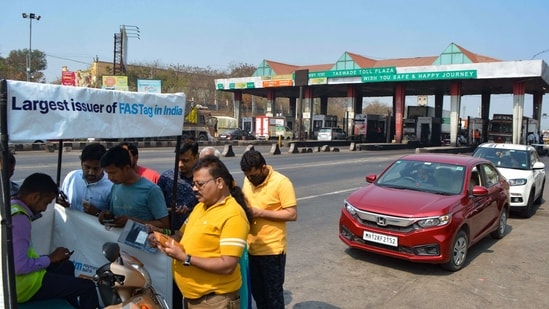
NHAI asks FASTag issuer banks to validate vehicle registration numbers to enhance accuracy| India News
# NHAI Orders FASTag Validation to Fix Toll Errors
**By Senior Mobility Correspondent | April 15, 2026**
The National Highways Authority of India (NHAI) has issued a strict directive requiring all FASTag-issuing banks to comprehensively validate vehicle registration numbers (VRNs) against the central VAHAN database. Announced on Wednesday, April 15, 2026, the mandate aims to rectify widespread data mismatches primarily associated with older RFID tags issued before centralized integration was standardized. By enforcing a rigorous cross-referencing protocol, the highway authority intends to eliminate tolling errors, curb revenue leakage, and establish a flawless data foundation ahead of India’s nationwide rollout of satellite-based Global Navigation Satellite System (GNSS) tolling.
[Source: Hindustan Times | Additional Context: Ministry of Road Transport and Highways (MoRTH) NETC Guidelines]
## The Root Cause of Registration Mismatches
The foundation of India’s National Electronic Toll Collection (NETC) program relies heavily on the seamless interaction between Radio Frequency Identification (RFID) tags and toll plaza scanners. However, the ecosystem has been plagued by legacy data inaccuracies.
According to the recent NHAI observation, a considerable number of VRN mismatches are explicitly associated with FASTags issued prior to their mandatory integration with the VAHAN database. In the early stages of FASTag adoption—particularly between 2016 and 2019—tags were frequently issued by point-of-sale agents, bank representatives, and vehicle dealerships using manual data entry.
During this period, many tags were linked to **chassis numbers** or **temporary registration numbers** because the permanent vehicle registration plates had not yet been issued by the Regional Transport Offices (RTOs). Customers frequently failed to update their FASTag profiles once they received their permanent license plates. Furthermore, manual entry errors led to typographical mistakes in the FASTag registry, creating a severe disconnect between the physical vehicle passing through a toll plaza and the digital record held by the issuing bank.
## Financial Repercussions and Toll Evasion
The discrepancy between the FASTag database and the VAHAN database is not merely an administrative oversight; it has significant financial implications. The NETC ecosystem, managed by the National Payments Corporation of India (NPCI), processes millions of transactions daily. When a vehicle’s registration number does not match the tag’s data, it creates a loophole for toll evasion and revenue leakage.
One of the most common issues involves **class mismatches**. Toll fares in India are calculated based on the vehicle class—for example, a multi-axle commercial truck pays a significantly higher toll than a standard passenger car.
“We have recorded instances where a FASTag originally registered to a light motor vehicle (LMV) was physically affixed to a heavy commercial vehicle,” explains Dr. Arindam Sen, an independent transport economist specializing in digital infrastructure. “Because the older tags were not cross-verified with VAHAN’s specific vehicle class parameters, the automated system incorrectly deducts the lower LMV fare, resulting in substantial financial losses for highway concessionaires.”
By forcing banks to validate the VRN against VAHAN, the system will automatically pull the exact vehicle make, model, and class directly from the government’s master registry, making class manipulation nearly impossible.
## The Role of the VAHAN Database
The VAHAN database, an initiative by the Ministry of Road Transport and Highways (MoRTH), serves as the centralized national register for all vehicles in India. It contains comprehensive data, including engine details, chassis numbers, owner information, vehicle class, and fitness certificates.
In recent years, NHAI has steadily tightened the noose on data discrepancies. The **”One Vehicle, One FASTag”** initiative launched in early 2024 was a major step toward deduplication, ensuring that multiple tags were not active for a single vehicle and vice versa. However, that initiative primarily addressed the duplication of tags rather than the underlying accuracy of the vehicle data itself.
The current 2026 mandate requires a deep-level Application Programming Interface (API) handshake. Issuer banks must run batch processing protocols to compare their active FASTag directories against the VAHAN master list. If the FASTag VRN returns a “no match” or reveals a discrepancy in vehicle class, the bank is obligated to flag the account.
## Implications for Issuer Banks
For India’s major FASTag issuer banks—including SBI, HDFC, ICICI, IDFC First, and Paytm Payments Bank’s successors—this directive presents a massive compliance undertaking. Banks currently manage an estimated **9.5 crore (95 million) active FASTags**.
Banks are now required to deploy automated scrubbing algorithms to identify mismatched accounts. Once identified, the financial institutions must initiate an immediate customer outreach program.
**Key responsibilities for banks under the new directive include:**
* **Data Scrubbing:** Identifying all FASTags linked to temporary registration numbers or chassis numbers.
* **Customer Notification:** Sending SMS, email, and app-based push notifications to affected users, giving them a stipulated grace period to update their details.
* **KYC Portal Upgrades:** Providing seamless, user-friendly digital interfaces where customers can upload copies of their Registration Certificates (RCs) for optical character recognition (OCR) verification.
* **Tag Hotlisting:** Deactivating or blacklisting FASTags that remain unverified after the grace period expires.
“The technological burden on banks is significant but necessary,” notes Meera Chandrasekhar, a banking technology analyst. “In the past, customer acquisition was the primary goal. Today, data fidelity is the priority. Banks that fail to sanitize their FASTag portfolios may face penalties from the NHAI and NPCI for facilitating non-compliant toll transactions.”
## Paving the Way for GNSS Tolling
The urgency of this validation drive is closely linked to the future of Indian highways. As of 2026, the NHAI is actively expanding its **Global Navigation Satellite System (GNSS) tolling network**. Unlike traditional boom-barrier toll plazas that rely on localized RFID scanners, GNSS tolling uses satellite tracking to calculate the exact distance a vehicle travels on a national highway, deducting the toll from a digital wallet seamlessly.
For a hybrid system (where RFID FASTags and GNSS co-exist) to function without chaos, absolute data accuracy is paramount. In a GNSS framework, automatic number plate recognition (ANPR) cameras serve as secondary enforcement mechanisms. If a vehicle’s license plate (captured by the camera) does not match the VRN registered to the FASTag and the GNSS On-Board Unit (OBU), the system cannot accurately process the charge, leading to billing disputes and enforcement failures.
Cleaning up the legacy FASTag data via VAHAN integration is the crucial missing link to ensure the GNSS rollout is not derailed by administrative bottlenecks.
## Actionable Steps for Vehicle Owners
For the everyday commuter and commercial fleet operator, the NHAI’s directive requires proactive compliance. Vehicle owners who purchased their FASTags prior to 2020, or those who initially registered their tags using a temporary registration number, are at the highest risk of disruption.
**How to Ensure FASTag Compliance:**
1. **Check Status:** Log into your issuing bank’s FASTag portal or the official NHAI ‘My FASTag’ mobile application.
2. **Verify VRN:** Cross-check the vehicle registration number listed on the FASTag profile with your physical license plate and Registration Certificate (RC).
3. **Update Details:** If the profile shows a chassis number or temporary plate, use the bank’s KYC update feature to upload a clear image of the front and back of your permanent RC.
4. **Monitor Notifications:** Pay close attention to SMS alerts from your FASTag issuer over the coming weeks. Ignoring a validation request could result in the tag being added to the toll plaza ‘blacklist’, forcing the driver to pay double the toll amount in cash as a penalty.
## Broader Impact on the Transport Sector
The push for verified data extends beyond toll collection. Law enforcement agencies heavily utilize the NETC infrastructure to track stolen vehicles and monitor interstate movement. A sanitized database ensures that police and transport authorities have access to real-time, accurate tracking data, bolstering national security and road safety.
Furthermore, commercial fleet operators stand to benefit from the standardization. Logistics companies managing hundreds of trucks often face administrative nightmares reconciling toll disputes caused by tag mismatches. A unified, VAHAN-verified system guarantees transparent billing, reducing operational friction for the supply chain sector.
## Conclusion
The NHAI’s directive to validate FASTag data against the VAHAN database marks the final phase in maturing India’s electronic toll collection infrastructure. Moving away from the fragmented data entry practices of the past, the system is now prioritizing absolute fidelity.
While the mandate will temporarily increase the administrative workload for issuer banks and require proactive updates from a segment of vehicle owners, the long-term benefits are undeniable. By eliminating revenue leakage, preventing toll evasion, and laying a robust digital foundation for upcoming satellite-based tolling technologies, the NHAI is ensuring that India’s highway network remains both financially sustainable and technologically advanced. Commuters are urged to verify their FASTag credentials immediately to ensure uninterrupted travel across the country’s rapidly expanding highway network.





