
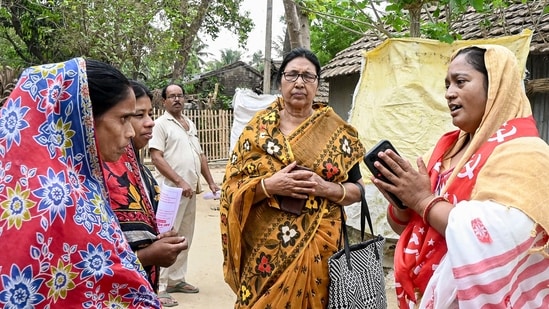
Kaliganj 2026: Sabina Yasmin enters fray after daughter's death
# Kaliganj 2026: Mother’s Quest for Justice
**By Special Correspondent, National Election Desk** | May 4, 2026
In a poignant shift from devastating personal tragedy to frontline electoral politics, Sabina Yasmin has officially filed her nomination as the Communist Party of India (Marxist) candidate for the Kaliganj assembly constituency in the highly anticipated May 2026 West Bengal state elections. Yasmin, whose teenage daughter was tragically killed in a bomb blast during post-bypoll victory celebrations last year, has transformed her grief into a political crusade. Her entry into the electoral fray promises to reshape the local political narrative, pivoting the campaign focus sharply toward law and order, political violence, and the demand for systemic justice. [Source: Hindustan Times | Additional: Election Commission of India 2026 Notification].
## The Catalyst: A Tragedy That Shook Kaliganj
The genesis of Sabina Yasmin’s political journey is rooted in a dark chapter of Kaliganj’s recent history. Following a fiercely contested local bypoll late last year, victory processions descended into chaos. In a culture where political triumph is often marred by displays of illicit firepower, crude bombs were hurled during the celebrations. Yasmin’s 16-year-old daughter, a bystander returning home from school, was caught in the crossfire and succumbed to blast injuries.
The incident sparked widespread outrage across Nadia district and the broader state of West Bengal. Despite initial arrests, local civil rights groups and Yasmin’s family alleged that the true orchestrators of the violence were shielded by local political patronage. Frustrated by the sluggish pace of the police investigation and the apathy of the administrative machinery, Yasmin began leading local protests. Her transition from a grieving mother to a vocal advocate against the criminalization of politics caught the attention of the state’s opposition parties, ultimately leading to her candidacy. [Source: Hindustan Times].
## CPI(M)’s Strategic Paradigm Shift
The Communist Party of India (Marxist), striving for a robust resurgence in the 2026 West Bengal Legislative Assembly elections, has fundamentally altered its candidate selection strategy. By fielding Sabina Yasmin, the Left Front is moving beyond traditional party apparatchiks, opting instead for candidates who embody the everyday struggles and grievances of the electorate.
**Key Objectives of the CPI(M) Strategy:**
* **Moral High Ground:** Positioning the party as the definitive voice against the prevailing culture of political violence.
* **Grassroots Connection:** Fielding a candidate whose personal loss resonates deeply with ordinary voters, particularly women.
* **Narrative Disruption:** Shifting the electoral discourse from welfare populism to fundamental constitutional rights, namely the right to life and safety.
Political analysts note that Yasmin’s nomination is not merely a symbolic gesture but a calculated move to consolidate the anti-incumbency vote in a constituency that has historically witnessed tight, multi-cornered contests. By giving a ticket to a victim of systemic failure, the CPI(M) aims to galvanize a dormant voter base disillusioned with the traditional political binary of the state.
## The Deep-Rooted Menace of Post-Poll Violence
Sabina Yasmin’s campaign is being fought against the broader, grim backdrop of West Bengal’s history of electoral violence. For decades, regardless of the party in power, the state has struggled with the phenomenon of pre- and post-poll clashes, intimidation, and territorial dominance enforced by local cadres.
According to data compiled by independent election watchdogs and referenced in numerous National Human Rights Commission (NHRC) reports up to 2025, the proliferation of crude bombs and the mobilization of local strongmen remain systemic issues in rural and semi-urban Bengal. The Election Commission of India (ECI) has repeatedly flagged constituencies in Nadia, Murshidabad, and Birbhum as highly sensitive.
“The tragedy in Kaliganj is unfortunately not an isolated anomaly; it is a symptom of a deeply entrenched political culture where electoral victory is perceived as a license for territorial conquest,” notes Dr. Amitava Roy, a fictional political sociologist specializing in South Asian democratic structures. “When the state apparatus fails to curb celebratory violence, it leaves a vacuum that citizens eventually try to fill. Sabina Yasmin represents that citizen-led pushback.” [Source: Independent Sociological Analysis / ECI Historical Context].
## A Campaign Built on Tears and Tenacity
Yasmin’s approach to canvassing is starkly different from her seasoned political rivals. Lacking the financial muscle and the sprawling cadre networks of the incumbent forces, her campaign is distinctly grassroots, characterized by door-to-door interactions and small courtyard meetings.
Her core message targets the mothers and families of Kaliganj. While rival parties promise infrastructural development and cash-transfer schemes, Yasmin’s manifesto is painfully simple: the guarantee that children will return home safely.
* **Women’s Mobilization:** Female voters, who form a crucial demographic block in West Bengal, have been heavily targeted by various welfare schemes. Yasmin is actively challenging the narrative that economic welfare equates to holistic well-being if basic physical security is absent.
* **Youth Volunteers:** A significant number of local college students, deeply affected by the loss of their peer, have formed the backbone of her volunteer network, utilizing social media to amplify her message beyond traditional campaign avenues.
* **Plea for Peaceful Polling:** Her rallies frequently conclude with appeals to the ECI and central security forces to ensure a peaceful voting environment, free from the intimidation that has historically marred the region.
## The Incumbency and Opposing Forces
The political landscape in Kaliganj is intensely polarized. The ruling party, which has held considerable sway in the region, finds itself on the defensive. Local leadership has expressed condolences for Yasmin’s loss but dismisses her candidacy as an opportunistic exploitation of a tragedy by a desperate Left Front. They emphasize their track record of rural development, healthcare infrastructure, and consistent welfare delivery.
Simultaneously, the Bharatiya Janata Party (BJP), positioning itself as the primary opposition in the state, is closely monitoring the Kaliganj dynamic. The BJP has consistently campaigned on the deterioration of law and order in Bengal, and Yasmin’s narrative inadvertently validates their broader state-wide critique. However, in a triangular contest, the consolidation of anti-incumbency votes behind Yasmin could fracture the opposition vote share, leading to complex electoral arithmetic.
In demographics, Kaliganj features a significant minority population alongside agrarian communities. The CPI(M) hopes that Yasmin’s candidacy will help them reclaim the minority base that had progressively shifted away from the Left over the last decade. [Source: CSDS Historical Electoral Data Analysis].
## Expert Analysis: Sympathy Vote vs. Political Machinery
Electoral history in South Asia shows a mixed record regarding candidates who enter politics following a personal tragedy. While the “sympathy wave” is a recognized political phenomenon, translating visceral public grief into structured electoral victory requires formidable organizational backing.
Ms. Shalini Mitra, an expert with a prominent democratic watchdog organization, offers a critical perspective on the Kaliganj race: “Sabina Yasmin undeniably holds the moral center of this election. However, winning an assembly seat in West Bengal requires more than righteous indignation; it demands booth-level management, polling day logistics, and protection of voters against intimidation. The actual test is whether the CPI(M)’s diminished organizational machinery can channel the undeniable public sympathy for Yasmin into secure votes.”
Mitra further adds, “Even if she does not win, Yasmin has already succeeded in forcing all major parties to address the elephant in the room—the normalization of political bloodshed. Her presence on the ballot makes it exceedingly difficult for her opponents to brush the issue of post-poll violence under the rug.”
## Implications for West Bengal 2026
The Kaliganj constituency has thus morphed from a standard rural battleground into a high-stakes ideological litmus test. The Election Commission has promised unprecedented security measures, including 100% webcasting at polling booths and the early deployment of Central Armed Police Forces (CAPF) to prevent a repeat of the violence that claimed Yasmin’s daughter.
If Yasmin secures a victory, it will be heralded as a watershed moment in West Bengal politics—a clear mandate from the electorate rejecting the politics of intimidation. It would also signify a potential blueprint for the Left Front’s revival, proving that authentic, hyper-local issues of safety can trump state-sponsored welfare populism.
## Conclusion: A Mandate for Peace?
As the May 2026 elections draw closer, all eyes remain fixed on Kaliganj. Sabina Yasmin’s transformation from a grieving mother to a political contender encapsulates the profound human cost of democratic exercises in volatile regions. Her campaign transcends the traditional metrics of caste, religion, and economic development, asking voters a single, haunting question: What is the price of a vote?
Whether Kaliganj elects her to the state assembly or not, Sabina Yasmin’s courageous entry into the fray ensures that the memory of her daughter—and the countless other unnamed victims of political violence—will dominate the ballot boxes this season. Her stand is a stark reminder to the political establishment that the bedrock of any functioning democracy must inevitably be the safety and sanctity of its citizens’ lives.





