
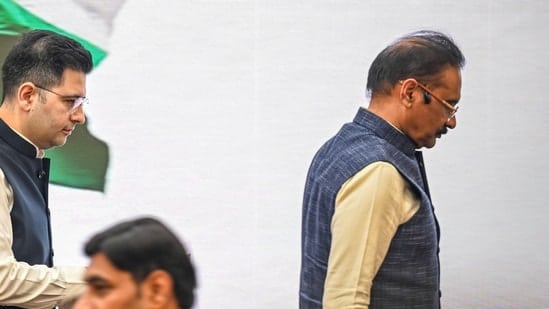
Kejriwal got Mittal into AAP, Mittal gave him home to stay, both made exits the same day: What happened in between| India News
# Kejriwal & Mittal: A Dual AAP Exit Explained
By Political Desk, India Policy Review, April 25, 2026
In a dramatic sequence of events that has deeply unsettled the foundations of the Aam Aadmi Party (AAP), former Delhi Chief Minister **Arvind Kejriwal** and Rajya Sabha Member **Ashok Kumar Mittal** made synchronized exits from their respective party roles in New Delhi on **April 25, 2026**. This simultaneous departure abruptly ends a highly scrutinized four-year political alliance. Kejriwal, who controversially brought the founder of **Lovely Professional University (LPU)** into the AAP fold in 2022, had been residing in Mittal’s official New Delhi bungalow. Their sudden, coordinated severing of ties raises immediate questions about AAP’s internal stability, ongoing regulatory pressures, and the evolving political landscape of India’s capital and Punjab. [Source: Hindustan Times]
## The 2022 Alliance: An Unexpected Rajya Sabha Berth
To understand the magnitude of these synchronized exits, one must look back to the aftermath of the **2022 Punjab Legislative Assembly elections**. Following AAP’s historic landslide victory, sweeping 92 out of 117 seats, the party earned the right to send seven members to the **Rajya Sabha** (the upper house of India’s Parliament).
While party loyalists expected long-time volunteers to be rewarded, AAP’s high command, led by Kejriwal, made a series of unexpected nominations. Among them was **Ashok Kumar Mittal**, the prominent educationist and billionaire founder of Lovely Professional University (LPU). The decision to grant a prestigious parliamentary berth to a political outsider immediately sparked intense internal and external backlash. Critics accused the AAP leadership of deviating from its core anti-corruption, pro-commoner ideology in favor of wealthy elites.
At the time, Kejriwal defended the move, citing the need for diverse intellectual voices and educational reformers in the Parliament. Mittal’s deep pockets and substantial influence in Punjab’s Doaba region—where LPU is headquartered—provided strategic electoral advantages for the party. However, this transactional relationship set the stage for years of quiet internal friction. [Source: Hindustan Times | Additional: Public domain electoral records]
## The Residential Connection: A Symbiotic Relationship
The relationship between the AAP Convener and the LPU founder extended far beyond parliamentary politics; it became deeply personal and logistical. Following a series of political and legal crises in late 2023 and 2024—including the intense public scrutiny over the renovation of the Chief Minister’s official residence (colloquially dubbed the “Sheeshmahal” controversy)—Kejriwal faced mounting pressure regarding his living arrangements.
Upon vacating his official Chief Ministerial residence, Kejriwal required a secure, prominent location in New Delhi. It was Ashok Kumar Mittal who stepped in, offering his spacious, government-allotted Lutyens’ zone bungalow to the AAP leader. This arrangement cemented the perception of a symbiotic bond. Mittal provided the embattled leader with prime real estate and logistical sanctuary, while Kejriwal ensured Mittal remained a protected and influential figure within the national political discourse.
However, political analysts frequently pointed out the inherent optical risks of this arrangement. “For a leader who rose to power championing the cause of the *Aam Aadmi* (common man) to reside in the sprawling estate of a billionaire private university chancellor created a glaring ideological contradiction that political opponents continuously exploited,” notes Dr. Rajeev Chandran, a senior fellow at the Institute for Democratic Studies.
## Mounting Pressures: What Happened in Between?
The period between the 2022 nomination and the dramatic **April 2026** exits was characterized by relentless political turbulence. Over these four years, AAP found itself entangled in multiple controversies, including the Delhi excise policy case, which saw several top-tier leaders, including Kejriwal himself, facing prolonged investigations by central agencies like the **Enforcement Directorate (ED)** and the **Central Bureau of Investigation (CBI)**.
As the political heat intensified, the dynamics between Kejriwal and Mittal began to shift. Three major factors contributed to the erosion of their alliance:
1. **Regulatory Scrutiny on Private Education:** As central agencies expanded their investigations into AAP’s financial networks, figures closely associated with the party’s high command faced collateral scrutiny. Sources suggest that LPU and Mittal’s broader business interests began facing administrative headwinds, making his vocal association with AAP a potential liability rather than an asset.
2. **Internal Punjab Dynamics:** Chief Minister **Bhagwant Mann**’s government in Punjab had been reportedly attempting to assert its independence from the “Delhi model” of governance. Mittal, viewed primarily as Kejriwal’s man rather than a grassroots Punjab leader, found himself increasingly isolated within the state’s party apparatus.
3. **Ideological Dissonance:** As AAP prepared for the 2026 strategic realignments, the party faced immense pressure from its grass-roots cadres to return to its original populist roots. Distancing the party from ultra-wealthy parliamentarians became a survival imperative for Kejriwal’s core team.
## The April 25 Exits: A Synchronized Departure
The simmering tensions reached a boiling point on the morning of **April 25, 2026**. In an unprecedented move, developments unfolded rapidly across two separate locations in New Delhi.
At 10:30 AM, Ashok Kumar Mittal’s office released a formal letter addressed to the Rajya Sabha Chairman and the AAP leadership, announcing his immediate resignation from the primary membership of the party. In his brief statement, Mittal cited “irreconcilable differences in the vision for higher education” and a desire to return full-time to his academic enterprises.
Less than two hours later, Arvind Kejriwal made an equally stunning announcement. After a prolonged period of political recalibration, Kejriwal announced his exit from the Lutyens bungalow provided by Mittal, simultaneously stepping down from his remaining central organizational roles within the current AAP infrastructure. The synchronized nature of these exits left political corridors buzzing with speculation.
While party spokespersons scrambled to frame the dual exits as “independent decisions,” the timing suggested a highly orchestrated, albeit strained, mutual separation. The implicit agreement was clear: Mittal would quietly exit the political stage to protect his educational empire, while Kejriwal would vacate the premises, severing the controversial ties that had haunted him since 2022. [Source: Hindustan Times]
## Expert Analysis: The Cost of Pragmatism
The unraveling of the Kejriwal-Mittal alliance provides a fascinating case study in the limits of political pragmatism. For years, AAP had been praised for its agile, if sometimes contradictory, political maneuvering. However, experts believe the April 25 fallout highlights the fragility of alliances built purely on mutual utility.
“This is the inevitable conclusion of a marriage of convenience,” states **Dr. Sunita Varma**, a professor of Political Sociology at Jawaharlal Nehru University. “In 2022, Kejriwal needed resources, prestige, and a footprint in Doaba. Mittal needed a national platform. But when the political climate turned hostile, the cost of the association outweighed its benefits for both men. Mittal’s exit is a clear indicator that corporate and institutional backers are re-evaluating the risk-reward ratio of associating with AAP in the current national climate.”
Furthermore, legal experts point out that Mittal’s resignation from the Rajya Sabha will trigger a by-election in Punjab. This forces AAP to defend a parliamentary seat at a time when the party is attempting to consolidate its internal ranks and manage the lingering fallout from various central investigations.
## Key Implications for AAP’s Future
The dual exits of April 2026 carry severe implications for the Aam Aadmi Party’s operational and electoral future:
* **Leadership Vacuum and Optical Realignment:** Kejriwal’s decision to step away from his residential setup and central roles indicates a major strategic retreat. The party must now urgently identify a new operational headquarters and redefine its leadership hierarchy.
* **Punjab By-Election:** Mittal’s vacated Rajya Sabha seat will test the strength of the Bhagwant Mann government. AAP will need to field a candidate who appeals to the grassroots volunteers who felt alienated by Mittal’s initial appointment.
* **Corporate Hesitancy:** The public dissolution of this high-profile alliance serves as a cautionary tale for other industrialists and educationists. AAP may find it increasingly difficult to attract high-net-worth individuals to its ranks, impacting its campaign financing capabilities for future electoral cycles.
## Conclusion: The End of an Era
The events of **April 25, 2026**, mark a definitive turning point in the history of the Aam Aadmi Party. The simultaneous departures of Arvind Kejriwal and Ashok Kumar Mittal from their intertwined arrangements close a controversial chapter that began with the 2022 Punjab victory.
What started as a strategic alliance—characterized by a Rajya Sabha nomination and shared residential quarters—ultimately collapsed under the weight of ideological contradictions and external regulatory pressures. As Ashok Kumar Mittal retreats to the relative safety of the academic and corporate world, Arvind Kejriwal and the AAP face the daunting task of rebuilding their political narrative.
Whether this dual exit serves as a catalyst for a much-needed internal purification or signals a deeper organizational decline remains to be seen. However, one fact is undeniable: the era of AAP relying on wealthy, non-political benefactors to anchor its national ambitions has sustained a profound and highly public blow.





