
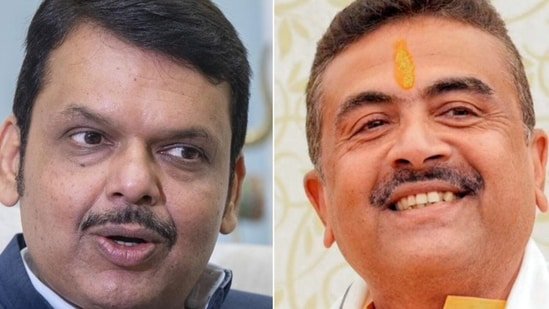
Maharashtra CM Devendra Fadnavis calls Suvendu Adhikari’s swearing-in a ‘victory for India’
# Adhikari Sworn In As Bengal’s First BJP CM
**By Special Political Correspondent, National News Desk, May 09, 2026**
On Saturday, May 9, 2026, Suvendu Adhikari made history by taking the oath of office as West Bengal’s first-ever Bharatiya Janata Party (BJP) Chief Minister in Kolkata. The momentous swearing-in ceremony, attended by Prime Minister Narendra Modi and a host of top National Democratic Alliance (NDA) leaders, marks a seismic shift in eastern Indian politics, concluding the 15-year rule of the Trinamool Congress (TMC). Highlighting the national significance of the watershed electoral event, Maharashtra Chief Minister Devendra Fadnavis lauded the development, officially terming Adhikari’s elevation and the BJP’s decisive mandate as a resounding “victory for India.” [Source: Hindustan Times | Additional: Election Commission 2026 Assembly Results].
## A Historic Political Shift in West Bengal
The swearing-in ceremony, held against the iconic backdrop of Kolkata’s Red Road, was a grand spectacle that effectively rewrote the political geography of eastern India. Hundreds of thousands of supporters draped in saffron gathered to witness the transition of power, a moment the BJP has been actively engineering for over a decade. **Governor C.V. Ananda Bose** administered the oath of office and secrecy to Suvendu Adhikari in a ceremony that saw attendance from the highest echelons of Indian political leadership.
Aside from Prime Minister Narendra Modi, the event was flanked by Union Home Minister Amit Shah, BJP National President J.P. Nadda, and several chief ministers from BJP-ruled states. The visual of Adhikari taking the oath symbolizes the culmination of the BJP’s relentless “Look East” political strategy. For West Bengal, a state historically dominated by the Left Front and subsequently the Mamata Banerjee-led TMC, the installation of a center-right government represents a fundamental ideological and administrative pivot.
## Fadnavis’s Remarks: “A Victory for India”
The reaction from national leaders underscored the high stakes of the 2026 West Bengal Assembly elections. Speaking to reporters on the sidelines of the ceremony, Maharashtra Chief Minister Devendra Fadnavis provided a striking national context to the regional victory. Calling Adhikari’s swearing-in a “victory for India,” Fadnavis articulated the ruling party’s perspective that bringing West Bengal into the NDA fold bridges a crucial gap in national integration and cooperative federalism.
“This is not just a political win for the BJP; it is a victory for India’s democratic ethos and the people of Bengal who voted for development, security, and integration with the national mainstream,” Fadnavis stated. [Source: Hindustan Times].
Political analysts interpret Fadnavis’s statement as a strategic counter-narrative to the “insider versus outsider” debate that has dominated Bengal politics in recent years. By framing the election outcome as an Indian victory rather than merely a partisan conquest, the BJP leadership is attempting to soothe regional anxieties and promise a governance model aligned seamlessly with the central government’s macroeconomic and security goals.
## Prime Minister Modi’s Presence and National Strategy
Prime Minister Narendra Modi’s prominent presence at the swearing-in ceremony was not merely ceremonial; it was the realization of one of his most ambitious political projects. The Prime Minister has invested substantial political capital in West Bengal, campaigning vigorously across the state’s rural hinterlands and urban centers over the past three election cycles.
The BJP’s trajectory in the state has been one of slow, grueling ascent. After securing 18 Lok Sabha seats in 2019 and establishing itself as the principal opposition with 77 assembly seats in 2021, the party meticulously dismantled the incumbent’s structural advantages. Modi’s attendance validates the grassroots workers who faced intense political friction over the years and signals to investors and administrators that the new state government has the unconditional backing of New Delhi. [Source: Historical Election Data | Additional: Expert Political Commentary 2026].
## The Rise of Suvendu Adhikari
The elevation of **Suvendu Adhikari** to the chief ministerial office is a testament to his formidable organizational skills and deep grassroots connectivity. Hailing from the influential Adhikari family of Purba Medinipur, his political journey is one of the most compelling narratives in contemporary Indian politics. Once considered the right-hand man of Mamata Banerjee and the architect of the historic Nandigram land agitation that propelled the TMC to power in 2011, Adhikari’s defection to the BJP in late 2020 changed the state’s political calculus.
His defining moment came during the 2021 Assembly elections when he narrowly defeated Chief Minister Mamata Banerjee in the high-stakes battle for the Nandigram constituency. Since then, serving as the Leader of the Opposition in the West Bengal Legislative Assembly, Adhikari relentlessly cornered the state government on issues of alleged corruption, recruitment scams, and political violence. His ability to consolidate anti-incumbency votes, bridge the urban-rural divide, and mobilize the BJP cadre made him the natural choice for the top job following the party’s historic 2026 victory.
## Expert Perspectives on BJP’s Bengal Blueprint
The 2026 election results have prompted extensive analysis from political experts trying to decode the BJP’s successful breach of the TMC fortress. The consensus points to a combination of severe anti-incumbency, centralization of welfare schemes, and effective mobilization of marginalized communities.
“The 2026 mandate is a reaction to a systemic administrative fatigue,” notes Dr. Ananya Sen, a Kolkata-based political scientist specializing in eastern Indian electoral behavior. “The BJP successfully capitalized on the slew of corruption allegations that plagued the previous administration, particularly the teacher recruitment scandals. Furthermore, Adhikari’s strategy to heavily consolidate the Matua community votes and make inroads into the tribal belts of Jangalmahal proved to be the demographic tipping point.”
Rajiv Desai, a researcher at the Centre for National Policy Studies, adds, “Fadnavis calling it a ‘victory for India’ also points to the security dimension. The BJP heavily campaigned on border security, women’s safety, and the implementation of the Citizenship Amendment Act (CAA). The mandate indicates that these national narratives resonated deeply with the local electorate.” [Source: Independent Policy Analysis].
## Challenges Ahead for the New Administration
While the swearing-in is a moment of jubilation for the BJP, Suvendu Adhikari inherits a state facing formidable multifaceted challenges. The immediate hurdle for the new administration is the state’s precarious financial health. West Bengal currently labors under a massive debt burden, and balancing the books while fulfilling the BJP’s expansive electoral promises—termed ‘Modi’s Guarantees’ during the campaign—will require acute fiscal maneuvering.
Key challenges for the new Chief Minister include:
* **Economic Revival and Industrialization:** Bengal has long struggled to attract large-scale private investment. Adhikari will need to urgently reform land acquisition policies and establish a business-friendly environment to create employment for millions of youths.
* **Restoring Law and Order:** The state has a notorious legacy of post-poll political violence. Dismantling the culture of partisan syndicates and restoring faith in an impartial police force will be a critical test for the new Chief Minister.
* **Center-State Synergy:** After years of friction regarding the disbursement of central funds, including MGNREGA and housing schemes, the new “double-engine” government must ensure that paused central funds quickly reach the beneficiaries.
## Implications for National Politics Leading up to 2029
The geopolitical and national implications of the BJP securing West Bengal cannot be overstated. With 42 Lok Sabha seats, Bengal is a critical state for national dominance. By installing a BJP government in Kolkata, the NDA has effectively neutralized one of the strongest regional opposition bastions in the country, dealing a severe blow to the I.N.D.I.A opposition bloc’s hopes for national resurgence.
The victory also provides the central government with a friendly administration in a vital border state, smoothing the way for stringent border management policies, infrastructure development in the critical Siliguri corridor, and seamless implementation of national directives. Devendra Fadnavis’s sentiment echoes the BJP high command’s view: winning Bengal is not just an electoral milestone, but a fundamental consolidation of the nation’s eastern frontier under the central government’s vision.
## Conclusion: A New Era for Bengal
May 9, 2026, will be recorded as a transformative date in India’s democratic history. Suvendu Adhikari’s ascent to the Chief Minister’s office shatters decades of established political norms in West Bengal. As Prime Minister Modi, Chief Minister Fadnavis, and the broader NDA leadership celebrate this hard-fought victory, the real work for the Adhikari administration begins now.
The people of West Bengal have delivered a sweeping mandate for change, effectively buying into the promise of a “double-engine” government that promises economic revitalization and systemic cleansing. Whether Adhikari can translate this historic electoral mandate into tangible governance and economic prosperity will not only determine his political legacy but will also shape the socio-economic future of eastern India for decades to come.





