
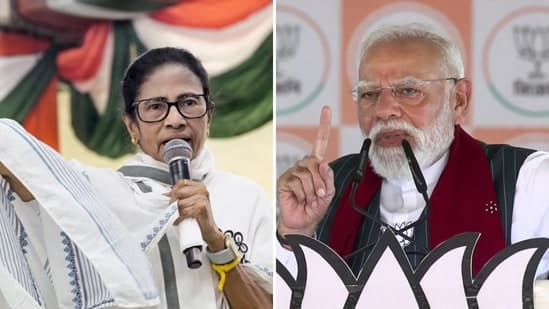
'Mati handed to infiltrators,' Modi attacks TMC in last leg of campaign; Mamata says 'BJP dar gaya'| India News
# Bengal 2026: Modi Slams TMC, Mamata Hits Back
**By Senior Political Correspondent, National News Desk, April 27, 2026**
In the decisive final phase of the fiercely contested West Bengal Assembly elections, the political battleground has witnessed a sharp escalation in rhetoric. Prime Minister Narendra Modi launched a scathing attack on the ruling Trinamool Congress (TMC), accusing the party of betraying its foundational “Maa, Mati, Manush” slogan by handing over the state’s land to “infiltrators.” In rapid retaliation, Chief Minister Mamata Banerjee dismissed the Prime Minister’s allegations, asserting that the aggressive campaigning indicates the “BJP dar gaya” (the BJP is scared). As polling day approaches, the multi-cornered contest has drawn in top leaders, including Union Home Minister Amit Shah and Leader of the Opposition in the Lok Sabha, Rahul Gandhi, both of whom have intensified their respective critiques of the TMC government.
[Source: Hindustan Times | Additional Context: 2026 West Bengal State Assembly Election Archives]
## The Weaponization of “Maa, Mati, Manush”
The phrase “Maa, Mati, Manush” (Mother, Land, and People) has been the emotional and political bedrock of the Trinamool Congress since it ousted the three-decade-old Left Front government in 2011. However, in the 2026 campaign trail, the Bharatiya Janata Party (BJP) has strategically attempted to appropriate and invert this narrative.
Speaking at a massive rally in the border district of Malda, **Prime Minister Narendra Modi** directly challenged the TMC’s commitment to the state’s residents. “The slogan was meant to protect the mother, the land, and the people. Today, mothers are unsafe, the people are suffering, and the ‘Mati’ (land) has been handed over to infiltrators for vote-bank politics,” Modi declared to a roaring crowd.
This line of attack underscores the BJP’s primary electoral strategy in border states, focusing heavily on national security, demographic anxieties, and allegations of state-sponsored appeasement. By highlighting alleged illegal immigration from neighboring Bangladesh, the BJP seeks to consolidate the Hindu vote in vulnerable frontier districts, a tactic that yielded significant dividends during the 2019 and 2024 Lok Sabha elections.
“The BJP is effectively trying to localize a national security narrative,” explains Dr. Ananya Sen, a Kolkata-based political sociologist. “By claiming that local land and resources are being usurped by outsiders protected by the ruling regime, the BJP is attempting to trigger a protective, sub-nationalist reflex among the state’s indigenous voters.”
## Mamata Banerjee’s Retort: “BJP Dar Gaya”
Unfazed by the Prime Minister’s assertions, **Chief Minister Mamata Banerjee** mounted a vehement counter-offensive. Addressing back-to-back rallies in South 24 Parganas and Kolkata, the TMC supremo characterized the BJP’s rhetoric as an act of desperation.
“They bring leaders from Delhi in chartered planes because they have no local faces. Now, seeing the crowds supporting the TMC, they are resorting to lies. The truth is simple: BJP dar gaya (the BJP is scared),” Banerjee told her supporters.
Banerjee’s campaign relies heavily on her government’s expansive welfare schemes, such as *Lakshmir Bhandar* (direct cash transfers to women), *Swasthya Sathi* (health insurance), and *Kanyashree* (financial aid for girls’ education). The TMC argues that the BJP’s focus on “infiltrators” is a smokescreen intended to distract voters from the central government’s economic track record and alleged step-motherly treatment regarding the release of central funds to West Bengal.
The TMC leadership has consistently denied allegations of sheltering illegal immigrants, pointing out that border security is the constitutional mandate of the Border Security Force (BSF), a central agency under the Union Home Ministry. “If there is infiltration, it is a failure of Amit Shah’s ministry, not the state government,” a senior TMC spokesperson noted during a recent press briefing.
## Amit Shah Amplifies the Security Pitch
Adding momentum to the BJP’s final-leg surge, **Union Home Minister Amit Shah** has also intensified his campaigning across the state. Shah has been instrumental in weaving the implementation of the Citizenship Amendment Act (CAA)—which saw its rules notified earlier in the decade—into the local electoral fabric.
In his rallies, Shah has promised that a BJP government in West Bengal would permanently secure the state’s borders and end the alleged syndicate raj (extortion networks) that he claims operates under TMC patronage. The Home Minister’s speeches frequently highlight the plight of the Matua community, a Dalit sub-caste with roots in East Bengal (now Bangladesh), assuring them of safe and dignified citizenship under the CAA while simultaneously promising strict action against undocumented immigrants.
[Source: Hindustan Times | Additional Analysis: Regional Demographic Electoral Trends]
## The Congress Paradigm: Rahul Gandhi’s Dual Strategy
Complicating the bipolar narrative between the TMC and the BJP is the stance of the Indian National Congress. Despite being a key ally of the TMC in the broader national I.N.D.I.A bloc formed to counter the BJP in Parliament, the Congress remains a bitter rival of the TMC at the state level in West Bengal.
On Sunday, **Leader of the Opposition in the Lok Sabha, Rahul Gandhi**, issued a sharply worded post targeting the TMC’s governance record. Gandhi criticized the state administration for systemic corruption, a lack of industrial employment, and compromised democratic institutions.
This aggressive posturing by the LoP highlights the intricate and often contradictory nature of Indian coalition politics. In West Bengal, the Congress has allied with the Left Front (CPI-M) to present a third viable alternative to the voters.
“Rahul Gandhi’s critique of the TMC serves a dual purpose,” observes political analyst Ronojoy Sen. “First, it prevents the anti-incumbency vote from flowing entirely to the BJP. Second, it revitalizes the beleaguered Congress-Left cadre in the state, asserting that they are not mere silent spectators to the TMC-BJP clash.”
By targeting the TMC’s alleged democratic deficits, the Congress aims to position itself as the principled opposition, distinct from the BJP’s polarized rhetoric and the TMC’s populist welfarism.
## Electoral Arithmetic: The Road to the Assembly
The 2026 West Bengal Assembly elections are widely regarded as one of the most consequential state polls of the decade. The state sends a massive bloc of legislators to the assembly, and the results hold profound implications for the political fortunes of both the BJP and the regional opposition.
To understand the stakes, one must look at the recent electoral trajectory of the state:
| Election Year | TMC Performance | BJP Performance | Left-Congress Alliance | Key Defining Issue |
| :— | :— | :— | :— | :— |
| **2016 Assembly** | 211 Seats | 3 Seats | 76 Seats | TMC Welfarism, Left Decline |
| **2019 Lok Sabha** | 22 Seats | 18 Seats | 2 Seats | BJP’s Nationalist Surge |
| **2021 Assembly** | 215 Seats | 77 Seats | 0 Seats | “Bengal’s Daughter” vs Central Might |
| **2026 Assembly** | *Polling Ongoing* | *Polling Ongoing* | *Polling Ongoing* | Welfare vs Anti-Incumbency/Security |
*Data reflects officially declared ECI results from previous election cycles. 2026 results are pending.*
The BJP is banking on a consolidation of anti-incumbency sentiment after 15 years of TMC rule. They are targeting specific demographics, including the Rajbanshis in North Bengal, the Matuas in South Bengal, and urban middle-class voters allegedly disillusioned by local corruption scandals.
Conversely, the TMC relies on its impregnable grip over the rural hinterlands, driven by a highly effective delivery mechanism for state welfare schemes. Furthermore, the state’s significant minority population, comprising roughly 27-30% of the electorate, has historically consolidated behind the TMC to thwart the BJP’s advances.
## Implications and Future Outlook
As the campaign draws to a close, the exchanges between PM Modi and CM Mamata Banerjee encapsulate the broader ideological war being waged in India’s eastern corridor.
The Prime Minister’s “infiltrator” remark is not merely a passing comment; it represents a calculated effort to frame the West Bengal election as a battle for civilizational and demographic survival. By arguing that the “Mati” of Bengal is being sold out, the BJP is appealing to deep-seated anxieties related to land, identity, and resources.
On the other hand, Mamata Banerjee’s “BJP dar gaya” narrative aims to project strength and invincibility. By framing the BJP’s aggressive campaigning as a symptom of electoral panic, she seeks to reassure her vote base and prevent any swing voters from defecting to the opposition camp.
Meanwhile, the Congress and Left alliance face an existential battle to remain relevant in a state they once dominated. Rahul Gandhi’s interventions signal that the national opposition block is not willing to concede the state entirely to the TMC, maintaining a competitive federal structure.
Ultimately, the results of the 2026 West Bengal elections will do more than just determine the next Chief Minister. They will test the limits of welfare politics against religious polarization, gauge the shelf-life of anti-incumbency in an era of direct benefit transfers, and potentially reshape the national political landscape as India looks toward the end of the decade. The electorate’s verdict on whether the “Mati” has been protected or compromised will soon be sealed in the electronic voting machines.





