
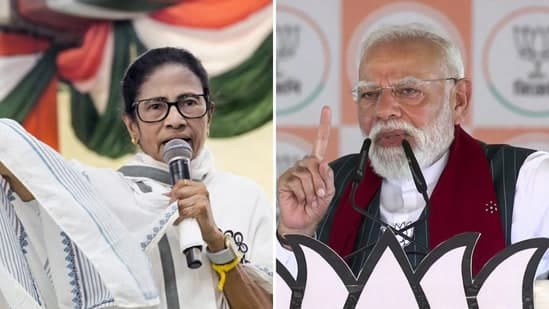
'Mati handed to infiltrators,' Modi attacks TMC in last leg of campaign; Mamata says 'BJP dar gaya'| India News
# Modi Targets TMC on Border; Mamata Hits Back
**By Staff Reporter, The India Dispatch | April 27, 2026**
In the high-stakes climax of the 2026 West Bengal Assembly elections, Prime Minister Narendra Modi launched a scathing attack on the ruling Trinamool Congress (TMC), accusing Chief Minister Mamata Banerjee of handing over the state’s “Mati” (land) to illegal infiltrators. As the campaign entered its final leg on Monday, April 27, 2026, Banerjee swiftly countered the demographic narrative, mocking the saffron party’s electoral anxieties by declaring “BJP dar gaya” (the BJP is scared). The volatile political landscape was further complicated by Union Home Minister Amit Shah’s aggressive security pitch and Leader of the Opposition Rahul Gandhi’s separate verbal assault on the TMC administration, turning the state into a fierce multi-cornered battlefield. [Source: Hindustan Times]
## The Battle for ‘Mati’: Modi’s Sharp Critique
Prime Minister Narendra Modi’s final campaign blitz across the critical border districts of West Bengal featured a calculated linguistic and ideological strike against the incumbent TMC. Addressing massive rallies, the Prime Minister took direct aim at Mamata Banerjee’s foundational slogan: “Ma, Mati, Manush” (Mother, Land, and People), which propelled her to power in 2011.
Modi argued that the TMC has systematically betrayed this core promise. “The ‘Mati’ of Bengal, the sacred land of Ramakrishna and Vivekananda, has been handed over to infiltrators by the TMC for the sake of vote-bank appeasement,” the Prime Minister stated, drawing thunderous applause. He accused the state government of compromising national security and allowing demographic manipulation in districts bordering Bangladesh.
**Key elements of the BJP’s closing arguments included:**
* **Border Security Allegations:** Accusing local TMC operatives of facilitating illegal crossings to inflate voter rolls.
* **Corruption Charges:** Highlighting ongoing investigations by central agencies into state-level recruitment and rationing scams.
* **Women’s Safety:** Reigniting memories of local unrest and alleged atrocities in pockets like Sandeshkhali, framing the TMC as protective of local strongmen.
Dr. Subrata Mitra, a Kolkata-based political analyst, noted the significance of this rhetoric. “The Prime Minister’s deliberate use of the word ‘Mati’ is a calculated move. It attempts to strip the TMC of its core regional identity by suggesting that the very land they promised to protect has been bartered for political survival,” Mitra explained. [Additional: Electoral Analysis, West Bengal Politics]
## ‘BJP Dar Gaya’: Mamata Banerjee’s Fierce Counter
Refusing to cede an inch of political ground, Chief Minister Mamata Banerjee launched a blistering counter-offensive across South Bengal. Addressing back-to-back rallies in fiercely contested constituencies, Banerjee dismissed the Prime Minister’s infiltration narrative as a desperate smokescreen deployed by a party facing imminent defeat.
“They bring leaders from Delhi in chartered planes to lecture us on Bengal’s culture,” Banerjee told a roaring crowd. “Why are they shouting so loudly in the last phase? Because *BJP dar gaya* (the BJP is scared). They have realized that the people of Bengal have rejected their politics of division and hatred.” [Source: Hindustan Times]
Banerjee anchored her defense in her administration’s extensive welfare economics, which has been the bedrock of her sustained popularity over the last 15 years. She heavily emphasized programs like *Lakshmir Bhandar* (direct cash transfers for women), *Kanyashree* (girls’ education), and *Swasthya Sathi* (health insurance).
The Chief Minister also turned the tables on the BJP regarding national security, pointing out that guarding the international borders is the primary jurisdiction of the central government’s Border Security Force (BSF), not the state police. “If there is infiltration, who is responsible? The central forces operate under Delhi. They fail to secure the borders and then blame Bengal’s administration,” she argued.
## Amit Shah Amplifies the National Security Pitch
Mirroring the Prime Minister’s intensity, Union Home Minister Amit Shah intensified his campaigning over the weekend. Shah focused heavily on the implementation of the Citizenship Amendment Act (CAA), the rules for which were officially notified by the central government leading up to the 2024 parliamentary elections.
Shah’s rallies, strategically placed in regions with significant Matua community populations—a key demographic that migrated from Bangladesh due to religious persecution—promised an end to the “reign of terror” and illegal immigration. He assured the refugee communities of permanent legal protection while simultaneously warning that the TMC was shielding illegal immigrants to build an artificial voter base. [Source: Hindustan Times]
“Amit Shah’s role in this campaign has been to act as the ideological enforcer,” says Meenakshi Sen, a researcher at the Centre for Eastern Indian Studies. “While Modi talks about the emotional betrayal of ‘Mati,’ Shah provides the hardline administrative promise of using central mechanisms to physically alter the demographic trajectory of the borderlands.”
## Rahul Gandhi and the Opposition Dynamics
The 2026 West Bengal election is notably not just a bipolar contest. The political matrix was further complicated by the intervention of Rahul Gandhi, the Leader of the Opposition (LoP) in the Lok Sabha. Taking to social media on Sunday, Gandhi launched a sharp critique of the TMC government, exposing the deep fractures within the national opposition at the state level. [Source: Hindustan Times]
Despite the TMC and the Indian National Congress being theoretical allies in the broader national INDIA bloc formed ahead of the 2024 Lok Sabha elections, state-level compulsions have forced a bitter divide. In West Bengal, the Congress has partnered with the Left Front to present a third alternative to the electorate.
Gandhi’s posts targeted the TMC’s governance record, alleging a collapse of democratic institutions, rampant political violence, and widespread corruption in state municipalities. By attacking the TMC, the Congress aims to consolidate the anti-incumbency vote that might otherwise drift entirely toward the BJP.
However, this three-way dynamic introduces a significant variable. **Political analysts identify three distinct electoral currents in 2026:**
1. **Pro-Incumbency Welfare Vote:** Primarily driven by rural women and beneficiaries of TMC’s state schemes.
2. **Hindutva and Anti-Corruption Consolidation:** Channeled aggressively by the BJP, appealing to urban middle classes and border-district Hindus.
3. **The Left-Congress Revival Attempt:** Targeting minority voters disillusioned with the TMC and secular voters uncomfortable with the BJP.
“Rahul Gandhi’s aggressive posture against Mamata Banerjee serves a dual purpose,” explains Dr. Mitra. “It protects the local Congress-Left cadre from being consumed by the TMC, but it also inadvertently aids the BJP by splitting the secular, anti-BJP vote in crucial multi-cornered constituencies like Murshidabad and Malda.” [Additional: Historical Voting Patterns Analysis]
## Demographic Politics and Border Realities
The rhetoric surrounding “infiltrators” and border security is not merely political theater; it touches upon the deeply entrenched anxieties in West Bengal’s border districts. Districts such as North 24 Parganas, South 24 Parganas, Nadia, Murshidabad, and Malda share porous boundaries with Bangladesh.
Over the decades, these regions have witnessed significant demographic shifts, resource competition, and complex socio-economic challenges. The BJP has capitalized on the localized resentment stemming from land disputes, smuggling networks, and changing cultural dynamics in these areas. By framing these issues as an existential threat to Bengali identity, the BJP hopes to breach the TMC’s formidable electoral fortress.
Conversely, the TMC relies heavily on the consolidation of minority votes, which make up roughly 27-30% of the state’s electorate, alongside its massive female support base. Banerjee’s strategy has been to frame the BJP’s National Register of Citizens (NRC) and CAA narratives as threats to genuine Indian citizens, thereby ensuring mass mobilization among vulnerable communities.
## Conclusion: A High-Stakes Verdict Awaits
As the campaign dust settles ahead of the final voting phases, the 2026 West Bengal Assembly elections are shaping up to be one of the most fiercely contested democratic exercises in recent Indian history. Prime Minister Narendra Modi’s heavy emphasis on the “Mati” being given to infiltrators signifies the BJP’s ultimate push to frame this election as a referendum on state security and demographic integrity.
On the other hand, Chief Minister Mamata Banerjee’s defiant “BJP dar gaya” stance underscores her reliance on robust grassroots machinery, sub-nationalism, and a deeply entrenched welfare delivery system. With Rahul Gandhi and the Left Front actively campaigning to reclaim lost ground, the resulting vote splits will play a decisive role in determining who commands the corridors of Nabanna (the state secretariat).
The electorate’s verdict will not only determine the political destiny of West Bengal for the next five years but will also send powerful reverberations through the national political landscape as India navigates the complex post-2024 parliamentary era. All eyes are now on the election commission’s logistical execution in the final phases, leading up to a dramatic counting day.





