‘Modi ji mentioned Congress 59 times, women barely’: Kharge slams PM’s speech after bill fails Lok Sabha test| India News
# Kharge Slams PM After Women’s Bill Fails
**New Delhi, April 19, 2026:** In a major legislative and political setback for the ruling National Democratic Alliance (NDA) government, the Constitution (131st Amendment) Bill, 2026, failed to pass the Lok Sabha test on Sunday after falling short of the required two-thirds special majority. The bill’s dramatic defeat on the floor of the Lower House triggered an immediate and fierce political war of words. Leading the opposition’s charge, Congress President Mallikarjun Kharge launched a blistering attack on Prime Minister Narendra Modi’s parliamentary address. Kharge accused the Prime Minister of utilizing the solemn legislative floor for partisan attacks rather than addressing the core issues of female empowerment, noting pointedly that the Prime Minister mentioned the Congress party “59 times” while barely speaking about the women the bill was meant to serve.
## The Legislative Stumbling Block: Understanding the Defeat
The failure of the Constitution (131st Amendment) Bill, 2026, marks one of the rare instances in recent parliamentary history where a government-backed constitutional amendment has collapsed on the floor of the Lok Sabha. Under Article 368 of the Indian Constitution, any bill seeking to amend the constitution requires a special majority. This mandates not only a majority of the total membership of the House but also a majority of not less than two-thirds of the members present and voting.
Despite issuing a strict three-line whip to its members and allies, the NDA government found itself numerically outmaneuvered by a consolidated I.N.D.I.A. bloc opposition. The exact voting figures indicated a heavily polarized House, with several regional parties staging tactical walkouts, effectively skewing the arithmetic required to cross the two-thirds threshold.
The 131st Amendment Bill was introduced as a critical follow-up to the historic Nari Shakti Vandan Adhiniyam (128th Amendment) passed in 2023. While the 2023 legislation successfully reserved 33% of seats for women in the Lok Sabha and state assemblies, its implementation was controversially tethered to the completion of the next delimitation exercise and census. The 2026 amendment was purportedly brought forward to address implementation timelines and administrative frameworks ahead of the impending delimitation process. However, it lacked the much-demanded provisions for an Other Backward Classes (OBC) sub-quota, which became the primary catalyst for its rejection by the opposition.
[Source: Hindustan Times | Additional: Parliamentary Records, April 2026]
## Kharge’s Blistering Attack on PM Modi’s Priorities
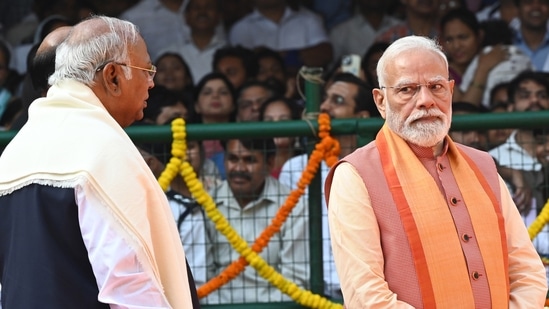
The immediate aftermath of the vote was characterized by intense political rhetoric, spearheaded by Congress President Mallikarjun Kharge. Addressing the media outside the parliament building, Kharge did not mince words in his assessment of the Prime Minister’s speech that preceded the crucial vote.
“Modi ji mentioned Congress 59 times, women barely,” Kharge stated, citing a tally kept by opposition members during the Prime Minister’s nearly 90-minute address. “When you bring a constitutional amendment of such magnitude—one that affects the democratic rights of half the population of this country—the nation expects the Prime Minister to speak on the intricacies of the bill, the empowerment of women, and the roadmap for their political inclusion.”
Kharge further alleged that the Prime Minister’s speech resembled an election rally address rather than a Prime Ministerial defense of a constitutional amendment. By repeatedly attacking the historical record of the United Progressive Alliance (UPA) and the Congress party, the opposition claims the government revealed its true intention: to use the women’s bill purely as an electoral wedge issue rather than a genuine legislative priority.
**Key allegations raised by the Congress President included:**
* **Misplaced Priorities:** Accusing the government of prioritizing political point-scoring over building a parliamentary consensus.
* **Evasion of Sub-Quotas:** Highlighting the Prime Minister’s failure to address the opposition’s core demand for an OBC women’s sub-quota.
* **Hollow Optics:** Framing the government’s push for the bill as a desperate attempt to salvage its image among female voters ahead of critical state elections.
## Decoding the Numbers: The I.N.D.I.A. Bloc’s Strategic Consolidation
The defeat of the bill is as much a story of opposition unity as it is of government miscalculation. The I.N.D.I.A. alliance, which has often faced criticism for internal fragmentation, managed a remarkable display of floor coordination.
The strategy was predicated on the demand for social justice. Parties like the Samajwadi Party (SP), Rashtriya Janata Dal (RJD), and the Dravida Munnetra Kazhagam (DMK) drew a hard line on the inclusion of specific sub-quotas for marginalized women. They argued that a blanket reservation heavily favors urban, upper-caste women, leaving rural and backward-class women structurally disenfranchised.
When the government refused to entertain amendments addressing these sub-quotas, the opposition unified. By ensuring maximum attendance of their MPs and voting cohesively against the unamended draft, the opposition successfully blocked the two-thirds majority requirement.
“The government arrogantly assumed that the opposition would capitulate out of fear of being labeled ‘anti-women’,” noted a senior Congress strategist who requested anonymity. “What they failed to realize is that our definition of women’s empowerment is inherently intersectional. You cannot empower women while ignoring the caste dynamics that keep the majority of India’s women marginalized.”
## The Broader Context: Delimitation, Census, and the 2023 Legacy
To understand the vitriol surrounding the failed 131st Amendment, one must look back to September 2023. The passage of the original Women’s Reservation Bill was hailed as a watershed moment. However, the fine print revealed that the reservation would only take effect after a new census was published and a subsequent delimitation exercise (redrawing of constituency boundaries) was completed.
As 2026 approached—the year the freeze on delimitation was constitutionally slated to be lifted—anxiety across the political spectrum grew. Southern states expressed deep concerns over losing parliamentary representation due to their successful population control measures compared to northern states. Meanwhile, the demand for a nationwide caste census gained unprecedented momentum.
The 131st Amendment was the government’s attempt to navigate this complex web. However, by attempting to decouple the women’s reservation implementation timeline from the broader demands of a caste census and proportional delimitation, the government stepped into a legislative minefield. The opposition seized the narrative, arguing that the government was trying to implement a flawed reservation model to reap electoral dividends without addressing systemic inequalities.
[Source: Hindustan Times | Additional: Constitutional Law Journal Analysis, 2026]
## Expert Perspectives on the Parliamentary Impasse
Political analysts and constitutional experts view the failure of the bill as a watershed moment in India’s current political cycle.
Dr. Meenakshi Iyer, a Senior Fellow at the Centre for Policy Research, notes, “What we witnessed in the Lok Sabha is a classic example of democratic friction. The government relied on the emotional and historic appeal of women’s reservation to bypass substantive debate on caste equity. The opposition called their bluff. Kharge’s observation about the Prime Minister’s speech highlights how deeply partisan the discourse has become; the floor of the House is now an extension of the campaign trail.”
Similarly, Ranjan Desai, a veteran constitutional analyst, points out the procedural rarity of the event. “A government rarely brings a constitutional amendment to a vote unless it is absolutely certain of the math. This defeat indicates a severe breakdown in back-channel parliamentary management. It shows that the traditional tools of parliamentary consensus-building have entirely eroded.”
From the ruling party’s perspective, the narrative is vastly different. Senior BJP leaders immediately launched a counter-offensive, labeling the Congress and its allies as “inherently misogynistic.” They argue that the opposition’s demand for an OBC sub-quota is merely a smokescreen to stall female empowerment—a stalling tactic they allege the Congress has employed for decades.
## Electoral Ramifications for 2026 and Beyond
The immediate fallout of this legislative failure will be felt in the electoral arena. Women voters have emerged as a decisive demographic in Indian elections, often demonstrating independent voting patterns that transcend traditional caste and household lines. In recent state and general elections, the “Mahila Vote Bank” has been the bedrock of the BJP’s welfare-driven electoral successes.
By aggressively pushing the 131st Amendment, the NDA hoped to solidify this voter base. Its failure will now initiate an intense battle of narratives:
* **The NDA’s Pitch:** The BJP is expected to campaign heavily on the narrative that they proposed the immediate facilitation of women’s rights, but the I.N.D.I.A. bloc actively vetoed it.
* **The Opposition’s Pitch:** The Congress and regional allies will take to the grassroots to explain that they did not block women’s reservation, but rather fought to ensure that backward class, Dalit, and Adivasi women get their rightful, guaranteed share within the quota, framing the BJP as anti-social justice.
Kharge’s tactical highlighting of the Prime Minister’s “59 mentions of Congress” is a deliberate attempt to frame the BJP’s governance model as obsessed with the opposition rather than focused on governance. It feeds into the broader opposition narrative that the current administration favors theatrical politics over substantive policy implementation.
## Conclusion: A Deepening Political Divide
The failure of the Constitution (131st Amendment) Bill, 2026, in the Lok Sabha is far more than a mere legislative hiccup; it is a manifestation of the deepening ideological and strategic divide in Indian politics. As Mallikarjun Kharge’s scathing critique of Prime Minister Modi’s speech illustrates, the debate over women’s representation has become inextricably linked with larger questions of caste equity, census data, and the nature of parliamentary discourse.
Because constitutional amendments cannot be promulgated via presidential ordinance, the bill has effectively reached a dead end in its current form. Any future attempt to revive it will require a fundamental renegotiation between the treasury and opposition benches—a prospect that seems highly unlikely in the current hyper-partisan climate. As the nation moves deeper into the 2026 political calendar, the reverberations of this failed Lok Sabha test will undoubtedly shape the campaigns, rhetoric, and voting behavior of millions across the country.
***
**By Special Political Correspondent, India Policy Review, April 19, 2026**