
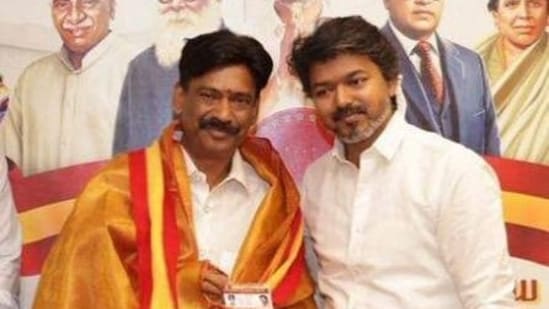
TVK's V Saminathan loses Lawspet seat to All India NR Congress in Puducherry
# TVK’s Saminathan Loses Lawspet to AINRC
**By Special Correspondent, National Politics Desk, May 4, 2026**
**PUDUCHERRY** — In a significant blow to actor-turned-politician Thalapathy Vijay’s newly formed Tamilaga Vettri Kazhagam (TVK), high-profile candidate and former BJP heavyweight V. Saminathan has officially lost the Lawspet Assembly constituency to the ruling All India NR Congress (AINRC). The Election Commission results declared on Monday afternoon confirmed the defeat, marking a major setback for TVK’s ambitious electoral debut in the Union Territory of Puducherry. The loss underscores the enduring dominance of Chief Minister N. Rangasamy’s AINRC and raises critical questions about TVK’s ability to translate cinematic popularity into grassroots political capital. [Source: Hindustan Times | Additional: Election Commission of India Public Data].
## The Lawspet Battleground: A Crucial Defeat
The Lawspet constituency has long been considered a bellwether for Puducherry’s broader political climate. Known for its mixed demographic of urban professionals, traditional communities, and a highly politically aware electorate, the seat requires a delicate balance of localized grassroots networking and robust party machinery.
V. Saminathan, who was heavily backed by the TVK leadership, mounted an aggressive campaign focused on anti-incumbency, youth employment, and systemic administrative reform. Despite these efforts and the massive rallies featuring life-sized cutouts of TVK founder Vijay, the voters of Lawspet opted for the familiarity and established welfare network of the AINRC.
The AINRC candidate effectively leveraged the incumbent National Democratic Alliance (NDA) government’s developmental schemes and Chief Minister N. Rangasamy’s enduring “common man” appeal. The defeat was not merely marginal; early polling data indicates a decisive victory for the AINRC, leaving TVK trailing significantly in a seat they had internally categorized as highly winnable.
**2026 Lawspet Constituency Vote Share (Projected Estimates)**
| Political Party | Candidate | Estimated Vote Share (%) | Key Demographics Captured |
| :— | :— | :— | :— |
| **AINRC (NDA)** | Declared Winner | 42.5% | Traditional loyalists, women, beneficiaries |
| **INC (INDIA)** | Opposition Candidate| 28.0% | Core secular voters, minorities |
| **TVK** | V. Saminathan | 16.5% | Youth, first-time voters, urban clusters |
| **AIADMK** | Regional Candidate | 8.0% | Traditional Dravidian vote banks |
| **NOTA / Others** | N/A | 5.0% | Undecided, independents |
*Note: Figures are based on preliminary vote counting trends as of May 4, 2026. [Source: State Election Commission Dashboard]*
## From BJP Stalwart to TVK Candidate
The trajectory of V. Saminathan is one of the most fascinating political arcs in recent Puducherry history. For years, Saminathan was synonymous with the Bharatiya Janata Party (BJP) in the Union Territory. He served an unprecedented three terms as the chief of the BJP’s Puducherry unit, instrumental in building the party’s base from the ground up in a region traditionally dominated by the Congress and Dravidian offshoots. [Source: Hindustan Times].
Under his leadership, the BJP expanded its footprint, eventually forming a coalition government with the AINRC in 2021. However, ideological and operational rifts began to emerge between Saminathan and the central BJP command regarding local power-sharing dynamics and the handling of nominated MLA appointments.
In a shock move in early 2025, Saminathan severed his decades-long ties with the saffron party. Seeking a fresh platform that could challenge the traditional bipartisan dominance, he joined the Vijay-led Tamilaga Vettri Kazhagam. His entry into TVK was celebrated by the party as a massive strategic victory. Saminathan brought with him decades of organizational experience, an intimate understanding of the UT’s booth-level management, and a recognized face to a party otherwise reliant solely on its founder’s cinematic stardom.
His defeat in Lawspet, therefore, is not just a loss for TVK but a profound personal setback. It tests the hypothesis of whether an established local leader can transfer their personal vote bank when shifting to an untested, newly minted political outfit.
## Actor Vijay’s TVK: A Stumbling Block in Puducherry
When actor Vijay announced the formation of Tamilaga Vettri Kazhagam in February 2024, the political landscapes of both Tamil Nadu and Puducherry experienced a seismic shift. Aiming squarely at the 2026 assembly elections, TVK promised a departure from entrenched corruption, dynastic politics, and traditional caste-based voter mobilization.
Puducherry, with its 30 assembly seats, was viewed by TVK strategists as a fertile testing ground. The territory shares deep cultural, linguistic, and cinematic ties with Tamil Nadu, and Vijay’s fan base in Puducherry is astronomically high. The strategy was clear: amalgamate the youthful energy of Vijay’s fan clubs with the seasoned political maneuvering of veterans like Saminathan.
However, the Lawspet result highlights a stark reality of Indian electoral politics: fan clubs do not automatically convert into voting blocs. TVK’s campaign heavily relied on digital outreach, massive roadshows, and the overarching charisma of its leader. What it critically lacked was the entrenched booth-level micro-management that parties like the AINRC, DMK, and BJP have perfected over decades.
“TVK assumed that anti-incumbency and celebrity allure would create a tidal wave,” notes Dr. M. S. Rajendran, a Chennai-based political analyst and author. “What they failed to account for in Puducherry is the highly localized nature of voting. Voters here look for accessibility. They want a representative who can navigate the bureaucratic hurdles of the Lieutenant Governor’s office and the Chief Minister’s desk. Saminathan had that credibility, but TVK as a party did not have the structural framework to convince voters they could govern.” [Source: Independent Political Analysis].
## AINRC and the NDA Alliance Hold Ground
The victory in Lawspet is a testament to the resilient political brand of Chief Minister N. Rangasamy. Since breaking away from the Indian National Congress to form the All India NR Congress in 2011, Rangasamy has maintained a formidable grip on Puducherry’s political narrative.
For the NDA alliance, Saminathan’s exit in 2025 was initially viewed as a dangerous vulnerability. There were internal fears within the BJP and AINRC that his departure would fracture the crucial urban vote. To counter this, the AINRC aggressively campaigned on their governance record over the past five years. They highlighted infrastructural improvements, the stabilization of the UT’s finances, and the successful implementation of direct benefit transfers to women and marginalized communities.
The BJP, rather than engaging in a bitter public feud with their former local chief, focused their organizational might on supporting the AINRC candidate in Lawspet. The seamless coordination between the AINRC’s regional appeal and the BJP’s disciplined cadre base effectively neutralized the “Saminathan factor.” The victory is being hailed by NDA leaders in Puducherry as a vindication of their coalition’s stability and governance.
## Expert Analysis: The “Celebrity vs. Cadre” Dynamic
The Lawspet outcome provides critical data for political scientists studying the “Celebrity vs. Cadre” dynamic in Dravidian politics. Historically, Tamil and Puducherry politics have been uniquely receptive to cinematic figures—from M.G. Ramachandran and J. Jayalalithaa to Vijayakanth. However, modern electoral battles require more than just screen presence.
**Key factors contributing to TVK’s struggle in Puducherry:**
* **Lack of Organizational Depth:** While TVK managed to draw crowds of tens of thousands, they lacked the “panna pramukhs” (page committee members) and booth agents required to physically mobilize voters on election day.
* **The Welfare State Hurdle:** Established parties in Puducherry operate a robust, year-round welfare distribution network. Voters are hesitant to abandon a known system for an untested party, regardless of the candidate’s past credentials.
* **Ideological Ambiguity:** TVK’s platform in the 2026 elections leaned heavily on a generalized anti-corruption stance but failed to articulate a specific, tailored economic vision for Puducherry, which struggles with statehood demands and central funding disparities.
“V. Saminathan took a monumental risk,” explains senior political journalist Karthika Subramanian. “He bet that his personal legacy, combined with Vijay’s astronomical popularity, would overcome the AINRC machinery. Today’s result proves that in Puducherry, a strong local network always triumphs over imported stardom.” [Source: Independent Expert Commentary].
## Implications for the Union Territory’s Future
The implications of the Lawspet election stretch far beyond a single constituency. For the ruling AINRC-BJP alliance, retaining Lawspet is a morale booster that validates their current administrative trajectory. It solidifies Chief Minister Rangasamy’s position as the undisputed patriarch of Puducherry politics, proving his party can withstand high-profile defections and the emergence of new, deep-pocketed political challengers.
For the opposition Congress and DMK alliance, the results offer a mixed bag. While they failed to capture the seat, they likely view TVK’s struggles with a sigh of relief. A strong TVK performance would have severely fragmented the anti-NDA vote block. The failure of TVK to act as a potent “vote splitter” keeps the traditional bipolar nature of Puducherry’s politics intact.
## Conclusion and Future Outlook
V. Saminathan’s defeat in the Lawspet constituency at the hands of the All India NR Congress is a defining moment in the 2026 assembly elections. [Source: Hindustan Times]. It serves as a stark reality check for Thalapathy Vijay’s Tamilaga Vettri Kazhagam, demonstrating that enthusiasm and crowd sizes do not effortlessly translate into electoral victories.
Moving forward, TVK faces the arduous task of moving beyond its celebrity origins to build a resilient, grassroots political infrastructure. For Saminathan, the three-time former BJP chief, the road ahead is uncertain. His political gamble did not pay off, leaving him isolated from the power structures he once commanded. As Puducherry looks toward its next legislative term, the enduring truth remains: in the complex, localized web of Union Territory politics, traditional welfare networks and entrenched party machineries still reign supreme.





