
‘New CM will be BJP worker, born in Bengal’: Amit Shah after Mamata Banerjee's ‘outsider’ remark| India News
# Shah: Next Bengal CM Will Be Local BJP Worker
By Special Political Correspondent, India Electoral Insight, April 24, 2026
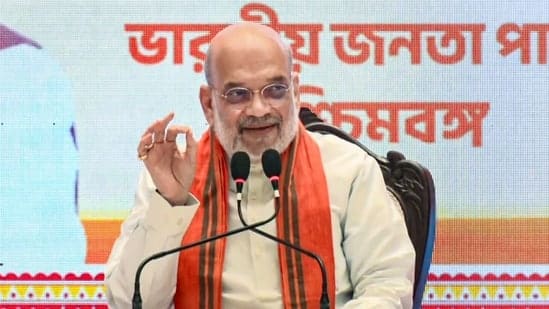
Union Home Minister Amit Shah declared on Friday that the Bharatiya Janata Party’s (BJP) chief ministerial candidate for West Bengal will be a locally born party worker, directly countering Chief Minister Mamata Banerjee’s persistent “outsider” allegations. Speaking at a high-stakes campaign rally ahead of the 2026 state assembly elections, Shah sharply criticized Banerjee over an alleged remark suggesting women should not leave their homes after 7 p.m., framing the upcoming electoral battle as a referendum on women’s safety and regional identity. This escalating rhetoric highlights the intense political maneuvering as both the ruling Trinamool Congress (TMC) and the opposition BJP vie for dominance in the crucial eastern state. [Source: Hindustan Times]
## The ‘Outsider’ Debate and the ‘Bhumiputra’ Strategy
The political discourse in West Bengal has long been dominated by the clash between regional pride and national integration. Since the fiercely contested 2021 assembly elections, Chief Minister Mamata Banerjee and the TMC have successfully wielded the *bohiragoto* (outsider) label against the BJP. The TMC’s narrative has consistently positioned the BJP as a party of North Indian, Hindi-speaking leaders disconnected from Bengal’s unique cultural and linguistic ethos.
Amit Shah’s latest declaration marks a definitive strategic pivot for the BJP. By guaranteeing that the next Chief Minister will be a “BJP worker born in Bengal,” the party leadership is actively attempting to neutralize the TMC’s most potent emotional weapon. This commitment to a *Bhumiputra* (son of the soil) signals an acknowledgment within the BJP high command that unseating a deeply entrenched regional leader requires an authentically local face.
**Key Fact:** The BJP contested the 2021 West Bengal Assembly elections without officially projecting a Chief Ministerial candidate, a strategy that political analysts frequently cite as a contributing factor to their inability to secure a majority against the TMC’s localized campaign. [Source: Hindustan Times | Additional: Historical Electoral Data]
“The BJP has recognized that the battle for Bengal cannot be fought purely on the charisma of national leaders,” notes Dr. Ayan Mukhopadhyay, an independent political sociologist based in Kolkata. “By committing to a homegrown Chief Minister, the party is trying to assure voters that a vote for the BJP is not a vote for remote control governance from Delhi, but for local leadership backed by central resources.”
## Women’s Safety Takes Center Stage
Beyond the battle of regional identities, Shah’s address heavily focused on law and order, specifically zeroing in on women’s security. The Union Home Minister launched a scathing attack on Banerjee over an alleged advisory suggesting that women should not venture out of their houses after 7 p.m. to ensure their safety.
Shah weaponized this remark, painting the current administration as incapable of providing basic security. He argued that suggesting women stay indoors is a regressive concession to criminal elements rather than a solution to law enforcement failures. Promising a secure environment, Shah stated that under a BJP government, women would be safe to navigate the state at any hour without fear.
The issue of women’s safety is highly sensitive and politically explosive in West Bengal. Over the past few years, the state has witnessed several high-profile civic protests demanding better protection for women and swifter judicial processes for gender-based violence. The BJP is leveraging these civic grievances, attempting to bridge the gap between urban middle-class anxieties regarding law and order and rural concerns over political violence. [Source: Hindustan Times | Additional: General Political Context]
## The Electoral Power of the Female Vote
The intense focus on women’s safety is not merely about law and order; it is a calculated effort to sway the most crucial demographic in West Bengal’s electoral arithmetic: women voters. Over the last two election cycles, Mamata Banerjee has cultivated a massive, fiercely loyal female voter base, primarily through direct benefit transfer (DBT) schemes.
The TMC’s flagship welfare programs, most notably *Lakshmir Bhandar*—which provides a monthly financial allowance to the female heads of households—have served as an impenetrable political shield for the ruling party. These welfare initiatives have consistently offset anti-incumbency sentiments and localized corruption allegations.
To fracture this consolidated vote bank, the BJP must present a counter-narrative that outweighs the immediate financial benefits of the TMC’s welfare schemes. By highlighting the “after 7 p.m.” remark, Shah is positioning physical safety, dignity, and freedom of movement as higher priorities than cash handouts.
**Key Fact:** Women constitute approximately 49% of the electorate in West Bengal, and their turnout has historically surpassed male voter turnout in recent assembly elections, making them the decisive demographic in tightly contested constituencies. [Source: Additional Public Electoral Data]
## TMC’s Counter-Narrative and Defense
The Trinamool Congress, however, has historically demonstrated immense resilience against such attacks. The party maintains that the BJP relies on taking statements out of context and spreading misinformation to malign the state government. TMC spokespersons frequently argue that West Bengal, and Kolkata in particular, routinely ranks as one of the safest regions for women in India, citing annual data from the National Crime Records Bureau (NCRB).
In response to Amit Shah’s assertions, the TMC is likely to double down on its welfare record and continue questioning the BJP’s internal cohesion. The ruling party frequently points out the factionalism within the state BJP unit, challenging the opposition to actually name their local Chief Ministerial candidate rather than making vague promises about a “local worker.”
“The TMC’s political strategy relies heavily on the ‘TINA’ (There Is No Alternative) factor regarding local leadership,” explains a senior political correspondent based in New Delhi. “As long as the BJP keeps the CM face ambiguous, the TMC will exploit that vacuum to ask voters: ‘If not Mamata, then who?’ Shah’s promise of a local leader is the first step to answering that question, but the party still has to navigate internal rivalries to project a unified face.” [Source: Additional Expert Analysis]
## The Challenge of Grassroots Mobilization
While high-profile rallies and fiery speeches from national leaders set the narrative tone, the actual battle for West Bengal’s 294 assembly seats will be fought at the booth level. The BJP’s primary challenge heading into 2026 is translating anti-incumbency sentiment and crowd enthusiasm into organized electoral machinery.
The TMC possesses a formidable grassroots network, interwoven with local administration and welfare delivery mechanisms. To compete, the BJP is focusing on aggressively empowering its *Mandal* (block) and booth-level workers. Shah’s assurance that the next CM will be a “party worker” serves a dual purpose: it rebuts the outsider tag, and it significantly boosts the morale of local BJP cadres who have faced intense political pressure and violence in the state.
Empowering local workers is essential for the BJP to ensure high voter turnout on polling days and to protect its supporters in rural areas where political dominance is often contested block by block.
## Implications for National Politics
The outcome of the 2026 West Bengal Assembly election carries weight far beyond the state’s borders. For Mamata Banerjee, retaining power is crucial to sustaining her image as one of the most formidable opposition figures to the BJP at the national level. A victory would reaffirm the strength of regional welfare models against national political narratives.
For the BJP, conquering West Bengal remains one of its most coveted ideological and electoral goals. A victory here would not only expand its footprint in the eastern corridor of the country but also validate its strategy of adapting national party structures to hyper-local sentiments. By addressing the cultural and security concerns directly, the BJP is testing a blueprint that seeks to harmonize regional pride with its broader nationalistic framework.
## Conclusion and Future Outlook
Amit Shah’s latest public address officially fires the starting gun for the 2026 electoral showdown in West Bengal. By promising a locally born Chief Minister, the BJP is attempting a tactical disarming of Mamata Banerjee’s most effective defensive narrative. Simultaneously, by pivoting the conversation toward women’s safety and seizing upon controversial remarks regarding evening curfews, the opposition is directly targeting the core of the TMC’s voter base.
**Key Takeaways:**
* **Narrative Shift:** The BJP is officially committing to a local *Bhumiputra* CM candidate to counter the TMC’s “outsider” accusations.
* **Focus on Law and Order:** Women’s safety, specifically highlighted by Shah’s criticism of the alleged “7 p.m.” remark, will be a central pillar of the BJP’s campaign.
* **Demographic Targeting:** Both parties recognize that the female electorate will be the kingmaker in 2026; TMC relies on welfare schemes, while BJP promises physical security and unhindered freedom.
As the election draws nearer, the political temperature in West Bengal is guaranteed to rise. The coming months will reveal whether the BJP can successfully unify its state cadre behind a single, credible local face, and whether the TMC can maintain its formidable coalition of rural support and female voters amidst mounting pressure over governance and law enforcement. The battle lines are drawn, setting the stage for one of the most fiercely contested democratic exercises in recent Indian political history.





