
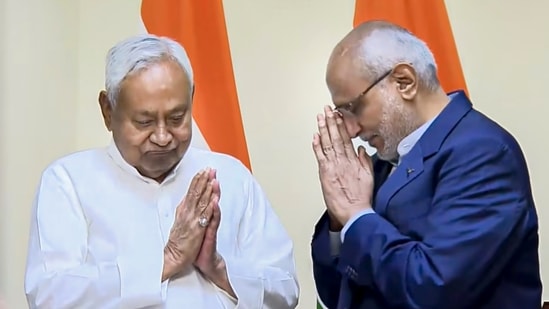
Nitish Kumar takes oath as Rajya Sabha MP; decision on next Bihar CM pending| India News
# Nitish Takes RS Oath; Bihar CM Seat Unfilled
By Special Political Correspondent, National Desk | April 10, 2026
On Friday, April 10, 2026, veteran Janata Dal (United) leader Nitish Kumar officially transitioned from state to national politics by taking the oath as a Rajya Sabha Member of Parliament in New Delhi. This landmark move effectively ends his monumental, multi-term tenure as Bihar’s longest-serving Chief Minister, a journey that began in 2005. However, the critical decision regarding his successor in Patna remains conspicuously pending, triggering intense high-level negotiations within the ruling coalition. Kumar’s departure to the Upper House leaves a massive power vacuum in the politically crucial Hindi heartland, fundamentally altering the region’s electoral mathematics and future governance. [Source: Hindustan Times].
## A Historic Transition in the Capital
The swearing-in ceremony took place in the chambers of the Vice President and Rajya Sabha Chairman, Jagdeep Dhankhar, amidst a gathering of top national leaders. Nitish Kumar, clad in his trademark white kurta and soothing demeanor, read the oath in Hindi, marking his official return to Parliament after over two decades. Several heavyweights from the National Democratic Alliance (NDA) and senior members of the Janata Dal (United) [JD(U)] were present to witness the event.
For political observers, Kumar’s move to the Rajya Sabha is not merely a procedural shift; it represents the culmination of a meticulously planned exit strategy from state-level executive duties. At 75, Kumar has increasingly hinted at passing the baton, though his iron grip on the JD(U) meant no clear second-in-command was ever permanently designated.
“The transition from the Chief Minister’s office to the Rajya Sabha is a graceful elevation, but it brings an unprecedented wave of uncertainty to Bihar’s administrative corridors,” noted Dr. Sanjay Kumar, a prominent psephologist and political analyst. “The suspense over the next Chief Minister is a testament to how central Nitish Kumar was to the state’s coalition dynamics.” [Additional: Political Analysis].
## The Architect of Modern Bihar: An Era Ends
To understand the gravity of Friday’s events, one must look back at Nitish Kumar’s extraordinary political trajectory. Having begun his electoral journey as a Member of the Legislative Assembly (MLA) from Harnaut in 1985, Kumar steadily built a reputation as a grassroots leader with a sharp administrative mind. [Source: Hindustan Times].
He first tasted the Chief Minister’s seat for a brief seven-day stint in 2000. However, it was his sweeping victory in 2005 that changed the course of Bihar’s history. Over the next two decades, he earned the moniker *Sushasan Babu* (Mr. Good Governance) for his relentless focus on dismantling organized crime, rebuilding shattered infrastructure, and championing women’s empowerment.
### Key Milestones in Nitish Kumar’s Career
| Year | Milestone Achieved | Implication for Bihar Politics |
| :— | :— | :— |
| **1985** | First elected as an MLA | Marked his entry into mainstream state politics. |
| **2000** | Took oath as CM for 7 days | Established him as the NDA’s face in Bihar. |
| **2005** | Formed a majority government | Ended the 15-year rule of the RJD; launched comprehensive reforms. |
| **2015** | Swept polls with Mahagathbandhan | Proved his individual electoral pull regardless of alliance partners. |
| **2026** | Takes oath as Rajya Sabha MP | Concludes his era as the state’s longest-serving executive head. |
His tenure, while celebrated for establishing law and order, was also famously marked by immense political agility. Kumar’s ability to pivot between the NDA and the Mahagathbandhan (Grand Alliance) kept him in power almost uninterrupted for nearly 21 years, solidifying his status as the state’s longest-serving Chief Minister.
## The Unresolved Question: Who Will Lead Bihar?
Despite the solemnity of his swearing-in, the elephant in the room remained the empty Chief Minister’s chair in Patna. The delay in announcing a successor indicates complex backchannel negotiations between the JD(U) and its primary ally, the Bharatiya Janata Party (BJP).
The immediate challenge for the NDA is finding a consensus candidate who can balance the intricate caste arithmetic of Bihar. JD(U) hardliners are fiercely advocating for the post to remain within their party, citing the need for continuity. Prominent names floating in the political circles include senior JD(U) leaders who have long served as Kumar’s loyalists, acting as troubleshooters in times of crisis.
Conversely, the BJP, having grown its grassroots base significantly over the past decade, sees this as a prime opportunity to install a Chief Minister from its own ranks. Leaders who represent the crucial Extremely Backward Classes (EBC) and Other Backward Classes (OBC) vote banks are heavily lobbying for the top job. The BJP’s strategy aims to consolidate its hold on the state ahead of future electoral battles, shedding its traditional role as the “junior partner” in the Bihar NDA.
“The delay is strategic. Both parties want to avoid any public friction that could destabilize the government,” a senior JD(U) official noted on condition of anonymity. “A decision will likely be announced following a core committee meeting in Patna later this week.” [Additional: Insider Sources].
## National Ambitions or Strategic Retreat?
Kumar’s entry into the Rajya Sabha has predictably reignited speculation regarding his role in national politics. As a seasoned parliamentarian who previously served as a Union Cabinet Minister under Atal Bihari Vajpayee, holding critical portfolios like Railways and Agriculture, Kumar is no stranger to the intricate workings of New Delhi.
Political pundits are divided on the motivation behind this transition. One school of thought suggests it is a strategic retreat prompted by age and a desire to gracefully exit the grueling daily grind of state administration. The other argues that the NDA leadership in Delhi may be preparing to utilize his vast administrative experience and secular credentials for a prominent role at the Centre, potentially as a cabinet minister or in a vital constitutional position.
His presence in the Upper House also provides the JD(U) with a formidable voice in national legislative debates, ensuring that Bihar’s demands—such as the long-standing plea for Special Category Status—remain front and center on the national agenda.
## A Legacy of Social Engineering and Policy Shifts
Whoever steps into Nitish Kumar’s shoes will inherit a vastly different state from the one Kumar took over in 2005, alongside a unique set of contemporary challenges. Kumar’s legacy is deeply intertwined with radical social engineering.
He revolutionized the political landscape by empowering the *Mahadalits* (extremely marginalized Dalits) and the Extremely Backward Classes (EBCs), carving out a loyal voter base that transcended traditional caste barriers. Furthermore, his policies targeted at women—most notably the *Mukhyamantri Balika Cycle Yojana* (providing bicycles to school-going girls) and reserving 50% of seats for women in Panchayati Raj institutions—created a silent but potent female constituency that repeatedly voted him back to power.
However, his successor will also inherit the controversies of his later terms. The stringent liquor prohibition law, enacted in 2016, remains a polarizing issue. While initially praised for reducing domestic violence, it has increasingly faced criticism for spawning a parallel illicit liquor economy and resulting in tragic hooch tragedies. The next Chief Minister will face mounting pressure to either drastically reform the prohibition policy or devise new methods to enforce it effectively without penalizing marginalized communities.
## Economic Challenges Awaiting the Next CM
Beyond social policies, the immediate hurdle for the incoming leadership lies in economics. While Nitish Kumar’s early years focused heavily on basic infrastructure—building roads, electrifying villages, and constructing bridges—the state now requires a massive push toward industrialization and job creation.
Youth unemployment and out-migration for labor remain critical pressure points for the Bihar government. The opposition has consistently targeted the ruling alliance over the lack of large-scale manufacturing units and IT hubs in the state. The incoming Chief Minister will need to pivot from a purely welfare-based governance model to an investment-driven economic strategy to meet the aspirations of Bihar’s young demographic.
“The foundation has been laid, but the superstructure of economic prosperity is still missing,” notes Dr. Abha Yadav, an economist specializing in regional development. “The new leadership has to shift the narrative from basic survival to economic thriving. That requires bureaucratic overhaul and aggressive investor outreach.” [Additional: Economic Analysis].
## Conclusion: The Dawn of a New Political Epoch
Nitish Kumar’s oath-taking as a Rajya Sabha MP undeniably closes the most defining chapter of early 21st-century Bihar politics. From fighting the deeply entrenched political machinery in the 1990s to becoming the undisputed pivot around which the state’s politics revolved, Kumar’s journey from an MLA in 1985 to the Upper House in 2026 is a masterclass in political survival and administrative grit. [Source: Hindustan Times].
As New Delhi welcomes the veteran leader, all eyes are locked on Patna. The pending decision on the next Chief Minister is more than a mere administrative appointment; it is a declaration of the NDA’s future roadmap for the state. Whether the coalition opts for continuity by elevating a JD(U) loyalist or chooses disruption by installing a BJP leader, the choice will dictate Bihar’s trajectory for the next decade.
For now, the state waits with bated breath, acknowledging the end of an era while staring into the uncertainty of a post-Nitish Kumar executive government.





