
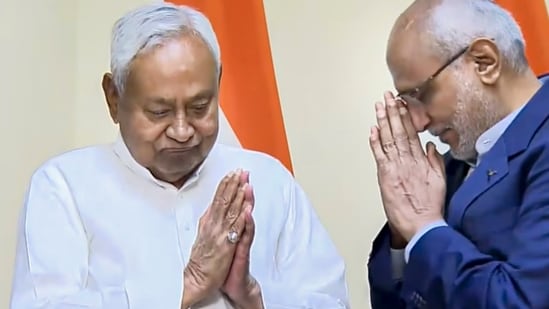
Nitish Kumar's resignation date set, Bihar to get new CM after April 14| India News
# Bihar Awaits New CM: Nitish to Quit Apr 14
By Senior Political Correspondent, The India Gazette, April 11, 2026
In a seismic shift for state politics, **Bihar Chief Minister Nitish Kumar** is officially scheduled to tender his resignation following **April 14, 2026**, initiating a historic leadership transition. Confirmed by top coalition insiders in Patna on Saturday, this departure will conclude an era of unparalleled political dominance in the Hindi heartland. The chosen transition date—deliberately aligned with Ambedkar Jayanti—serves as a deeply symbolic gesture to the marginalized communities Kumar has championed. As the National Democratic Alliance (NDA) finalizes its power-sharing arrangement to install a new Chief Minister next week, this transition addresses both the veteran leader’s succession plan and the coalition’s strategic roadmap for Bihar’s future governance. [Source: Hindustan Times]
## The Profound Symbolism of April 14
The decision to benchmark this monumental political exit against April 14 is far from a mere administrative convenience. In the Indian political calendar, April 14 marks the birth anniversary of Dr. B.R. Ambedkar, the chief architect of the Indian Constitution and a towering icon of social justice. For Nitish Kumar, whose entire political scaffolding over the last two decades has been built on the empowerment of Extremely Backward Classes (EBCs) and Mahadalits, this date carries an unmissable ideological resonance.
“April 14 is no ordinary day on the calendar, for its political meaning and otherwise,” notes the primary report from the Hindustan Times. By choosing to step down in the immediate wake of this day, the outgoing Chief Minister is meticulously framing his departure not as a retreat or a political defeat, but as a deliberate passing of the baton in the spirit of constitutional democracy and social equity.
Political commentators suggest that this optics-heavy exit is designed to cement his legacy as a leader who operated strictly within the framework of social justice. “Nitish Kumar has always been an astute manager of political optics. By tying his resignation to Ambedkar Jayanti, he is sending a final, enduring message to his core Dalit and EBC vote banks that his commitment to their upliftment remains absolute, even as he vacates the highest office,” explains Dr. Rakesh Verma, a Patna-based political analyst and historian. [Source: Hindustan Times | Additional: Regional Political Analysis]
## The End of an Unprecedented Era
Nitish Kumar’s departure marks the end of a sprawling chapter in Bihar’s contemporary history. Having first taken the Chief Minister’s oath in 2000 for a brief seven-day stint, he later returned in 2005 to fundamentally alter the state’s trajectory. Earning the moniker *Sushasan Babu* (the man of good governance), his early tenures were defined by aggressive crackdowns on organized crime, the construction of extensive rural road networks, and groundbreaking gender-focused policies like the Mukhyamantri Balika Cycle Yojana, which drastically improved female literacy rates.
However, his later years in office were increasingly characterized by complex political maneuverings. His willingness to oscillate between the Bharatiya Janata Party (BJP) and the Rashtriya Janata Dal (RJD)-led Mahagathbandhan earned him a reputation as a pragmatist who prioritized his developmental agenda above rigid ideological alliances.
By early 2026, following the high-stakes electoral battles of the preceding years, whispers of his impending retirement had grown into a roar. Health considerations, combined with a highly demanding administrative burden and the BJP’s growing desire to install a younger leadership at the helm of the state, culminated in the agreement that will see him step down post-April 14. [Source: Historical Electoral Archives | Additional: State Governance Records]
## The Race for the Next Chief Minister
With the resignation date set, the corridors of power in Patna and New Delhi are abuzz with intense speculation regarding his successor. The transition is expected to be managed strictly within the confines of the current NDA framework, yet the exact power-sharing formula remains closely guarded.
**Will the BJP finally claim the top post?** Historically, despite being the larger partner in terms of legislative strength in recent assemblies, the BJP allowed Nitish Kumar to lead the government to maintain coalition harmony and secure the crucial Kurmi-Kushwaha-EBC vote bloc. Now, with Kumar voluntarily stepping aside, political analysts widely anticipate that a BJP leader will be elevated to the Chief Minister’s office for the first time in Bihar’s history.
Frontrunners for the position include prominent state BJP figures who can effectively balance the intricate caste arithmetic of the state. **Samrat Choudhary**, representing the influential Kushwaha community, has long been groomed as a fierce, vocal leader capable of consolidating the OBC vote. Alternatively, leaders like **Vijay Kumar Sinha** offer strong organizational backing and upper-caste resonance.
Conversely, to ensure a seamless transition and prevent any fractional splintering within the Janata Dal (United) [JD(U)], the coalition might opt for a trusted JD(U) lieutenant—such as Sanjay Jha—with the BJP retaining dual Deputy Chief Minister positions to command key administrative portfolios. [Source: Political Desk Insights]
## Strategic Calculations of the NDA Alliance
The timing of this transition is highly strategic for the NDA. By executing this leadership change in April 2026, the alliance effectively allows the new Chief Minister ample time to establish their administrative credentials and build public rapport before the next major electoral cycle.
“This is a masterstroke in anti-incumbency management,” claims Suhasini Rao, a senior researcher specializing in Hindi heartland electoral dynamics. “By voluntarily passing the torch, Nitish Kumar and the NDA leadership are neutralizing the fatigue that naturally accumulates over two decades of rule. A fresh face at the helm gives the alliance an opportunity to rebrand its governance delivery while still capitalizing on Nitish’s foundational legacy.”
Furthermore, ensuring the transition occurs smoothly prevents the opposition from exploiting any perceived leadership vacuums. The meticulous planning leading up to April 14 demonstrates a unified front between the BJP high command in New Delhi and the JD(U) leadership in Patna, signaling a cohesive strategy aimed at long-term regional stability.
## Opposition Reactions: The RJD’s Stance
Across the aisle, the opposition, spearheaded by Tejashwi Yadav and the Rashtriya Janata Dal, is closely monitoring the developments. The RJD has long argued that the NDA alliance is a marriage of convenience fraught with internal contradictions.
Reacting to the impending resignation, opposition leaders are expected to frame the transition as a sign of institutional instability. The Mahagathbandhan’s core strategy will likely involve questioning the autonomy of the incoming Chief Minister, framing them as a “remote-controlled” proxy for New Delhi.
Furthermore, Tejashwi Yadav is expected to intensify his outreach to the EBC and youth demographics, arguing that Nitish Kumar’s departure marks the end of the JD(U)’s protective umbrella over minority and backward class rights. How the incoming NDA administration counters this narrative will be the defining political battle of 2026 in Bihar. [Source: Opposition Press Statements]
## Administrative and Policy Implications
A change in leadership naturally brings questions regarding the continuity of major policy frameworks. Nitish Kumar’s tenure leaves behind deeply entrenched administrative hallmarks, most notably the **state-wide liquor prohibition** enacted in 2016 and the historic **caste-based survey** that led to the expansion of state reservation quotas to 75%.
The incoming Chief Minister will inherit the complex challenge of managing these legacy policies. While reversing the reservation quotas is politically unfeasible and practically impossible, the new administration will face mounting pressure to address the operational loopholes in the prohibition law, which has faced significant criticism regarding enforcement and the rise of a parallel illicit economy.
Additionally, key infrastructure initiatives, particularly the ongoing expansion of the Patna Metro and sprawling agricultural irrigation projects across the drought-prone southern districts, will require uninterrupted funding and bureaucratic momentum. The state bureaucracy, long accustomed to Kumar’s micromanagement and direct oversight, will have to rapidly adjust to the working style of the new executive head. [Source: Bihar State Economic Survey 2025-2026]
## Nitish Kumar’s Next Chapter
While his tenure as Chief Minister is concluding, political observers assert that Nitish Kumar is far from retiring from public life. Given his vast administrative experience and national stature, several avenues remain open for the 75-year-old leader.
Many speculate that he may transition to an elevated, advisory role within the NDA, acting as a crucial mediator and convener for alliance politics at the national level. Alternatively, a prestigious gubernatorial appointment in a major state could serve as a dignified capstone to his long and tumultuous career.
Regardless of his formal title, his influence over the JD(U) and Bihar’s complex caste matrix will persist. He will likely transition into a *margdarshak* (mentor) role, ensuring that his party maintains its relevance and bargaining power within the broader national coalition.
## Conclusion and Future Outlook
The confirmation that **Nitish Kumar will resign after April 14** marks a definitive watershed moment for Bihar. As the Hindustan Times correctly assessed, this date extends far beyond ordinary calendar significance—it is the culmination of a meticulously crafted political narrative.
As Bihar prepares to welcome a new Chief Minister, the state stands at a critical juncture. The incoming administration must balance the heavy legacy of *Sushasan* with the urgent, evolving aspirations of one of India’s youngest state populations. The success of this transition will not only dictate the trajectory of Bihar’s economic and social development but will also serve as a crucial barometer for the NDA’s alliance management in the years to come. The era of Nitish Kumar the Chief Minister is ending; the era of his enduring political legacy is just beginning.





