
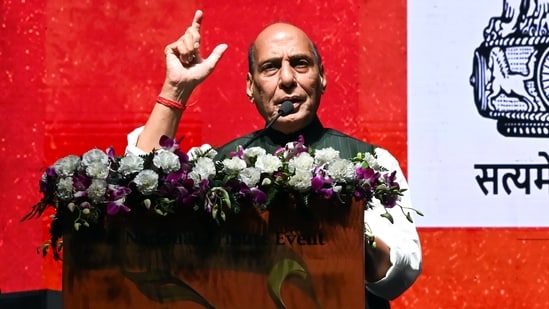
Operation Sindoor anniversary: Rajnath to lead national security review in Jaipur
# Jaipur Security Review Marks Sindoor Anniversary
By Special Correspondent, The Strategic Observer, May 7, 2026.
Defense Minister Rajnath Singh convened a high-level national security review in Jaipur today, marking the first anniversary of ‘Operation Sindoor.’ On May 7 last year, the Indian armed forces executed a series of preemptive, precision missile strikes targeting nine identified terror launchpads across Pakistan and Pakistan-occupied Kashmir (PoK). Today’s strategic summit brings together top military commanders, intelligence chiefs, and policy advisors to evaluate the current threat matrix, assess border preparedness, and refine India’s proactive defense posture. The review underscores New Delhi’s unwavering commitment to counter-terrorism and regional stability while evaluating the tactical lessons learned over the past twelve months. [Source: Hindustan Times | Additional: Ministry of Defence Public Briefings].
## The Genesis of Operation Sindoor
To understand the gravity of the Jaipur security review, one must revisit the geopolitical climate of early 2025. In the months preceding May, Indian intelligence agencies intercepted credible chatter regarding a coordinated, multi-pronged infiltration attempt designed to target civilian infrastructure in Jammu and Kashmir. Unlike previous counter-terrorism operations that heavily relied on infantry cross-border raids or manned aerial bombardments, the military leadership opted for a distinct approach to neutralize the imminent threat.
Operation Sindoor was conceptualized as a pure stand-off precision strike. In the early hours of May 7, 2025, India launched a synchronized barrage of advanced tactical ballistic and cruise missiles. The targets were strictly confined to nine heavily fortified terror training camps and logistical nodes situated deep within Pakistan and PoK. The use of indigenous missile technology allowed the armed forces to obliterate the targets with pinpoint accuracy without exposing Indian pilots or ground troops to enemy fire or capture.
By categorizing the strikes as “intelligence-led, non-military preemptive actions,” New Delhi effectively communicated that its quarrel was not with the Pakistani military or civilians, but strictly with the state-sponsored terror apparatus operating within its borders.
## Inside the Jaipur High-Level Security Review
The choice of Jaipur for this pivotal anniversary review is strategically significant. The city hosts the headquarters of the Indian Army’s South Western Command, known as the Sapta Shakti Command, which plays a critical role in securing the western borders. Defense Minister Rajnath Singh is presiding over the closed-door summit, joined by National Security Advisor (NSA) Ajit Doval, Chief of Defence Staff (CDS) General Anil Chauhan, the three service chiefs, and top officials from the Research and Analysis Wing (R&AW).
The core agenda of the Jaipur summit is comprehensive. First, the leadership is assessing the current status of infrastructure upgrades along both the Line of Control (LoC) and the International Border (IB). Second, there is a dedicated focus on countering gray-zone warfare, particularly the escalating use of weaponized drones by cross-border syndicates to drop narcotics, small arms, and improvised explosive devices (IEDs). Finally, the review aims to audit the integration of multi-agency intelligence grids to ensure that real-time data continues to translate into actionable, tactical triumphs.
## A Paradigm Shift in India’s Defense Doctrine
Operation Sindoor cemented a paradigm shift in India’s strategic doctrine. For decades, New Delhi’s approach to cross-border terrorism was defined by strategic restraint, characterized by diplomatic protests and defensive border management. The surgical strikes of 2016 and the Balakot airstrikes of 2019 signaled the beginning of a more aggressive posture. However, Operation Sindoor codified the doctrine of “Proactive Deterrence.”
By utilizing surface-to-surface missile systems—largely believed by defense analysts to include advanced variants of the BrahMos cruise missile and the Pralay tactical ballistic missile—India demonstrated an escalation matrix that caught its adversaries off-guard. This stand-off capability lowered the threshold for armed response. It proved that India could inflict severe infrastructural damage on terror networks swiftly and unilaterally, bypassing the complex logistics of airspace violations and the inherent risks of aerial dogfights.
This shift also highlights the success of the ‘Atmanirbhar Bharat’ (Self-Reliant India) initiative in the defense sector. The successful deployment of indigenous precision-guided munitions has sent a strong message to both allies and adversaries regarding India’s growing self-sufficiency in high-tech warfare.
## Geopolitical Ramifications and Diplomatic Maneuvering
The immediate aftermath of Operation Sindoor tested India’s diplomatic agility. Within hours of the missile strikes, the Ministry of External Affairs launched a massive diplomatic outreach, briefing foreign envoys in New Delhi. The international response was largely indicative of a shifting global tolerance toward terrorism. Key Western capitals, including Washington, Paris, and London, released statements acknowledging India’s right to self-defense, while quietly urging both nuclear-armed neighbors to exercise restraint to prevent a wider conventional war.
Pakistan’s response was notably muted compared to previous incidents. Grappling with severe domestic political turbulence and a precarious economic situation, Islamabad found itself unable to mount a proportional conventional military response. Furthermore, Operation Sindoor brought renewed international attention to Pakistan’s compliance with the Financial Action Task Force (FATF). The destruction of nine active terror camps provided undeniable evidence that terror financing and logistical harboring were still active issues, complicating Islamabad’s efforts to secure international monetary bailouts.
## Modernizing the Armed Forces Post-Sindoor
The success of the May 7 strikes accelerated several crucial modernization drives within the Indian Armed Forces. The Jaipur review is heavily focused on the progress of C4ISR (Command, Control, Communications, Computers, Intelligence, Surveillance, and Reconnaissance) capabilities. Post-Sindoor, the Ministry of Defence fast-tracked the procurement and deployment of advanced satellite communication systems and high-altitude, long-endurance (HALE) Unmanned Aerial Vehicles (UAVs) to monitor the border 24/7.
Furthermore, Operation Sindoor highlighted the absolute necessity of jointness among the military branches. The coordinated use of intelligence from R&AW, targeting data from the Indian Air Force, and launch capabilities from the Army’s strategic forces showcased a preview of the Integrated Theater Commands. The ongoing security review in Jaipur is reportedly dedicating a substantial session to ironing out the final logistical and administrative hurdles in rolling out these theater commands, ensuring that future operations benefit from even tighter tri-service synergy.
## Expert Perspectives on the Evolving Security Matrix
Strategic analysts view the Jaipur review not merely as an anniversary commemoration, but as a critical operational audit.
“Operation Sindoor was a watershed moment because it altered the cost-benefit analysis for the sponsors of cross-border terrorism,” explains Dr. Arvind Mehra, a Senior Fellow at the Center for Land Warfare Studies (CLAWS) in New Delhi. “By proving that India will utilize its sophisticated missile arsenal to neutralize non-state actors, New Delhi essentially called the nuclear bluff that had historically shielded these terror camps. The Jaipur review is crucial because it ensures our forces don’t succumb to complacency. The adversary is constantly evolving, shifting from large camps to decentralized modules.”
Ambassador Neena Gupta, a former Indian envoy with extensive experience in strategic affairs, highlights the diplomatic triumph. “The true victory of May 7 was the synchronized diplomatic strategy. We acted kinetically but communicated diplomatically. The preemptive declassification of targeting data to foreign embassies ensured that the global narrative remained firmly focused on counter-terrorism. Today’s review led by the Defense Minister will likely focus on sustaining this diplomatic capital.”
## The Road Ahead: Eternal Vigilance and Preparedness
As Defense Minister Rajnath Singh concludes the security review in Jaipur, the overarching message from the defense establishment is one of eternal vigilance. While Operation Sindoor successfully dismantled significant terror infrastructure and provided a year of relative quiet along the western front, the underlying ideological and logistical machineries of terror networks remain stubbornly intact.
The key takeaways from the first anniversary of Operation Sindoor are clear: India’s threshold for cross-border terrorism has permanently lowered, its reliance on indigenous defense technology is yielding tangible strategic dividends, and the integration of its military and intelligence apparatus is stronger than ever.
Looking to the future, the focus will undoubtedly shift toward countering asymmetric and technological threats, specifically cyber warfare and drone incursions. The Jaipur security review guarantees that as the tactics of non-state actors evolve, so too does the shield and the sword of the Indian Armed Forces. The legacy of Operation Sindoor is not just a successful military strike, but the establishment of a robust, dynamic, and unapologetic national security doctrine.





