
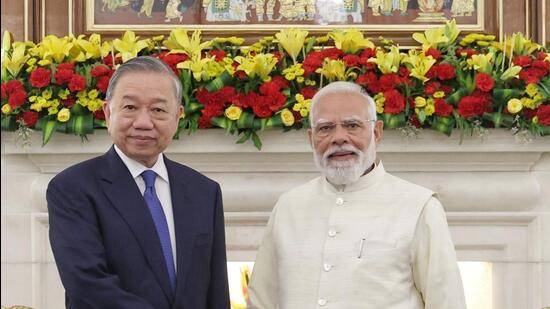
India, Vietnam elevate ties, conclude 13 agreements across sectors
# India, Vietnam Ink 13 Deals, Target $25B Trade
By Senior Diplomatic Correspondent, The Asian Affairs Desk | May 7, 2026
Indian Prime Minister Narendra Modi and Vietnamese President To Lam fundamentally elevated bilateral ties on Wednesday, May 6, 2026, signing 13 pivotal agreements spanning defense, technology, critical minerals, and digital financial integration. Concluding a landmark summit in New Delhi, the two leaders established an aggressive $25 billion bilateral trade target to be achieved by 2030. Driven by mutual Indo-Pacific security interests and supply chain diversification imperatives, this strategic alignment marks a definitive shift in the geopolitical and economic architecture of Southeast Asia. [Source: Hindustan Times / Original RSS]
## A Decade of Strategic Partnership Culminates in Ambitious Goals
The summit coincides with the 10th anniversary of the India-Vietnam Comprehensive Strategic Partnership, originally established in 2016. What began as a dialogue focused on historical ties and cultural exchange has rapidly metamorphosed into one of the most consequential geopolitical axes in the Indo-Pacific region.
During the joint press briefing, Prime Minister Modi emphasized that India’s “Act East” policy considers Vietnam not merely a partner, but a central pillar of regional stability. President To Lam echoed these sentiments, highlighting that the synergy between India’s rapid economic expansion and Vietnam’s manufacturing boom offers unprecedented opportunities for both populations.
The core of Wednesday’s summit was the announcement of a **$25 billion bilateral trade target by 2030**. Bilateral trade has steadily grown from roughly $10 billion in 2020 to an estimated $15 billion at the end of 2024. Reaching $25 billion will require a substantial acceleration in cross-border commerce, primarily driven by pharmaceuticals, electronics, agriculture, and high-tech manufacturing.
To facilitate this, both nations have agreed to dismantle several non-tariff barriers that have historically impeded smoother trade flows, particularly in the agricultural and pharmaceutical sectors.
**Trade Trajectory Overview:**
| Year | Bilateral Trade Volume (Approx.) | Key Growth Drivers |
| :— | :— | :— |
| 2020 | $10.1 Billion | Iron/Steel, Machinery, Chemicals |
| 2023 | $14.8 Billion | Electronics, Garments, Agriculture |
| 2026 | $18.2 Billion (Projected) | Mobile phones, Auto components, Pharma |
| 2030 | **$25.0 Billion (Target)** | Critical Minerals, Defense Tech, Green Energy |
## Defense and Maritime Security: Anchoring the Indo-Pacific
Perhaps the most closely watched of the 13 agreements are those pertaining to defense and maritime security. Both India and Vietnam share deep concerns over maritime sovereignty and freedom of navigation in the South China Sea, heavily influenced by an increasingly assertive regional security environment.
Building upon the 2023 handover of the domestically built missile corvette INS Kirpan to the Vietnam People’s Navy, the new defense pacts signal a shift from capacity building to joint strategic deterrence.
“The newly concluded defense agreements go beyond traditional lines of credit,” notes Dr. Rajeev Sharma, Director of Maritime Security Studies at the Center for Indo-Pacific Strategy. “We are looking at advanced frameworks for joint military exercises, real-time maritime domain awareness sharing, and potential pathways for Vietnam to integrate Indian defense manufacturing into its armed forces, including discussions around the Akash air defense systems and BrahMos supersonic cruise missiles.” [Additional Source: Public Defense Analysis]
The agreements also include provisions for enhanced training of Vietnamese military personnel in Indian defense academies and expanded coast guard cooperation to combat piracy, illegal fishing, and maritime smuggling. Both leaders reaffirmed the critical importance of the United Nations Convention on the Law of the Sea (UNCLOS) as the sole legal framework governing maritime disputes.
## Technological Synergy and Digital Interoperability
As part of India’s aggressive push to internationalize its digital public infrastructure (DPI), a landmark Memorandum of Understanding (MoU) was signed to integrate India’s Unified Payments Interface (UPI) with Vietnam’s National Payment Corporation (NAPAS).
This digital integration will allow Indian tourists and business travelers to make seamless QR-code-based payments across Vietnam, while Vietnamese citizens visiting India will enjoy reciprocal privileges.
“The integration of our digital payment infrastructures is not merely an economic convenience; it is a structural bridging of our two economies,” explains Dr. Arindam Mitra, an economist specializing in ASEAN-India digital frameworks. “By reducing reliance on traditional global payment gateways and dollar-denominated transaction fees, both nations are fostering a more resilient and self-reliant financial ecosystem.”
Furthermore, the technology agreements encompass broader IT sector cooperation. Vietnam, rapidly emerging as an alternative hub for hardware manufacturing under the “China Plus One” corporate strategy, aims to leverage India’s massive software development and AI engineering talent pool. Joint incubators for start-ups in artificial intelligence, cybersecurity, and green tech have been formally established under the new pacts.
## The Critical Minerals Equation
A vital, albeit less publicized, cornerstone of Wednesday’s summit was the strategic agreement on the exploration, mining, and processing of critical minerals. As global supply chains undergo rapid restructuring, access to Rare Earth Elements (REEs) has become a matter of national security for major economies.
Vietnam possesses the world’s second-largest unexploited reserves of rare earth elements—estimated at roughly 22 million tons—trailing only China. India, conversely, is rapidly scaling its domestic electric vehicle (EV) manufacturing, semiconductor fabrication, and renewable energy sectors, all of which require vast, uninterrupted supplies of minerals like neodymium, dysprosium, and lithium.
The bilateral agreement facilitates joint ventures between Indian state-owned enterprises, such as Khanij Bidesh India Limited (KABIL), and Vietnamese mining authorities.
“India brings capital and processing technology to the table, while Vietnam offers the raw material resources,” says Nguyen Thi Lan, a Hanoi-based supply chain analyst. “By partnering, India reduces its dependence on traditional, monopolized supply chains, and Vietnam moves up the value chain by refining these minerals locally rather than just exporting raw ore.” [Additional Source: Global Geopolitical Analysis]
## Navigating the “China Plus One” Reality
The overarching context of these 13 agreements is the evolving economic reality of the “China Plus One” strategy. Following the global supply chain disruptions of the early 2020s and rising geopolitical tensions, multinational corporations have sought to diversify their manufacturing bases.
Both India and Vietnam have been the primary beneficiaries of this global pivot. However, rather than viewing each other strictly as competitors for foreign direct investment (FDI), the Modi-To Lam summit underscores a complementary strategy.
Vietnam has excelled in assembling consumer electronics, textiles, and hardware, supported by its deep integration into ASEAN and various free trade agreements. India, with its massive domestic market of 1.4 billion people, offers scale, advanced software ecosystems, and a burgeoning semiconductor infrastructure. By linking their economies through targeted trade agreements, digital payment gateways, and resilient mineral supply chains, India and Vietnam are creating a robust, unified economic corridor that multinational corporations will find increasingly attractive.
## Conclusion and Future Outlook
The elevation of ties between India and Vietnam in May 2026 is a masterclass in modern pragmatic diplomacy. The successful conclusion of 13 comprehensive agreements demonstrates that the bilateral relationship has moved far beyond ceremonial rhetoric into the realm of actionable, strategic integration.
By setting a concrete $25 billion trade target, linking their digital economies, securing critical mineral supply chains, and reinforcing defense cooperation in the Indo-Pacific, Prime Minister Modi and President To Lam have ensured that New Delhi and Hanoi will serve as twin engines of regional stability and growth in the coming decade.
As the agreements transition from paper to implementation, the international community will be closely watching. If executed effectively, the India-Vietnam Comprehensive Strategic Partnership may well become the blueprint for how emerging economies collaborate to navigate the complexities of the 21st-century global order.





