
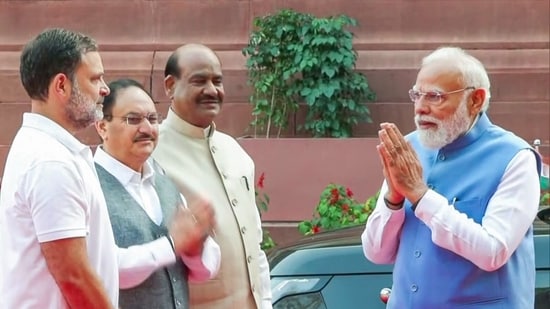
PM Modi steps out of car, stops for conversation with Rahul Gandhi in Parliament premises
# Modi, Rahul Share Rare Parliament Chat
**By Special Correspondent, The India Gazette, April 11, 2026**
Prime Minister Narendra Modi and senior Congress leader Rahul Gandhi engaged in a highly unusual and cordial conversation on the Parliament premises on Saturday morning. The impromptu interaction occurred when PM Modi, preparing to depart after paying floral tributes to social reformer Mahatma Jyotiba Phule on his birth anniversary, stepped out of his official convoy to approach Gandhi. This rare display of political camaraderie between India’s two most prominent ideological adversaries has immediately captured national attention, offering a brief respite from the fiercely polarized atmosphere that typically dominates New Delhi’s political corridors. [Source: Hindustan Times]
## A Moment of Bipartisanship on Phule Jayanti
The traditional ceremony held at the Parliament complex to honor Mahatma Jyotiba Phule is a routine affair, usually marked by solemn floral tributes and strict adherence to protocol. On Saturday, April 11, 2026, the event was attended by high-ranking dignitaries, including Vice President Jagdeep Dhankhar, Lok Sabha Speaker Om Birla, and several cabinet ministers. Both Prime Minister Modi and Rahul Gandhi were present to offer their respects to the 19th-century anti-caste crusader.
However, the routine event took an unexpected turn at its conclusion. As PM Modi’s security detail prepared for his departure, the Prime Minister was seen walking toward his armored vehicle. In a move that surprised onlookers, political leaders, and the press corps alike, Modi abruptly paused, turned back, and stepped away from his car door. He walked directly toward the designated area where opposition leaders, including Rahul Gandhi, were standing.
Eyewitnesses report that the Prime Minister initiated a warm exchange with Gandhi. While the exact audio of their conversation remains private, visuals captured by the official broadcasters and journalists present show both leaders sharing genuine smiles. The interaction, which lasted for nearly two minutes, featured animated hand gestures and nodding from both sides, indicating a substantive, albeit brief, conversation rather than a mere exchange of pleasantries. [Source: Hindustan Times | Additional: Public domain parliamentary broadcast analysis]
## Decoding the Viral Visuals
In the digital age, a two-minute conversation between the Prime Minister and the de facto leader of the opposition is enough to send the internet into a frenzy. Within minutes of the interaction, the video clip of PM Modi stepping out of his car to speak with Gandhi went viral across social media platforms.
Body language experts and political commentators immediately began dissecting the footage. The Prime Minister’s posture appeared relaxed, devoid of the aggressive posturing that often accompanies parliamentary debates. Similarly, Rahul Gandhi, who has been one of the most vocal critics of the National Democratic Alliance (NDA) government, appeared receptive and engaged, smiling warmly at the Prime Minister’s remarks.
**Key observations from the footage:**
* **The Approach:** The Prime Minister proactively broke his security cordon protocol to initiate the chat, signaling a deliberate choice to engage.
* **The Posture:** Both leaders maintained open body language, with arms uncrossed, suggesting a temporary suspension of their usual defensive political stances.
* **The Departure:** The conversation ended with a mutual nod of respect, after which PM Modi returned to his vehicle and Gandhi rejoined his party colleagues.
Social media users, tired of the relentless toxicity that often characterizes political discourse, widely praised the moment. Hashtags related to the interaction trended globally, with citizens noting that such moments are essential reminders of the democratic fabric that binds the nation together, despite deep-seated political differences.
## The Political Context of Early 2026
To truly understand the weight of this brief interaction, one must view it against the backdrop of the prevailing political climate in 2026. The years following the 2024 general elections have seen the battlelines between the ruling Bharatiya Janata Party (BJP) and the opposition INDIA bloc harden significantly.
Debates in the new Parliament building have frequently been marred by disruptions, fiery rhetoric, and ideological clashes over economic policies, state elections, and institutional autonomy. Rahul Gandhi has persistently targeted the Prime Minister on issues ranging from wealth inequality to democratic backsliding, while PM Modi has consistently characterized the Congress party as a dynasty-driven entity out of touch with India’s developmental aspirations.
Given this context, an unscripted, friendly chat is deeply anomalous. It comes just ahead of a crucial cycle of state assembly elections scheduled for late 2026, where both leaders will once again spearhead their respective campaigns, trading fierce political blows. The visual of them cordially conversing serves as a stark contrast to the adversarial campaigns they are currently orchestrating behind the scenes.
## Expert Perspectives on Democratic Decorum
Political analysts have weighed in on the significance of the event, cautioning against over-interpreting the political implications while acknowledging its symbolic value.
“In mature democracies, political adversaries are not personal enemies. Unfortunately, the rhetoric in recent years has blurred that line,” notes Dr. Arvind Menon, a New Delhi-based political sociologist. “What PM Modi and Rahul Gandhi demonstrated today is performative civility, but it is a highly necessary performance. It sends a message to their respective cadres that despite ideological warfare, the basic decencies of parliamentary democracy remain intact.”
Another senior analyst, Dr. Sunita Rao, highlighted the timing. “Doing this on Mahatma Jyotiba Phule’s birth anniversary is poignant. Both leaders are acutely aware of the cameras. By stepping out of his car, PM Modi projected the image of a magnanimous statesman. By responding warmly, Rahul Gandhi projected maturity. It is a win-win for the optics of both leaders.” [Additional: Sociological analysis of Indian political behavior]
## Jyotiba Phule’s Legacy: A Unifying Catalyst
It is no coincidence that this moment of unity occurred during an event honoring Mahatma Jyotiba Phule. Born on April 11, 1827, Phule was a titan of social reform who fought tirelessly against the deeply entrenched caste system and championed women’s education alongside his wife, Savitribai Phule.
In the modern political landscape of 2026, Phule’s legacy is highly contested yet universally revered territory. Both the ruling BJP and the opposition Congress have made concerted efforts to align their political messaging with Phule’s vision of social justice, particularly to court the crucial Other Backward Classes (OBC) and marginalized voter demographics.
The shared veneration of such historical figures often provides the rare common ground required for political rivals to interact without the burden of their party manifestos. Standing before the portrait of a man who envisioned a unified, egalitarian society, the temporary truce between Modi and Gandhi felt contextually appropriate. It highlighted how India’s foundational social reformers continue to bridge modern political divides, even if only for a few minutes.
## A History of Rare Encounters
While today’s interaction is dominating headlines, it is not the first time the two leaders have shared a viral moment. Over the past decade, their personal interactions have been few and far between, but each has left a lasting imprint on the public memory.
The most famous of these encounters occurred during the 2018 Monsoon Session of Parliament when Rahul Gandhi, after delivering a scathing speech against the government, walked across the well of the Lok Sabha and embraced a visibly surprised PM Modi. That moment of the “hug” became one of the defining images of the 16th Lok Sabha.
Since then, their interactions have largely been restricted to customary greetings at events like the G20 Summit, Republic Day parades, or all-party meetings. However, those interactions are typically bound by rigid protocols. Saturday’s event stands out because it was a spontaneous deviation from the script—a deliberate choice by the Prime Minister to halt his exit and engage, and a reciprocal willingness from Gandhi to participate in the exchange.
## Conclusion: Implications for Indian Democracy
As the video of the interaction continues to circulate across news channels and social media timelines, the broader implications for Indian democracy are being heavily debated. Will this brief conversation translate into a softening of political attacks? Will it lead to better floor management and bipartisan consensus on pending legislative bills in Parliament?
The realistic answer is no. The fundamental ideological differences between the NDA and the INDIA bloc are too deep-rooted to be resolved by a momentary chat in the Parliament courtyard. By Monday, both leaders will likely be back to their respective podiums, delivering blistering critiques of one another’s policies and visions for the country.
However, the value of this moment lies not in its policy implications, but in its optical assurance. In an era where political tribalism often threatens to fracture the social consensus, seeing the Prime Minister and his chief challenger share a laugh serves as a vital pressure valve. It reassures the public that beneath the cutthroat electoral arithmetic and the relentless verbal skirmishes, the foundational civility required to run the world’s largest democracy still exists.
As India navigates the complex political and economic challenges of 2026, moments like these—where the armor is briefly lowered—remind the electorate that their leaders are, ultimately, colleagues within the same democratic institution.





